
In an 1844 daguerreotype by French engraver Adolphe Duperly, life occupies an unpaved Cornwall Street lined by one- and two-story buildings in Falmouth, a port town on Jamaica’s northern coast. Two people converse in an open doorway facing the street, straddling the threshold of the house and the raised foundation that separates the buildings from the road, where a livestock sale is taking place.1 Movement of both people and commodities is revealed in the interface between the shared and private spaces. Small groups travel by foot and horse-drawn carriage in the print’s foreground, where Falmouth’s foremost open-air marketplace, Water Square, sits just out of view.2 Among this activity, we see two women traveling with goods upon their heads. Prior to Jamaica’s apprenticeship period that began in 1834 and full emancipation in 1838, these women could have belonged to the free Black population living in the city, or they could have been enslaved, traveling to the market with permission from their enslaver.3 Alternatively, they could have emancipated themselves, blending into conventional legal categories of movement through their participation in the market: a practice termed market marronage.4
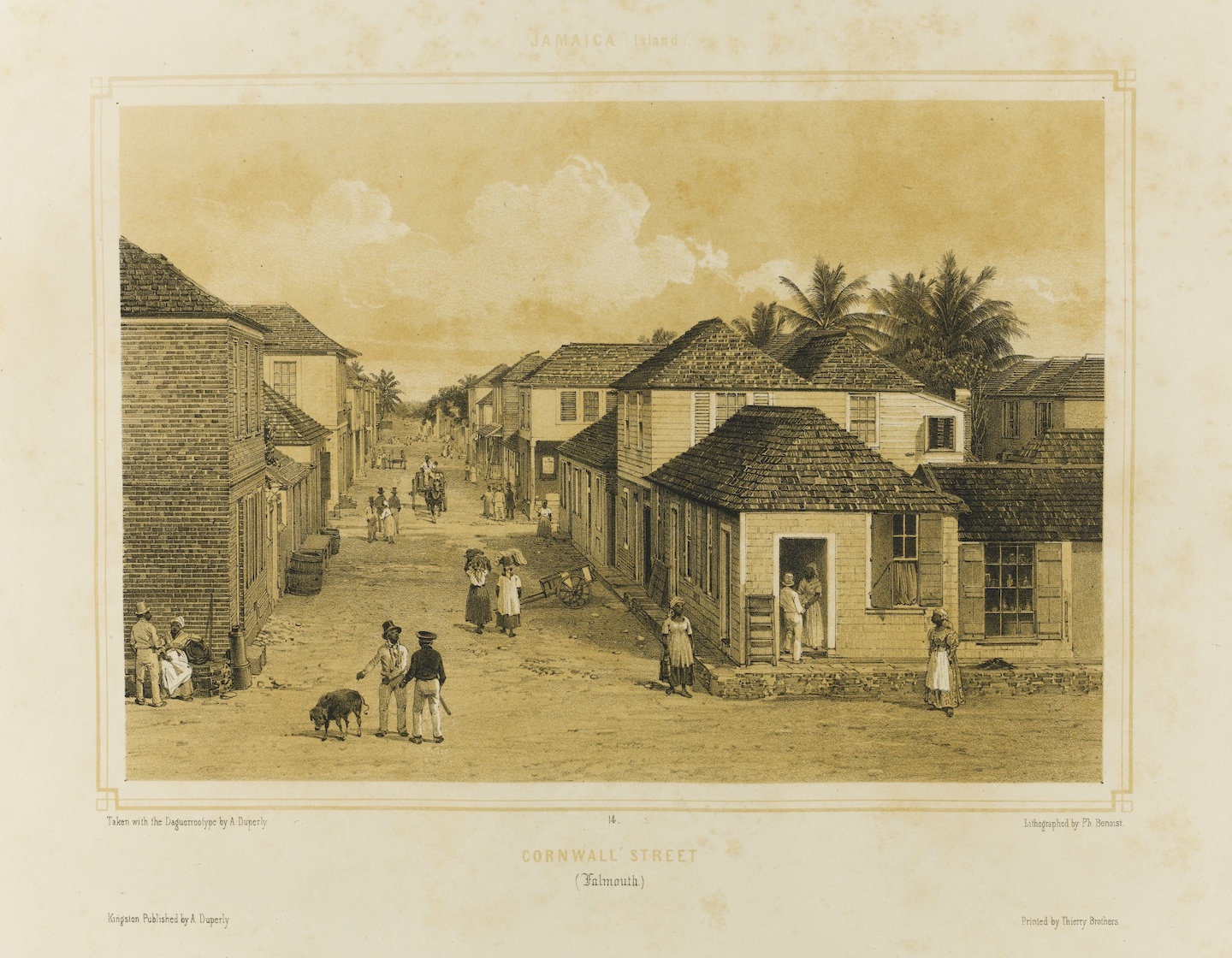
While visible in open spaces—such as roadways and public markets—that were largely under the authority of enslavers, self-emancipators had to become indistinguishable from those engaged in legal market activity; in Jamaica, this applied to a mixed crowd of both free and enslaved people. Escapees from enslavement hoped to hide in plain sight by blending into the activity of the majority Black population while on roads, in markets, and in densely populated urban spaces.5 While visible, traveling with goods or paper assisted in this camouflage: white Jamaicans would expect to see free and enslaved Black Jamaicans traveling to and from markets, with letters or documents granting them permission to travel for other reasons.6 Even so, market marronage was a dangerous practice. As historian Shauna Sweeney writes, self-emancipators faced “the constant threat of reenslavement, incarceration, or violence” that would follow, were they identified and recaptured.7
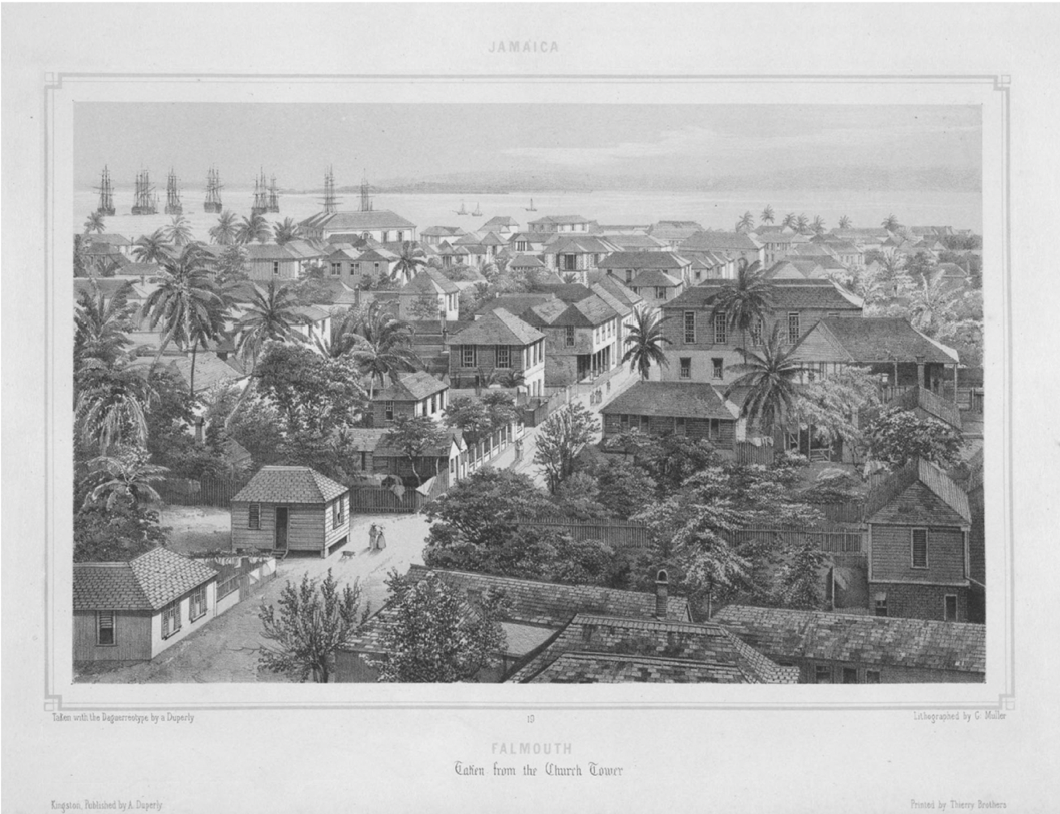
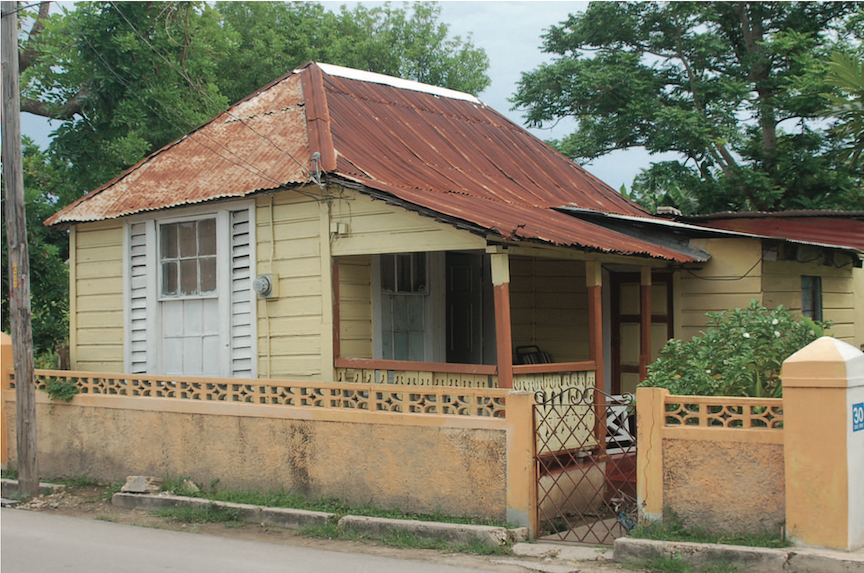
Histories of this risky yet visible practice were inadvertently documented by enslavers’ advertisements complaining of runaway women selling goods at market and “being harboured” in town.8 As harbour suggests, this practice in open spaces could not have existed without an invisible counterpart in private. Outside active market times, self-emancipators relied on access to hidden spaces where their independence—their act of illegal resistance—was supported.9 In the same landscape these two market women traversed, another of Duperly’s prints from 1844 shows a small hipped-roof house raised on piles. In Architecture and Empire in Jamaica, historian Louis Nelson reveals how these two-room houses were commonly owned by the free Black population of Falmouth, and at times were used to harbor self-emancipators from enslavement.10 Termed board houses for the way they were constructed, these houses were typically timber box-framed and board-walled, with a shingled roof. Ownership of these houses varied, with some free Black homeowners in Falmouth owning both the board house and the land on which it was sited, and others owning only the house.11 Occupancy by self-emancipators would have connected these houses to the urban markets where they were located, where people, particularly women, escaping slavery would spend their days selling goods while they remained on the run.12 These houses were precisely the kind of counterpart space that could have supported market marronage.
Existing scholarship on the colonial landscape in Jamaica, while providing rich social histories, has not yet explored the connections between this housing type and market spaces. The structure of Architecture and Empire in Jamaica treats board houses and markets as distinct spheres of activity, while historians’ accounts of urban marronage focus only on public spaces. Bringing together the separately narrated histories of these spaces—and reinterpreting the archival material and building documentation that support them—can help us draw a yet-unexplored connection between open and concealed spaces, market and home, free and enslaved, empire-building and resistance. This interconnected spatial reading helps foreground the covert action of self-emancipating Jamaican women, which necessarily entailed appropriating and operating between spaces of sanctioned movement and activity. The plantation system—and its attendant subjugation of human life for the sake of capital—dominated most arable land in Jamaica. The board house, when understood in connection with markets, was a physical node in networks of resistance to this landscape, assisting enslaved people in their escape. There is no single, straightforward way to trace this resistance; rather, I am applying Saidiya Hartman’s method of critical fabulation: using “a narrative of what might have been or could have been” to push against the way in which enslaved people’s lives have been violently erased through absences in the archive.13 Amid these absences, defining multiple conceptions of resistance is necessary to interpret the connected landscape of board houses and markets in late eighteenth- and early nineteenth-century Jamaica. These intersecting and diverging ideas provide multiple tools for understanding how resistance operated spatially: within, between, and against the physical sites through which it was enacted.
Linking the Board House and Market Marronage
The potential for market marronage relied on Jamaica’s active internal marketing system. Enslavers wanted to reduce the cost of feeding enslaved people, particularly because shipments of food from other colonies or imperial capitals were expensive and unpredictable. They compensated for this by allocating small plots of land where enslaved people could grow and sell their own food. This network of plots gradually became integral to the local food system.14 However, creating these internal markets also meant that enslaved people could keep whatever surplus they earned from selling their produce.15 By the end of the eighteenth century, small-scale internal trade was a vital part of Jamaica’s economy, providing food and handcrafted goods to residents of all classes.16
Thus, while Jamaica’s markets originated in enslavers’ attempts to further profit by human exploitation, enslaved people transformed them into a means for economic agency and greater mobility outside the confines of their enslavers’ property. This is evidenced by the way enslaved people’s travel to the markets was gradually encoded into law.17 In one 1807 law, which legalized undocumented travel by enslaved people if they were carrying goods like “firewood, grass, fruit, provisions, or small stock,” its authors anxiously reinforced that “it is absolutely necessary, that the slaves in this island should be kept in due obedience to their owners, and in due subordination to the white people in general.”18 While it reified racial hierarchy on the island, this law legalized a form of movement that enslaved people repurposed to liberate themselves.
By traveling with goods, self-emancipators could evade surveillance by blending in with other enslaved and free Jamaicans going to and from markets.19 Jamaican women did just this, withdrawing their commodified labor from the plantation system and hiding in plain sight in public marketplaces.20 This form of escape was more available to women than to men because labor was highly gendered in pre-emancipation Jamaican society. During slavery, legally selling goods in markets was a role generally carried out by women, allowing self-emancipated women more mobility within crowds. Self-emancipated men, on the other hand, could more easily blend into commonly male roles, such as “fishermen, hirelings, or maritime laborers.”21 Escape into markets, though, was unsustainable in isolation. Maintaining market marronage relied upon complex Black social networks. These connections played two invaluable roles: fostering cultural knowledge around the potential for and the practice of escape, and providing physical space to support the transgressive use of internal markets.22 Both roles were fulfilled by the board houses that harbored runaway enslaved people, making these houses constitutive of spatial and social networks that enabled market marronage.
Open markets near board houses—though frequented by both free and enslaved people—were commonly controlled by the white planter class. By the late eighteenth century, plantation owners in Jamaica commonly constructed, owned, and maintained shared-use roads for transporting goods from plantation to port, which enabled them to monitor and control movement on rural and urban roadways.23 Beyond these shared-use roads, publicly owned spaces were created by parish vestries, local governing bodies elected by landholding white Jamaicans. These political bodies’ decisions were, in turn, representative of middle- and upper-class white enslavers’ interests.24 Parish vestries also created urban police forces by the late eighteenth century, in part out of fear of uprisings against the planter class. Police responsibilities were closely tied to securing public commercial space: regulating public markets and cart licenses, restricting where the selling of goods took place, enforcing curfews, and monitoring enslaved people traveling without written permission.25 Because most space in colonial Jamaican towns was controlled by enslavers and a government that explicitly and implicitly protected their interests, rebellion required access to private spaces owned by supporters of self-emancipation, who could shield escapees from the risks incurred in both public and private spaces built to serve the planter class.
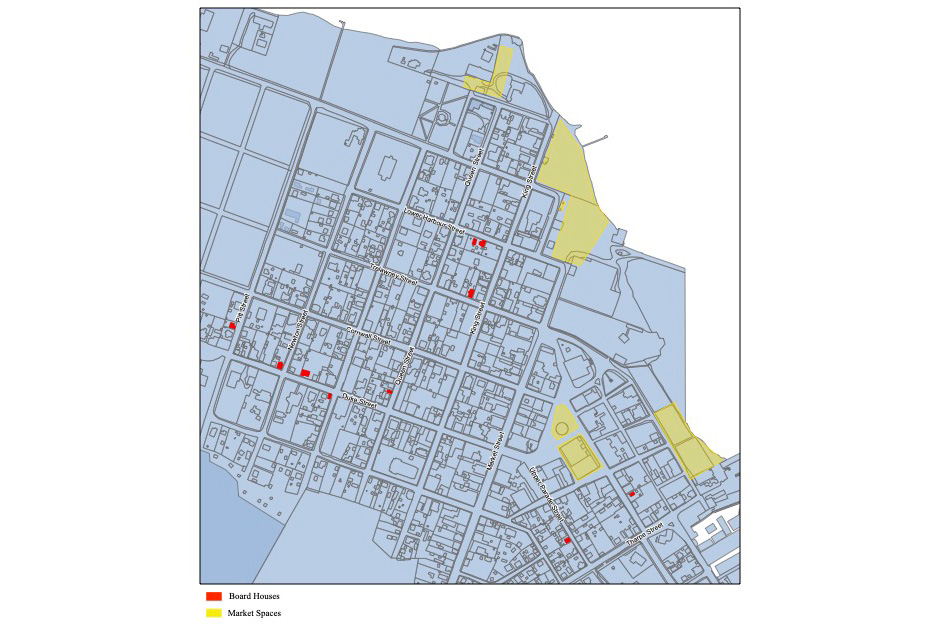
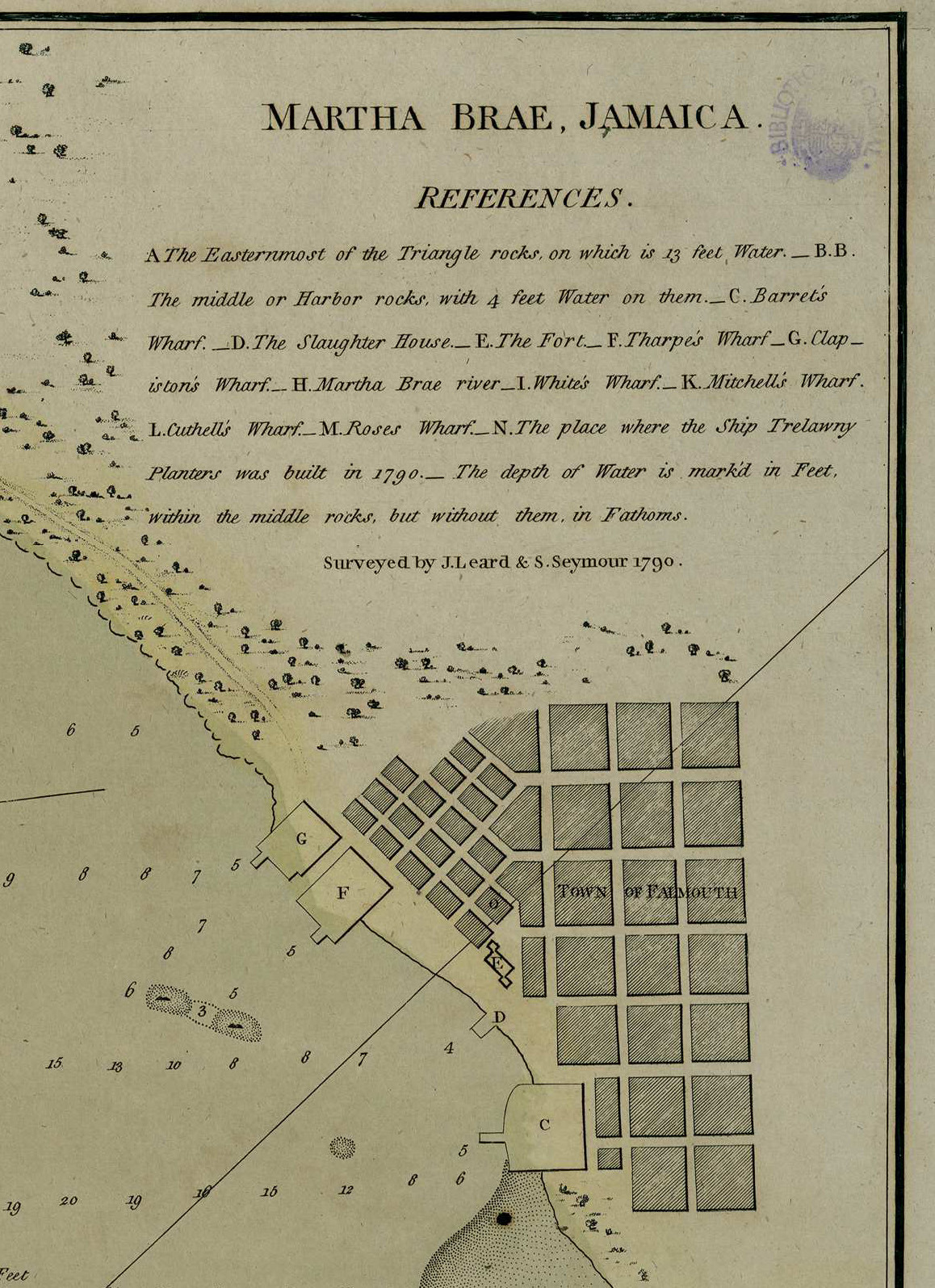
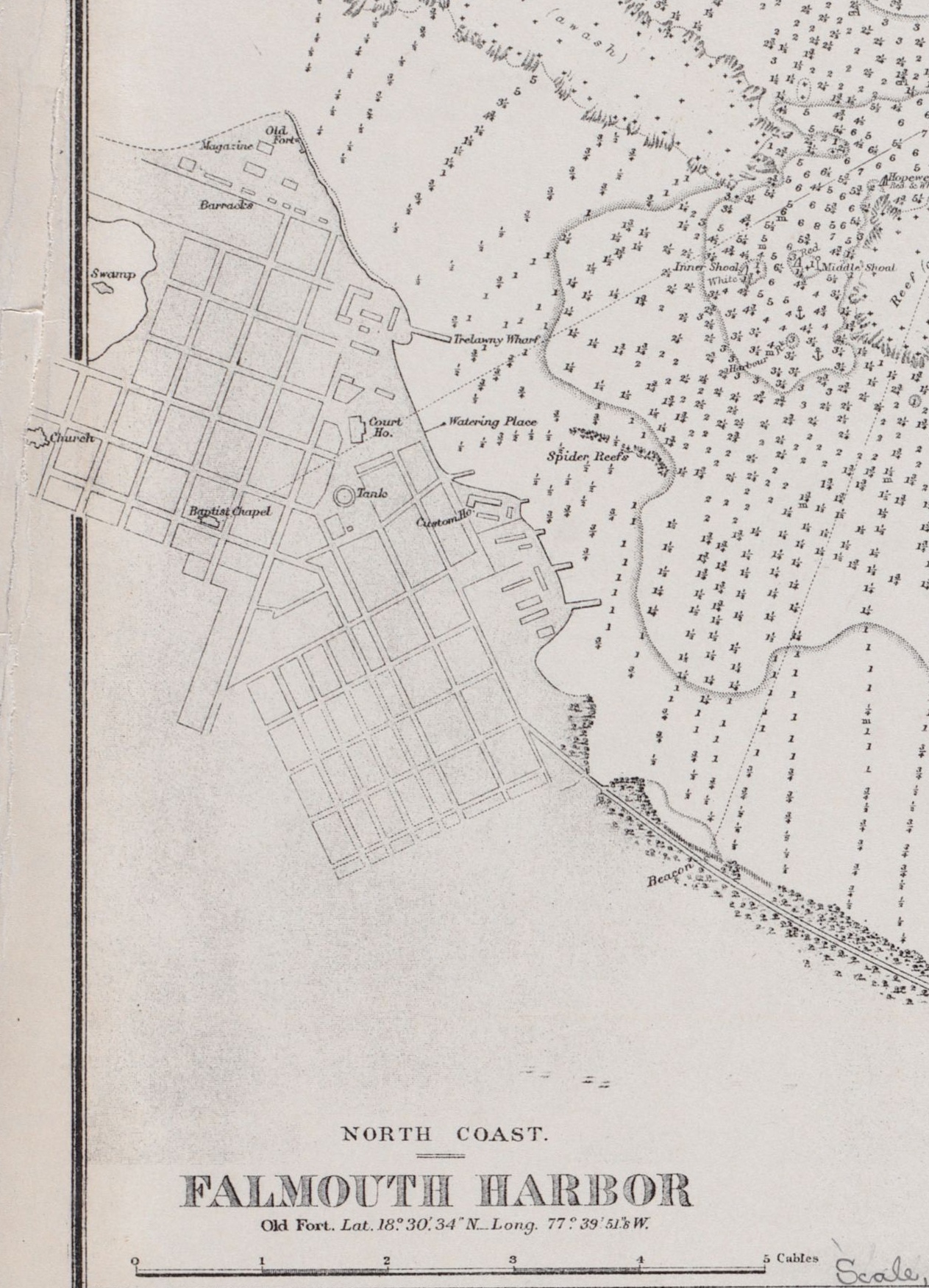
Falmouth is one place where this relationship between the board house and market marronage remains evident. By the late eighteenth century, Falmouth had become the center of the small-scale internal marketing system in the parish of Trelawney.26 Class differences, however, determined access to the buying and selling of goods, with commercial activity of the middle and lower classes typically occupying smaller and less fixed parts of the city’s geography. For instance, free people of color sold goods from small shops, booths, or mobile pushcarts near the wharves.27 Even these temporary structures were out of reach for most enslaved people, who sold the goods they had grown or made at open-air public markets. Falmouth’s spatial organization suggests that markets may have intersected with nearby board houses to facilitate market marronage. Among the city’s historic structures, during archaeological work conducted between 2008 and 2018, Nelson and students at the University of Virginia’s Falmouth Field School identified several eighteenth- and nineteenth-century board houses sited next to both formal and informal market spaces.28 These particular board houses can be sorted into roughly three groups: those near Lower Harbour Street, Duke Street, and Upper Parade Street. Had any of these groups of houses—through strategic door placement and strong social ties among the owners—been used to harbor runaways, they also would have been close to markets, whether at Water Square or nearby wharves. The three board houses on Lower Harbour Street are only about 0.06 miles west of the space surrounding Barrett’s wharf and 0.10 miles south of Fort Balcarres, where seasonal booths were used to sell goods.29 The houses along Duke Street are between 0.15 and 0.35 miles west of Water Square, and the houses near Upper Parade Street are roughly only 0.05 mile from both Water Square and the space around Clapiston’s and Tharpe’s Wharves. This proximity would have been useful for those engaged in market marronage, as it reduced the distance self-emancipators had to travel between spaces of relative safety.
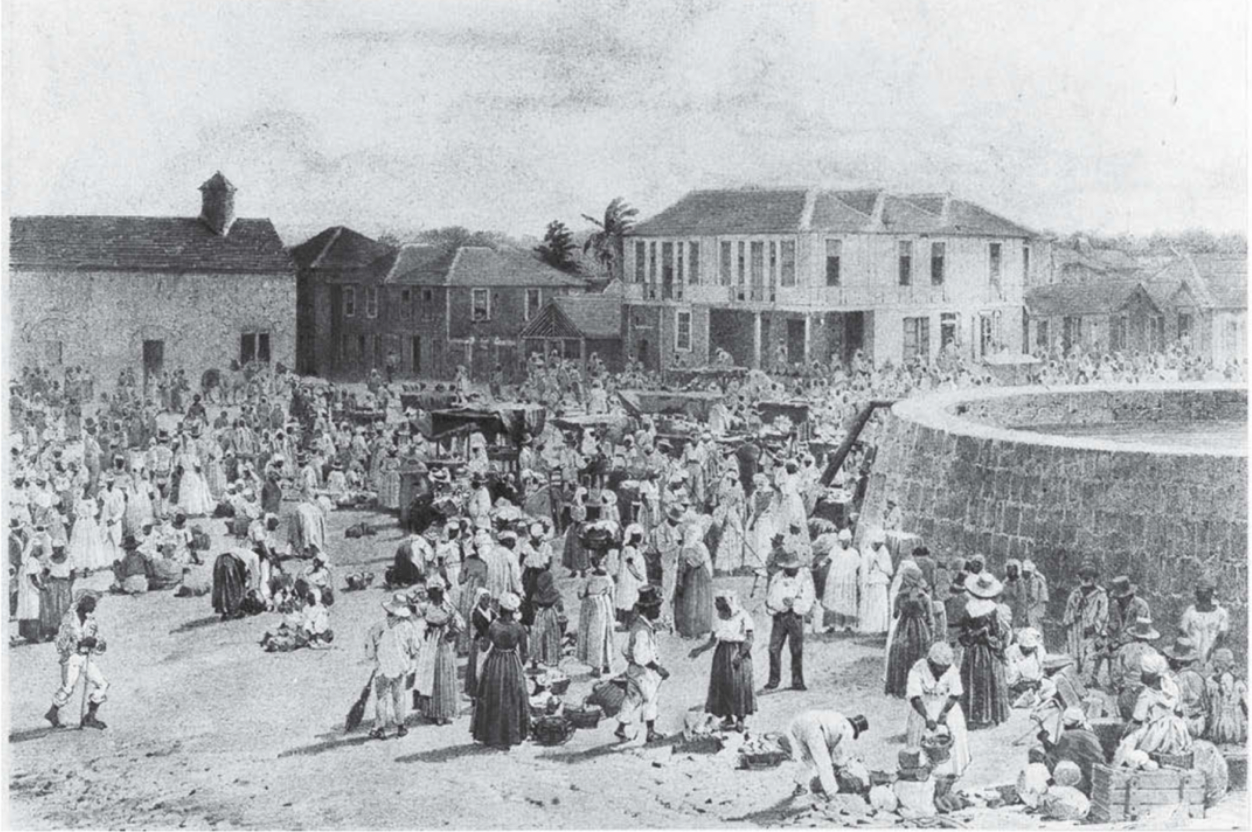
Once a self-emancipator had reached Water Square, the large number of people buying and selling goods would provide greater cover. This is evident in Duperly’s daguerreotype of Water Square, where the open space is crowded with almost exclusively Black Jamaicans, talking, gathering, and selling goods from baskets and pushcarts. While the local vestry commissioned construction of a “shed for the Negro market” in 1800, Water Square more accurately remained an open space where streets intersected, rather than a “well-structured public space”30 that would have been, in other words, more easily surveilled and controlled. Still, public ownership was used to reinforce the security and social order of this shared space: public whippings were held in Water Square and, three years after the market shed was built, the vestry also constructed a small holding cell for arrested sailors.31 Even with these public reinscriptions of punitive security, open-air marketplaces were bustling activity centers for Black Jamaicans. Pre-emancipation markets were not limited to economic exchange, but were also places for “food, sociability, music, and dance.”32 This environment was particularly lively on Sundays, customarily the day for enslaved people to sell surplus goods.33 On Sundays, therefore, the density and variety of the crowd would provide greater cover for self-emancipated market women. It is easy to imagine how, on one of these designated market days, colonial surveillance of potential self-emancipators would be limited by bustling crowds of the mixed-status Black majority. This would also likely be true of the space around the wharves, where Nelson describes “intense racial and social intermixing” and shopping activity that the upper classes found “disreputable.”34
If movement between board house and market in Falmouth enabled market marronage economically, movement between the houses themselves also played an important role in escape. In Falmouth, where free people of color lived in racially integrated neighborhoods, the groupings of eighteenth- and nineteenth-century board houses support the possibility that a network was created to harbor self-emancipating individuals.[35] For example, three board houses were identified on the same block off Lower Harbour Street. And whereas fenced enclosures around and between houses were commonplace, another of Duperly’s Falmouth prints notably shows a board house in the foreground with no enclosure around its yard. Had the owners of these houses on Lower Harbour Street worked together to harbor a self-emancipator, their proximity and lack of enclosure would have enabled someone to move among houses with minimal travel on public roads, evading surveillance.
The Board House as Homeplace
To understand more about how the Jamaican board house supported market marronage, bell hooks’ concept of the homeplace illustrates a dynamic of resistance to colonial power. According to hooks, the homeplace is a domestic space of care and affirmation, of respite from racial oppression and surveillance, and of understanding oneself as “[subject], not [object].”35 hooks discusses African American history, ranging from times of slavery in the United States to those contemporary to the essay’s publication in 1990. She emphasizes that the creation of homeplace is a labor that has been shared by Black women across time and geography, writing that creating a homeplace is a politically radical act of resistance that has been utilized “by black women in white supremacist societies [sic].”36 If the power of homeplace came from the way it resisted “an oppressive and dominating social reality,” it is certainly useful in understanding Black women’s efforts to resist enslavement and white supremacy in colonial Jamaica.37
Also vital to hooks’ homeplace was its gendered form of labor, one in which Black women refashioned the homemaking role assigned to them to enable politically radical action.38 Several board houses in Jamaica were owned by free Black women, which Nelson suggests could have arisen in part through a Black woman’s role as mistress to a wealthy white man, providing a route to otherwise rare home ownership.39 These houses had architectural features that suggested the creation of a private sphere, a homeplace, which turns away from the racial violence of the outside world. For Black Jamaicans who were able to purchase land and construct board houses, home ownership provided access to space that, while still subject to colonial laws and surveillance, offered some degree of privacy from the town. This privacy was enhanced by the relationship of these houses to their lots. The board houses at 7 Lower Harbour Street and 54 Duke Street in Falmouth show an openness to the yards they abut, with doors facing this private outdoor area and only windows facing the street.40 This orientation of circulation away from the street suggests a withdrawal from the publicly shared and surveilled urban environment just beyond the private home and yard. The yard was also used for everyday life, with fruit-bearing trees in the yard creating “shaded social space.”41 The house’s positioning toward its yard, and thereby toward Black Jamaicans’ private social life, can be understood as spatially countering colonial dehumanization in favor of creating a sense of homeplace.
Further, these houses consistently had two exterior doors, a striking feature because it directly opposed laws restricting Black households to just one door leading in or out—part of a broader effort to surveil Black Jamaicans and prevent enslaved people from escaping.42 This kind of single-door legislation was passed several times starting in the mid-eighteenth century, but was not strictly enforced by vestries, and as evidenced by the surviving homes Nelson has documented, free Black Jamaicans continued to build two-door houses even with this legislation in place.43 With this feature, clusters and neighborhoods of board houses were made collectively accessible and resistant to surveillance: “When the free Black community worked together to harbor a runaway, such neighborhoods could become a labyrinth of small, highly permeable spaces known intimately by those colluding but bewildering to authorities.”44 In houses of this type that remain standing, the first, front door opens onto the yard next to the house, rather than directly onto the street; there is also a rear door that provides an exit out of the room farthest from the street.45 If colonial authorities arrived to search a board house within such a cluster, a self-emancipator could move out the rear door of the home and into another house nearby.46 This permeability available to self-emancipators but not to colonial authorities—whose legal understanding of property would have confined each house to itself, rather than belonging to an expansive, rebellious social compact—demonstrates how those who built board houses leveraged subjective local knowledge to resist colonial control. Through its relationship to the yard and noncompliance with single-door laws, the board house can be read as a homeplace: a site of resistance through affirming social interaction withdrawn from white surveillance.
The two exterior doors take on further significance as part of the homeplace when considering how surveillance operated as a tool of colonial power in slave societies. Racialized surveillance was used during European colonial expansion to produce and reify racial difference, privileging whiteness socially and institutionally.47 Given that surveillance was enacted not only by British officials but by mobilizing citizens to identify and report self-emancipators, this form of control was near “totalizing.”48 This surveillant white gaze functioned not only to prevent escape from enslavement but to force each person being surveilled to experience themselves as a “racial Other,” creating a “moment of fracture of the body from its humanness.”49 In maintaining two exterior doors, Black Jamaicans used their board houses to resist this totalizing and dehumanizing gaze by making all movement within and between their homes more private, thereby creating opportunity for deniability and escape. This feature pushed against racial surveillance in favor of creating a restorative private sphere, one owned by supporters of self-emancipation. In turn, it made room for Black Jamaicans to experience themselves not as objects of the white gaze but self-determinatively. hooks’ concept of homeplace allows us to reinterpret these board houses of eighteenth- and nineteenth-century Jamaica. In a country structured around British colonial efforts to dehumanize Black Jamaicans, withdrawing built space from racial surveillance was radical. This creation of homeplace would also have been a form of labor and care specific to women, not as a “natural” result of gender but as an active, dedicated choice to resist.50
The labor to create sites of respite from racial oppression would have been a powerful resource, even if experienced briefly by a self-emancipator. hooks emphasizes that the homeplace is not diminished by being “fragile” or “transitional,” as its value rests in enabling a “small private reality” apart from the world of white racism and surveillance.51 “Transitional” is an apt descriptor for the way escaped enslaved people likely experienced board houses. For people engaged in market marronage, the duration of their escapes varied. Through newspaper advertisements for runaway enslaved people, Sweeney and Nelson both found records of self-emancipators being harbored for several months—between eight and eighteen—though others’ escapes would have been cut short by recapture.52 While some self-emancipators would try to escape Jamaica by boat,53 others would attempt to remain at large in the colony, selling in urban markets. The latter self-emancipators would have relied on multiple people—“networks of kin and community”—for their continued freedom, moving frequently between public and private realms, and possibly between multiple board houses.54 For self-emancipators experiencing fragile freedom through market marronage, hooks’ thinking on the transitional yet restorative value of the homeplace highlights the significance of even short-term access to a place like the board house.
Board House and Market, Homeplace and Plot
Board houses could not have supported market marronage without proximity to Jamaica’s economic centers. Like hooks, Sylvia Wynter has theorized about practices of resistance, particularly the subversive cultural values developed and exercised against systems of racialized oppression. hooks’ and Wynter’s theories, however, tie resistance to different spaces. In connecting these plural modes of resistance to one another, I aim to think more expansively about how pathways toward freedom were spatially developed in a Jamaican context. hooks’ homeplace is necessarily domestic space, even if “fragile and tenuous (the slave hut, the wooden shack),”55 and in her writing on the resistance politics of Black architecture, she repeatedly centers such spaces—her grandfather’s small brick house, “wood-frame dwellings,” “small shacks.”56 The homeplace is an “inside” in opposition to the “culture of white supremacy, on the outside,” suggesting that its value comes from the way in which it, in part physically, separates itself from the outside world.57 Reading the board house as a homeplace, then, ascribes self-preservation to its withdrawal from the urban realm. For hooks, it is through turning inward—utilizing the physical privacy offered by the home—that a culture of resistance is made possible. This logic is architecturally expressed through door placement that facilitated connection with the yard, rather than the street, and enabled escape for self-emancipators. This conception of the board house is similar to Nelson’s structuring of Architecture and Empire, in which free Black housing is narrated separately from markets that were more directly tied to plantation capitalism. However, the board house’s relationship to market marronage encourages us to think about linkages between free Black housing and the market, and about how the homeplace conception of resistance necessarily interacts with a wider world.
Where hooks conceives of the homeplace as separate from and in opposition to otherness,58 Wynter argues that similar acts of cultural resistance could and did develop within such spaces. In Wynter’s analysis, the economy of the Caribbean was characterized by the plantation and the plot. The plantation depended on the labor of enslaved people to maximize profits for the capitalist market and the empires that market enriched. The plot resisted this dominant system. Wynter takes advantage of the dual meaning of the word plot. She uses the narrative plot of the novel—both as a product of the market and a mode of expression in resistance to it—to illuminate how physical plots of land where enslaved people grew their own food operated within plantation capitalism and also were used by enslaved people to counter it.59 For Wynter, the plot was a space where Black survival and cultural cultivation occurred in the margins of a systemically violent white supremacist social and economic structure. But even as it enabled Black survival, the plot could not be in diametric opposition to the plantation or the market, as it sustained them as well. Wynter argues that the “Caribbean response” to this condition is characterized by “ambivalence,” implying a tension between opposition and acceptance of the two intertwined systems.60
This tension is important. Wynter identifies resistance in the Caribbean as emerging not from a positionality removed from the plantation system but rather from a position of conflict within it. While hooks’ homeplace describes resistance rooted in a private home that turns away from the outside world, Wynter’s plot describes how resistance could grow through co-option of spaces enmeshed in the plantation economy. Though hooks’ homeplace might also be considered a co-option of space in the context of plantation capitalism, the private homes that hooks uses to illustrate the homeplace do not materially support the plantation economy in the same way that the plot does. Wynter’s conception of the plot thus brings a new dimension to the board house’s relationship to resistance, as it articulates how spaces simultaneously marginal and integral to the plantation economy could support values similar to, or become, homeplaces. From this perspective, the board house’s connections to the outside world are just as important as its turning inward and away from surveillance. Thus, when read together, hooks’ and Wynter’s theories provide a path toward understanding board houses and markets as connected sites whose relationships to resistance against colonial domination should no longer be narrated separately. Spaces within the home and conflictedly outside it both could have been used to develop, and mutually reinforce, the kind of resistant cultural values that hooks and Wynter both describe.
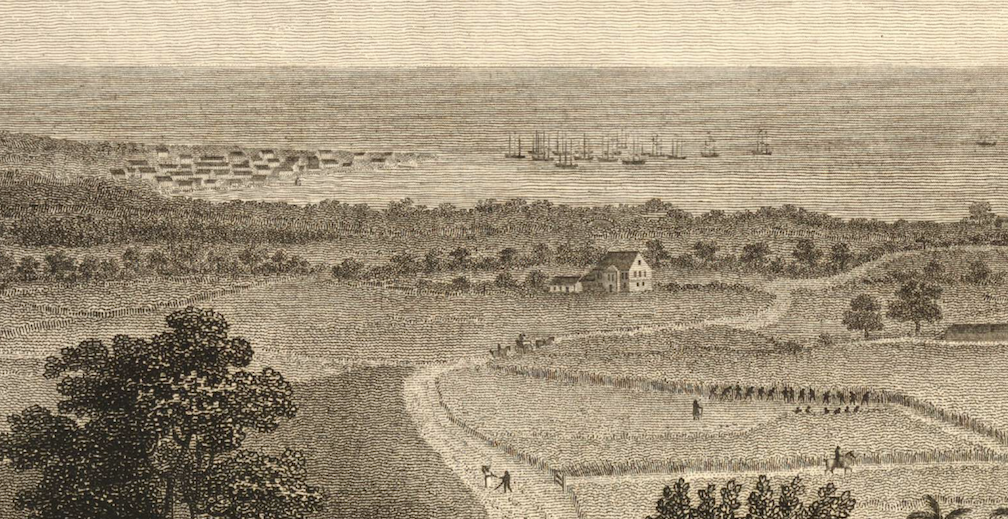
Through this interconnected reading, we also gain a more spatially expansive interpretation of resistance in pre-emancipation Jamaica’s landscape. For market marronage to operate through the board house, networks of resistance would have spanned several parts of a region’s geography, from a single house to markets spread throughout a town, to rural plantations and subsistence plots. Open-air markets—to which board houses were linked through residents’ market activity—played a vital role in connecting urban and plantation Jamaica. By extension, the board house and the market enabled free and enslaved Black people to connect with one another by means of the geographies they shared, sometimes committing market marronage. In Falmouth, this means the landscape that might at first appear as disparate parts dominated by the plantation—fields of crops worked by enslaved laborers, privately owned roads flanked by trees, a town concentrated around a harbor dedicated to the import and export of commodities, including people—was also spatially connected through resistance. In connection to market marronage, the board house (as homeplace) demonstrates how people sought to counter this oppressive system with new modes of occupation in the cracks opened—spatially, legally, and culturally—by provisional plots of land.
As spaces for free and escaped Black Jamaicans, board houses and markets were built within and yet pushed against the plantation economy. Interpreting the board house and the market as interconnected through the homeplace and the plot—conceptions of spatial resistance amid racial and economic violence—helps us imagine how this housing type could have been used by Black Jamaicans to enact resistant cultural practices under circumstances designed to suppress them. In doing so, it also draws a connecting thread through varied theories of resistance that foreground power in the transgressive use of spaces that might otherwise be interpreted as marginal due to their position in the dominant social order. How might this alignment turn us toward spaces that have thus far been deemed less valuable, in order to understand the entwined histories of architecture and resistance? What would it mean to understand the co-option of spaces both visible and concealed—both of and withdrawn from racial capitalism—as mutually constitutive of a liberatory relationship to the built environment? Duperly’s 1844 prints of Falmouth situate the board house with its open yard as intimately linked to the town’s bustling market in Water Square. A self-emancipator’s life would have straddled these two spaces: one restorative in its withdrawal from colonial surveillance, the other enabling escape through its ties to the plantation system—both life-sustaining for people creating their own freedom.
-
Louis P. Nelson, “Falmouth, Jamaica: Early Housing in a Caribbean Town,” in Falmouth, Jamaica: Architecture as History, eds. Louis P. Nelson, Edward A. Chappell, Brian L. Cofrancesco, and Emilie Johnson (Kingston: University Press of the West Indies, 2014), 18. ↩
-
Nelson, “Falmouth, Jamaica,” 17. ↩
-
In August 1834, the British Slavery Abolition Act marked the start of an “apprenticeship” system in Jamaica, under which formerly enslaved people were still required to work 40.5 unpaid hours per week for their former enslavers, but could choose how to spend their time outside this work obligation. Apprentices could work additional paid hours for their own former enslavers or at other plantations, or use their time for leisure or cultivating and selling goods at local markets. A law ending apprenticeship and granting full freedom to the formerly enslaved was enacted in August 1838. See Douglas G. Hall, “The Apprenticeship Period in Jamaica, 1834–1838,” Caribbean Quarterly 3, no. 3 (1953): 142–166. ↩
-
Shauna J. Sweeney, “Market Marronage: Fugitive Women and the Internal Marketing System in Jamaica, 1781–1834,” William and Mary Quarterly 76, no. 2 (2019): 205; While this depiction of Falmouth is from shortly after emancipation in 1834, its representation remains relevant to understanding the port town’s pre-emancipation built environment and marketing activity, as Jamaica’s internal marketing system carried on in similar form post-emancipation. ↩
-
Simon P. Newman, “Hidden in Plain Sight: Escaped Slaves in Late Eighteenth- and Early Nineteenth-Century Jamaica,” William and Mary Quarterly (OI Reader) (June 2018): 6–13; Sweeney, “Market Marronage,” 197–200. ↩
-
Newman, “Hidden in Plain Sight,” 22–23, 37; Sweeney, “Market Marronage,” 213. ↩
-
Sweeney, “Market Marronage,” 206. ↩
-
Sweeney, “Market Marronage,” 208–212. ↩
-
Sweeney, “Market Marronage,” 218–220. ↩
-
Louis P. Nelson, Architecture and Empire in Jamaica (New Haven, CT: Yale University Press, 2016), 226–228. ↩
-
Louis P. Nelson, “The Architectures of Black Identity: Buildings, Slavery, and Freedom in the Caribbean and the American South,” Winterthur Portfolio 45, no. 2/3 (2011): 184–187. ↩
-
Sweeney, “Market Marronage,” 204. ↩
-
Saidiya Hartman, “Venus in Two Acts,” Small Axe 12, no. 2 (2008): 12. ↩
-
Sidney Wilfred Mintz and Douglas Hall, “The Origins of the Jamaican Internal Marketing System,” Yale University Publications in Anthropology, no. 57 (1960): 3–5, 16. ↩
-
Mintz and Hall, “The Origins of the Jamaican Internal Marketing System,” 3–5. ↩
-
Mintz and Hall, “The Origins of the Jamaican Internal Marketing System,” 16. ↩
-
Mintz and Hall, “The Origins of the Jamaican Internal Marketing System,” 15. ↩
-
Mintz and Hall, “The Origins of the Jamaican Internal Marketing System,” 20. ↩
-
Newman, “Hidden in Plain Sight,” 22. ↩
-
Sweeney, “Market Marronage,” 203–205. ↩
-
Sweeney, “Market Marronage,” 212–213. ↩
-
Sweeney, “Market Marronage,” 202, 220. ↩
-
Hayden Bassett, “Lines of Infrastructural Control in Plantation Jamaica,” Perspecta 52 (2019): 107–114. Bassett describes the strategies enslavers used to make enslaved people’s travel both visible and restricted to existing roads. These included creating linear viewsheds and lining road boundaries with mortared glass or sharp vegetation, as well as police patrols to monitor activity. ↩
-
Kamau Brathwaite, The Development of Creole Society in Jamaica, 1770–1820 (Kingston: Ian Randle Publishers, 2005), 20–23, 40–43. ↩
-
Aaron Graham, “Towns, Government, Legislation and the ‘Police’ in Jamaica and the British Atlantic, 1770–1805,” Urban History 47 (2020): 52–56. ↩
-
Jean Besson, “Gender and Development in the Jamaican Small-Scale Marketing System: From the 1660s to the Millennium and Beyond,” in Resources, Planning, and Environmental Management in a Changing Caribbean, eds. David Barker and Duncan McGregor (Kingston: University Press of the West Indies, 2003), 18–19. ↩
-
Nelson, Architecture and Empire in Jamaica, 170–171. ↩
-
Louis P. Nelson, “The Falmouth Project,” University of Virginia, link. ↩
-
Nelson, Architecture and Empire in Jamaica, 170. ↩
-
Nelson, “Falmouth, Jamaica,” 13. ↩
-
Nelson, “Falmouth, Jamaica,” 8–13. ↩
-
Newman, “Hidden in Plain Sight,” 47. ↩
-
Besson, “Gender and Development in the Jamaican Small-Scale Marketing System,” 17. ↩
-
Louis P. Nelson, “The Falmouth House and Store: The Social Landscapes of Caribbean Commerce in the Eighteenth Century,” in Building the British Atlantic World, eds. Daniel Maudlin and Bernard L. Herman (Chapel Hill: University of North Carolina Press, 2016), 204–205. ↩
-
bell hooks, “Homeplace: A Site of Resistance,” in Yearning: Race, Gender, and Cultural Politics (New York: Routledge, 1990), 42. ↩
-
hooks, “Homeplace,” 42. ↩
-
hooks, “Homeplace,” 45. ↩
-
hooks, “Homeplace,” 44. ↩
-
Nelson, Architecture and Empire in Jamaica, 232–233. ↩
-
Nelson, “The Architectures of Black Identity,” 182–184. ↩
-
Nelson, Architecture and Empire in Jamaica, 226. ↩
-
Nelson, Architecture and Empire in Jamaica, 228; the efforts of white Jamaicans to prevent this practice are demonstrated by a 1770 law that declared the necessity of measures like single-door limits and reports of the number, location, and residents of “negro huts and houses” to stop “the number of runaway negro and other slaves... daily resorting to and being harboured in the said huts or houses.” While this law focused specifically on St. Jago de la Vega, Port-Royal, and Kingston, it does suggest that, to the dismay of colonial authorities, collaborative use of small-scale housing like the board houses supported escape from slavery in urban spaces throughout Jamaica. See “An act for remedying the inconveniencies...,” December 19, 1770, in The Laws of Jamaica 2:88–89. ↩
-
ames Robertson, Gone Is the Ancient Glory: Spanish Town Jamaica, 1534–2000 (Kingston: Ian Randle Publishers, 2005), 87; Nelson, Architecture and Empire in Jamaica, 228. ↩
-
Nelson, Architecture and Empire in Jamaica, 228. ↩
-
Nelson, Architecture and Empire in Jamaica, 228. ↩
-
Nelson, Architecture and Empire in Jamaica, 228. ↩
-
Simone Browne, Dark Matters: On the Surveillance of Blackness (Durham, NC: Duke University Press, 2015), 16–17. ↩
-
Browne, Dark Matters, 21. ↩
-
Browne, Dark Matters, 98. ↩
-
hooks, “Homeplace,” 45. ↩
-
hooks, “Homeplace,” 46–47. ↩
-
Sweeney, “Market Marronage,” 197–220; Nelson, Architecture and Empire in Jamaica, 228. ↩
-
Sweeney, “Market Marronage,” 216; Nelson, Architecture and Empire in Jamaica, 229. ↩
-
Sweeney, “Market Marronage,” 219–220. ↩
-
hooks, “Homeplace,” 42. ↩
-
bell hooks, “Black Vernacular: Architecture as Cultural Practice,” in Art on My Mind: Visual Politics (New York: The New Press, 1995), 148–149. ↩
-
hooks, “Homeplace,” 42. ↩
-
hooks, “Homeplace,” 46. ↩
-
Sylvia Wynter, “Novel and History, Plot and Plantation,” Savacou 5, no. 1 (1971): 95–102. ↩
-
Wynter, “Novel and History, Plot and Plantation,” 99. ↩
Jenna Mullender will be pursuing an MS in Historic Preservation at the University of Pennsylvania in Fall 2025. She is interested in how preservation research can uncover histories of resistance embedded in the built environment, helping us understand the practices that can reshape our landscapes more justly today. She holds a BA in Urban Studies from the University of Texas at Austin.