
Phantasmagoria
In his essay “Paris, Capital of the Nineteenth Century,” Walter Benjamin traces the emergence of the architectural interior as a private space—a space associated with the psychical interior—to the reign of the nineteenth-century French monarch, and last “King” of France, Louis-Philippe. The concept of offices, specifically buildings designated solely for work occurring outside the space itself (as compared to, say, the market designed for both trade and commerce), largely emerged in the eighteenth century with the expansion of colonialism—the Old Admiralty Building in London, where the British Royal Navy and Admiralty were headquartered, was the first purpose-built office building in the world, finished in 1726; the East India Company rebuilt its headquarters in London soon after, from 1726 to 1729—and the Industrial Revolution expanding the scope of business and the rationalization of administrative affairs.1 This trend exploded in the early nineteenth century, becoming the norm rather than the exception, and construction of the Ministry of Foreign Affairs, the first purpose-built office building in Paris, was initiated in 1844 and completed in 1855. With the newly established separation of one’s living space (the interior) and one’s working space (the “counting-house”), Benjamin writes, “the private citizen entered upon the historical scene”:
The private citizen who in the counting-house took reality into account, required of the interior that it should maintain him in his illusions. This necessity was all the more pressing since he had no intention of adding social preoccupations to his business ones. In the creation of his private environment he suppressed them both. From this sprang the phantasmagorias of the interior.2
The word “illusions,” as used by Benjamin, seems to have two meanings: It signals both the psychic illusions, or even delusions, of the mind and the visual illusions of the phantasmagoria, historically created via camera obscura or magic lantern. The latter, the visual elements of the interior—decor and so on—are crucial for producing and maintaining the former: Phantasmagoria upholds phantasy. And phantasy, according to Freud, expresses the wish that is frustrated; in the unconscious it is also hardly distinguishable from, or even inferior to, memory.3 The interior, then, creates psychical reality through material reality, allowing for the projection of the wish fulfilled, and even the belief of the wish fulfilled.
Smoke and Mirrors
But while the importance of the interior after the nineteenth century was founded upon a separation from the workplace, in recent years, especially in the wake of COVID shutdowns and the mainstream advent of the gig economy, this separation has been severed. The boundaries between work, leisure, and play have become blurred in space as in life. In Nathan Fielder and Lance Oppenheim’s new documentary, You Can See Everything, the film’s subject, the disgraced Theranos founder Elizabeth Holmes, works, like many of us, from home. And being filmed constantly, she is, in that context, never not at work. We see her on the phone, making deals, but we also see her working to convince Fielder—and thus the viewer and the greater public—that she is innocent.
Holmes not only works from home but makes her home work for her, as interiors allegorize and moreover supplant the interiority of their residents. The title, You Can See Everything, implies an unfettered view—and in that, truth. But this access to “truth” is performed through an invitation, not into Holmes’s psyche but into her home. Now incarcerated, Holmes is mostly shown indoors in the days before her surrender at the Federal Prison Camp in Bryan, Texas, within the walls of her and partner Billy Evans’s Del Mar rental, a two-home property with a Zestimate of almost nine million dollars.4 In the film, Holmes and Evans invite Fielder, who appears on-camera, to stay with them, granting an illusion of an unimpeded view into their lives.

But what access is granted in time is lost in divulgence. Though Holmes promises in a (ambiguously flirty) text message, “fyi you can totally see everything,” the viewer, echoing Fielder, is left feeling that Holmes isn’t telling the full story. This is the central problem of You Can See Everything: Fielder, the viewer’s surrogate within the space of the film, cannot puzzle through Holmes’s truth. Holmes and Evans rely on the illusion of “all-access” to create a sense of transparency yet miscalculate what that access really offers: a feeling of unsettledness, of something not quite right. The viewer is offered, for example, a look into Evans’s research process, as we see him watch science videos at approximately double speed, only to parrot what he just recently learned later in the film. His projected expertise comes from information we suspect was not quite digested. Holmes’s wide eyes, as another example, perhaps meant to evoke impressions of naivety, are left open just a bit too long; in a metonym of motherhood and all its cultural connotations, she rocks her baby with her foot just a bit too vigorously. The Theranos machine splayed out on the dining room table is mobilized as a testament to the technology’s expansive capabilities, although it remains disassembled, inert—and is allegedly not even the official machine.5 Through the too-careful arrangement of gestures, objects, and spaces, we feel the performance. Though the “unimpeded view” of this life at home through interiors is meant to offer transparency, it in fact obscures the person within them.
Despite the prominence of the visual, the film and its central question—whether Holmes can be trusted—reportedly hinge on two turns of speech. First, whether the “can” in “can run any test” (from an interview Holmes gave for a profile in Fortune in 2014) operates in the present or future tense—Holmes, apparently, can’t see the difference; and, second, whether Holmes was correctly quoted in a 2023 New York Times article as saying, in reference to dramatized versions of herself, “They’re not playing me. They’re playing a character I created”—Holmes claims she must have said, “they created.”6 Both moments, left unresolved, seem to, at least to the filmmakers, be smoking guns. The latter, Fielder states, illuminates the former: If Holmes really was misquoted, then it speaks to a larger narrative crafted around her persona in which the media is invested; if she wasn’t but insists otherwise, then she has a problem with facticity, supporting her fraud conviction.
The 2023 New York Times profile continues, just after that quote:
So, why did she create that public persona? “I believed it would be how I would be good at business and taken seriously and not taken as a little girl or a girl who didn’t have good technical ideas,” said Ms. Holmes, who founded Theranos at 19. “Maybe people picked up on that not being authentic, since it wasn’t.”7
These lines are neither discussed nor disputed in the film.
The Void
Perhaps it’s not such a crime to create a persona. Like the fairly generically decorated rental, Holmes performs a fairly generic character. The very notable exception is the baby accoutrements: Holmes’s children and their belongings are placed center stage, as in the now-viral clip of her bouncing the baby with one foot. In another instance, a playpen forms the bars through which we see Holmes holding her younger child at the beginning of the film—a not-so-subtle foreshadowing of her then-impending incarceration. Otherwise, in my memory of the home’s furnishings, they are more or less identical to the ones I see in the now off-market rental’s 2016 Zillow listing. In the aughts and early teens, Holmes played a Silicon Valley founder straight out of central casting: In an interview published recently in the New York Times, Amy Chozick, author of the 2023 profile, states that “Holmes told me repeatedly how [Theranos COO and Holmes’s ex-partner Sunny] Balwani encouraged her to ‘kill Elizabeth’—to wear black turtlenecks, to not talk like a ‘little girl,’ to drink green juice, go vegan, not sleep for more than five hours, etc.”8
In You Can See Everything, the character changes though the persona is no more fleshed out—and perhaps that’s the point. In a now-viral moment from the trailer, a wide-eyed Holmes asks Fielder, both of them seated on the couch, “Why would I deceive you?” In another scene, Fielder shows Holmes (and Evans) Abbott and Costello’s “Who’s on First” routine, only to be shocked when Holmes is unable (or unwilling) to name the central joke: that the first baseman’s name is “Who.” Holmes, Fielder and Oppenheim seem to say, is either the world’s most literal person, incapable of the subtleties and nuances of conversation, rendering the issue of the “can” at the heart of her fraud null, or she is the world’s most effective manipulator. But her “manipulation,” if it is that, is less active than passive. Holmes doesn’t gaslight; she hardly maneuvers. Rather, I think, she performs the void.

In a now-deleted Instagram post from October 2015, the artist, writer, and coiner of “Sad Girl Theory” Audrey Wollen posted a collage with landmark artworks by male artists crossed out with large Xs, accompanied by text that reads, “BEWARE MALE ARTISTS MAKING ARTWORK ABOUT EMPTINESS / NOTHING DOES NOT BELONG TO YOU / GIRLS OWN THE VOID / BACK OFF FUCKERS!!!!” Though gone from her page, I find it, screenshotted and cropped, on Tumblr, where most things from the Internet go to stay.9 The void, like a generically furnished seaside rental (and perhaps like an upstairs nursery covered with yellow wallpaper), offers a space for projection.10 In the concept of horror vacui—that nature abhors a vacuum—that which is empty must be filled. This is not to say that Holmes, or women in general, is/are empty, but rather to imagine that Holmes performs emptiness, so that she may offer a space for projection, whether of desire or pity or something else that can save her.11
Once More, with Feeling
An important part of You Can See Everything is Fielder and Oppenheim’s solicitation of Amanda Seyfried, star of the Theranos dramatization The Dropout, to reenact interactions between Fielder and Holmes that were not—or could not be—filmed, among them Fielder’s visit to Holmes in prison. You Can See Everything is not Fielder’s first reenactment; that was in the 2015 episode of Nathan for You “Smokers Allowed,” in which Fielder, in order to get around smoking laws in California that ban cigarettes indoors except in stage productions, transforms a bar into a play, with the establishment’s regulars as actors: He posts a sign that says “Smoking Allowed,” with fine print stating that anyone who enters the bar is consenting to act in the play. He sets aside a small section with two chairs for the audience, who are surprisingly taken with the performance. Buoyed by this feedback, Fielder then transcribes the night’s action (filmed, of course) to create a script, casting actors for the (re-)production. The episode’s most emotional moment involves Fielder stepping in for an actor whose chemistry with his scene partner he finds unbelievable. The scene features a woman telling her boyfriend she loves him: Fielder repeats, “Again,” after the actress’s eleven reiterated “I love you”s, his voice increasingly breaking.
The reenactment framework of “Smokers Allowed” is expanded in Fielder’s later television project, The Rehearsal, which premiered in 2022, though it is expanded to include preenactment: The premise, introduced in the first episode, is that Fielder will help guests rehearse anxiety-inducing life events using elaborate stage re-creations and actors, eliminating all variables and imagining all possible scenarios, before the guests take on the events for real. In the first episode, Fielder builds a bar to help a man who wants to tell his trivia team he lied about having a master’s degree.
The show develops as Fielder assists a woman, Angela, who is considering motherhood, first with the use of a robot baby, then with increasingly older children, in an accelerated version of parenthood. When the first man Angela dates quits the rehearsal due to the robot baby’s incessant crying, Fielder takes over as her scene partner. Though Fielder continues other rehearsals, including teaching “the Fielder method,” an acting class created for the purpose of recruiting actors for his scenarios, the parenting trial goes on, taking over the show. Eventually, Fielder conducts his own rehearsal for a confrontation with Angela and repeats one of the child actors’ scenes with other actors in order to understand what went wrong with the parenting trial at large, centering around the child actor calling him “Daddy” off-script.
Fielder’s p/reenactments collapse boundaries between the so-called real and the fictive, the so-called original and the reproduction, and the so-called performance and the rehearsal. In Performing Remains, the performance studies scholar Rebecca Schneider invites readers to do the same. Discussing Civil War reenactments and their affective register, she writes, “Many of [the reenactors] find reenactment to be, if not the thing itself (the past), somehow also not not the thing (the past), as it passes across their bodies in again-time… I am fascinated that for many reenactors there exists the lure: if they repeat an event just so, getting the details as close as possible to fidelity, they will have touched time and time will have recurred.”12
Though Fielder’s prior p/reenactments unsettle the privileged status of the so-called original and thus its claim to truth, the reenactments in You Can See Everything may initially appear to operate according to a different logic. For viewers unfamiliar with Fielder’s oeuvre, those reenactments rely on an assumption of fidelity built up through true crime’s conventional use of reenactment as a faithful re-creation of events. Yet absent evidence of Holmes’s delivery or even her exact wording—both conveyed to Seyfried only from Fielder’s memory and thus inevitably colored by his feelings (of whatever nature) for Holmes—we are left with an imperfect reenactment, one whose fidelity cannot be verified. And, perhaps when what is at stake is truth—or, at least, Holmes’s truth, Fielder’s method falls short.
The decision to rent the Del Mar house to film Fielder and Seyfried’s reenactments offers an uncanniness highlighted by the objects in the house that remained after Holmes and Evans moved out. A coffeemaker and the now-infamous yellow bowl used to mix eggs, for example, have remained, raising the question of what the two brought into the home and how much of the domestic was there for them, ready-made, only to be left behind. In Fielder’s prior “rehearsals,” an uncanniness emerges from the repetition of scenes previously only imagined, reminding the viewer that reality, too, follows scripts. And Fielder’s building of exact replica sets raises another question: What is an interior but a fabricated set for the housing of these scripts? Though placing the viewer with Fielder and Seyfried in the space where they had just watched Fielder interact with Holmes could serve to create an appearance of continuity—or, at least, contiguity—rather than rupture, the space is too continuous, leaving the viewer with the impression that there is no original, that it is all reenactment.
This feeling continues with Evans’s deepfake-ification of Holmes. The two go to a studio where Holmes is photographed performing a range of gestures and facial expressions, ostensibly to generate a hologram that will allow her to maintain a continuity of presence while incarcerated—purportedly for their children. But Evans later shows Fielder deepfake videos created using this photographic data, a practice the film places alongside Evans’s running of Holmes’s X account. Both are acts of digital ventriloquism. But perhaps ventriloquism operates elsewhere in the film, too: in the staging of objects and domestic interiors, which, like the hologram, are made to speak on behalf of a person whose presence they ostensibly make available. The objects in these spaces seem to acquire a voice that is not quite their own, their arrangement producing a particular account of the person who inhabits them. The film, it could be argued, thus stages a form of spatial ventriloquism, in which the arrangement of objects and interiors gives material form to an identity that is itself being performed. If, however, Holmes ventriloquizes herself, as the interiors seem to suggest, whence comes the voice? Where is Elizabeth Holmes?13
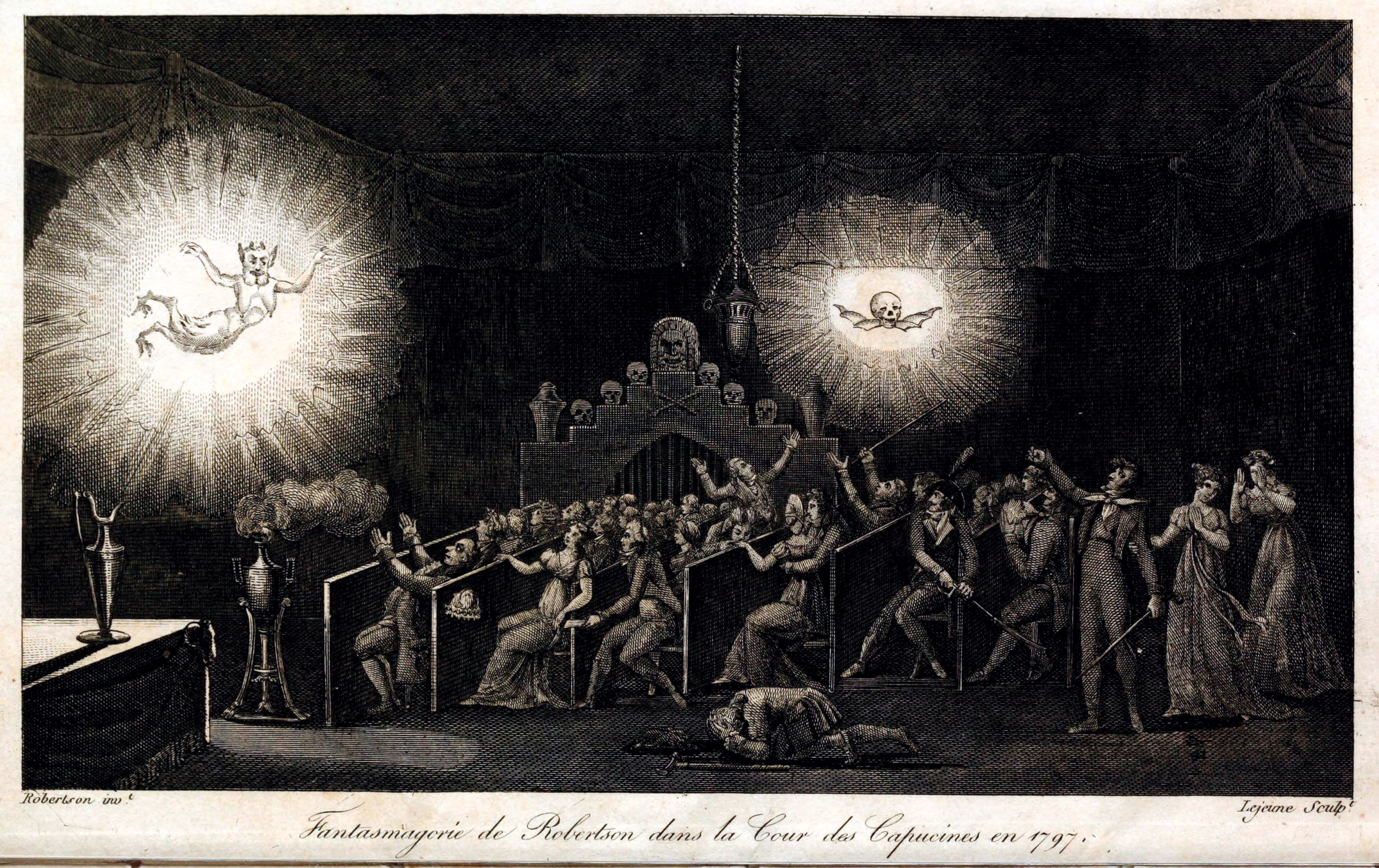
Phantasmagoria, Take 2
The phantasmagoria, historically, is specter-theater. From their conception and into their most popular era during the late eighteenth and nineteenth centuries, magic lantern shows tended toward frightening images of ghouls, demons, and the like. In “Paris, Capital of the Nineteenth Century,” Walter Benjamin evokes the phantasmagoria six times; he repeats the term throughout his unfinished Arcades Project. For Benjamin, this uncanny light show stands for modernity. The relationship between the psychic and domestic interiors is thus, according to Benjamin, deeply imbricated with industry, capital, and, in Louis-Philippe’s colonial expansion, Empire.14 It’s a short road from there to Veblen’s “conspicuous consumption.”
In You Can See Everything, the phantasmagoria of the interior, however, is not the tangible shadows of overly conspicuous décor; rather it is what is contained within these items: absence. In an interior in which there is “nothing to see,” there is an assertion that psychically, there is nothing to see either—and thus, with one look, with one question, with one movie, you can see everything.
-
For a much more in-depth history of the modern office, see Rob Harris, A History of the Office and Office Work: From Castle to Condominium (Routledge, 2025). ↩
-
Walter Benjamin, “Paris, Capital of the Nineteenth Century,” trans. Quentin Hoase, New Left Review 1, no. 48 (March/April 1968): 83. ↩
-
“[Phantasies] have indeed also a kind of reality; it is a fact that the patient has created these phantasies, and for the neurosis this fact is hardly less important than the other—if he had really experienced what they contain. In contrast to material reality these phantasies possess psychical reality, and we gradually come to understand that in the world of neurosis psychical reality is the determining factor.” See Sigmund Freud, “Psychical and Material Reality,” in Introductory Lectures on Psycho-Analysis, trans. Joan Riviere (George Allen & Unwin, 1922), 309. ↩
-
See the Zillow listing for 2986 Sandy Lane, Del Mar, CA here: link. ↩
-
In an interview with the Los Angeles Times published after the release of the film, former Theranos researcher Tyler Shultz points out that the device Holmes displayed was not the device used in Theranos’s operations but a future version that was never completed or used. See Emily St. Martin, “‘You Can See Everything’: Theranos Whistleblower Says Elizabeth Holmes is ‘Still Lying,’ ” Los Angeles Times, October 20, 2026, link ↩
-
The recording Fielder plays for Holmes that contains the phrase “can run any test” seems to come from preparatory material for Roger Parloff, “This CEO Is Out for Blood,” Fortune, June 12, 2014, link. The phrase, however, does not make it into the final article. See also Amy Chozick, “Liz Holmes Wants You to Forget About Elizabeth,” New York Times, May 7, 2023, link. ↩
-
Chozick, “Liz Holmes Wants You to Forget About Elizabeth.” ↩
-
Amy Chozick, interview with Patrick Healy, “Elizabeth Holmes Quote Drama,” New York Times, October 22, 2026, link. ↩
-
@hairtusk, “Women and Emptiness,” Tumblr, July 21, 2021, link. ↩
-
See Charlotte Perkins Stetson, “The Yellow Wallpaper,” New England Magazine 11, no. 5 (January 1892): 647–656. ↩
-
I explore this in relation to the concept of innocence in a Substack post that preceded my writing this article. See Grace Sparapani, “Pedagogy of the Repressed,” bukimi (Substack), October 19, 2026, link. ↩
-
Rebecca Schneider, Performing Remains: Art and War in Times of Theatrical Reenactment (Routledge, 2011), 8–10. ↩
-
The question of what happens when Holmes is taken out of her interior and into one over which she has no control—the prison—is an important one. In the second half of the film, as Holmes’s likeness exits the film after her incarceration, the setting explodes. We move from the Del Mar house to a series of interiors: Evans’s home in Austin, Amanda Seyfried’s home and ranch, the prison grounds, Fielder’s hotel room. To explore this explosion in detail would be generative, but it is outside the scope and possibilities of this (shorter) essay. ↩
-
See Thorstein Veblen, The Theory of the Leisure Class: An Economic Study of Institutions (Macmillan, 1899). ↩
Grace Sparapani is a late-stage doctoral candidate in Art History at the University of Texas at Austin, where she sits at the nexus of contemporary art (namely, performance, film, and video), literature, and theory (namely, psychoanalysis and trauma studies), especially as these intersect with the interests of the state. Her writing can be found in Hemisphere, Frontiers, frieze, and the Avery Review, among others, and she is a former Avery Review contributing editor. Her dissertation poses the question of the pre-traumatic symptom, and her teaching thus far focuses on hauntology and wider questions of haunting. Her next project will think about art and visuality in and of the nuclear condition.