
Every week, I daydream about skating a checkpoint’s ledge. On my route to my grandmother’s home, I have this fantasy often. Just outside the Hizme checkpoint—where tens of thousands of settlers from the metastasized network of illegal colonies pour into occupied Jerusalem daily—there’s a perfect ten-meter-long ledge, dressed up to make the colonists’ checkpoint look less like what it is. A little European, a little Mediterranean—the fantasy they believe is theirs. Its design hides the cruelty and structural impoverishment the regime has produced. Settlers crossing from their illegal colonies should never have to see the displaced. The village of Hizme stays hidden behind this ledge.
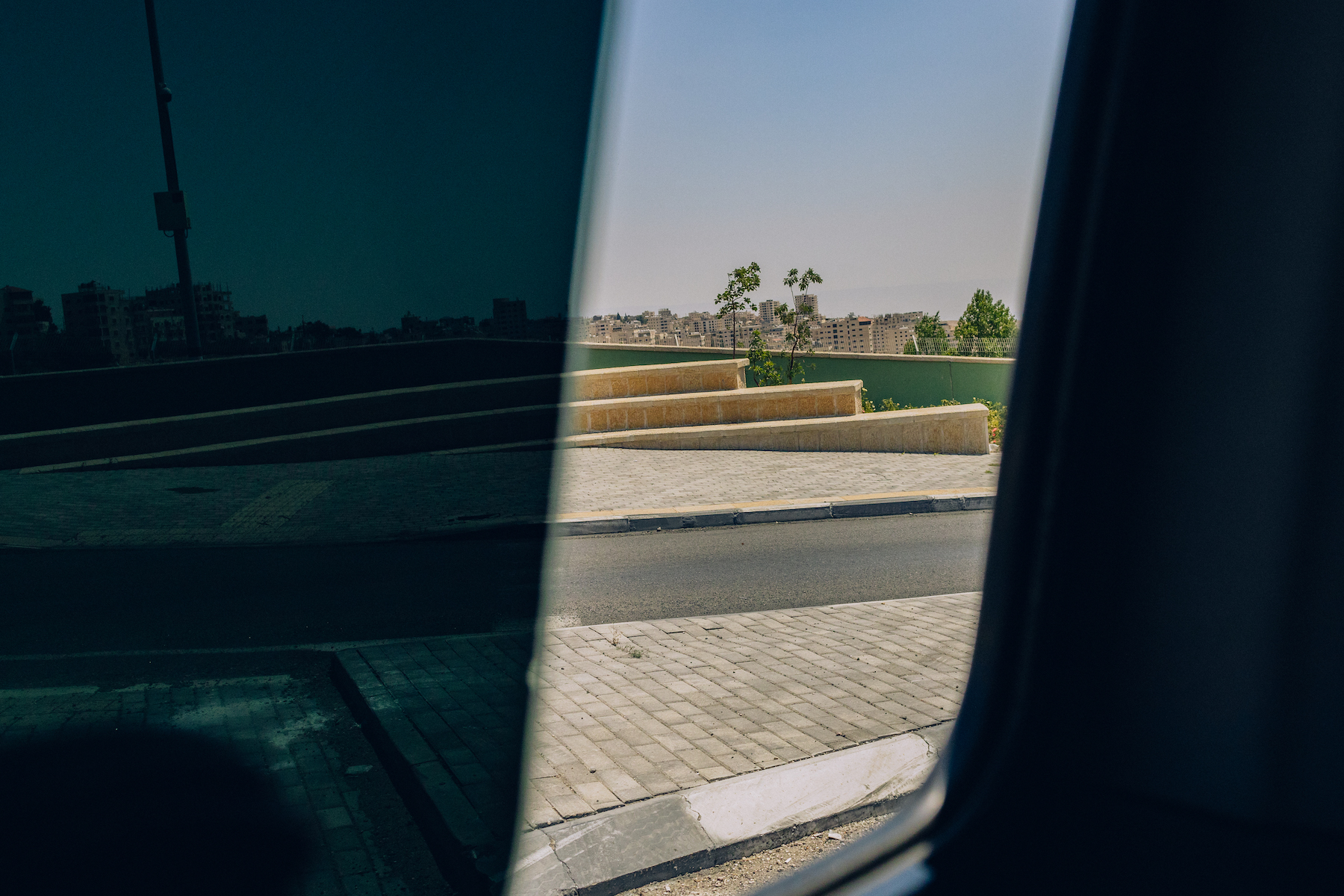
The ledge was built by Palestinian day laborers, of course. The day laborers, from these same towns or ethnically cleansed villages nearby, and the limestone dug up from Israeli quarries pillaging the occupied land.1 Cursed to dig up and reshape their own land for the occupation’s blueprint, just to earn a few hundred shekels more than they’d make building for a Palestinian project. Exploiting Palestinian natural resources, labor, and the hands and psyches of the Indigenous to make concrete the colonial imaginary.
Every time I sit in that traffic, I fantasize about stopping the servees (public taxi) and having a skate session on the ledge. Maybe a front nose slide if I had a decent-enough warm-up, or a nollie heel flip out if I was any good at all. I would get the video clip—my trucks gnawing into the limestone, scoring the surface with my own markings. This space is ours, not yours. Then, I’d get off my skateboard, dap up the homie filming, pick up a sledgehammer, and destroy it. Or park an earth mover next to it and rip the whole thing from the ground.
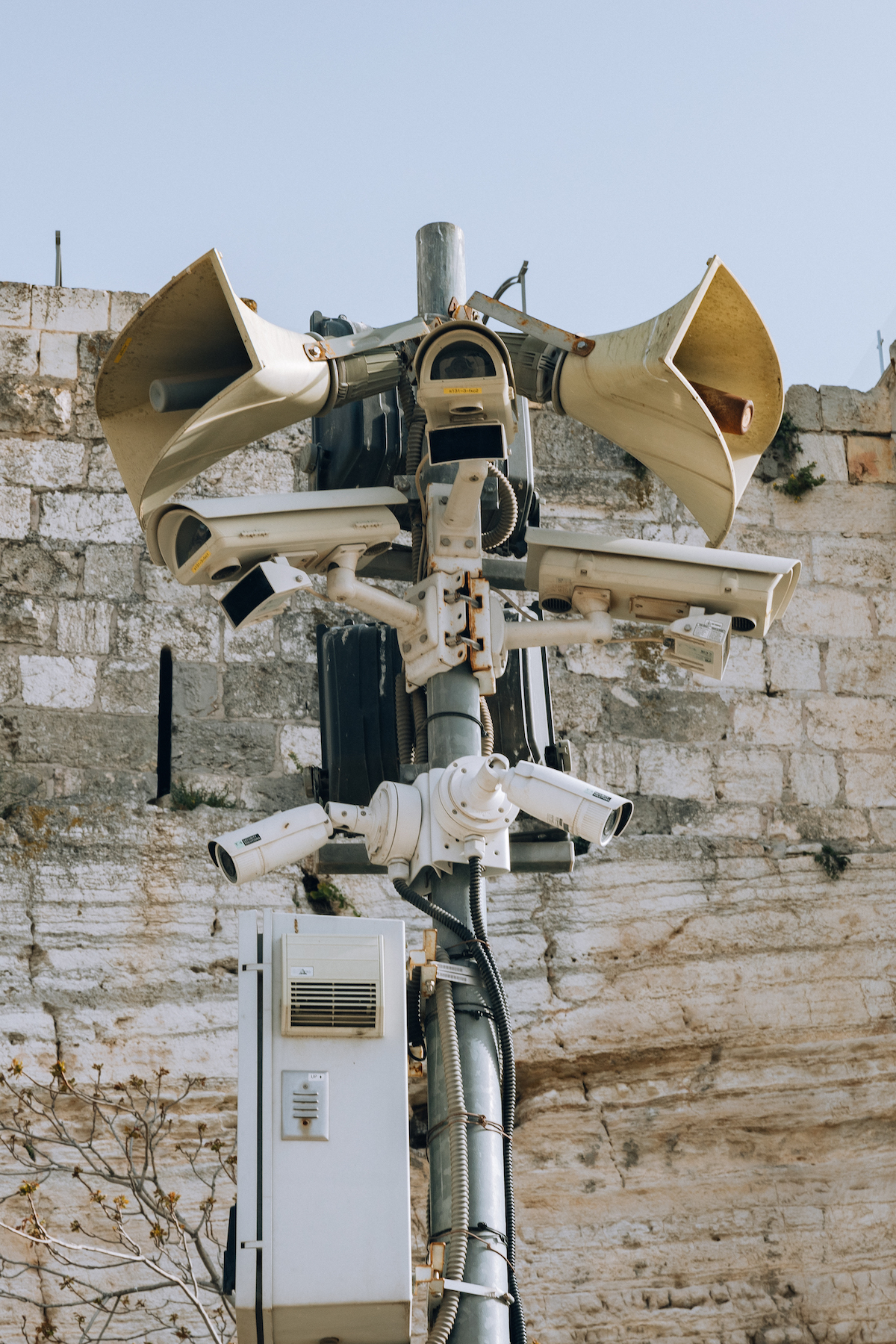
The radio in the servees crackles on. I snap out of the daydream to the broadcast of the day’s martyrs in north Gaza.
Fifty miles away, the Gaza Skate Team shares a video on their Instagram page.2 In the clip, Rajab and Belal make their way to the skate park in northern Gaza. The park is scattered with shrapnel—bits of US-made missiles and mangled roofing. The air looks heavy; the horizon unfamiliar without the silhouettes of buildings that once surrounded the park.
In the video, they say the park is damaged, but skateable. They do what any skater would do at a busted spot. Begin cleaning it. Using their boards like brooms, and then with their T-shirts… they scrape out the smaller pebbles and shrapnel, parting a narrow strip of concrete, just wide enough to skate through. Rajab drops in on the big quarter-pipe, pumps the roller, carves back and forth. It was the first time he rode transition since the ongoing genocide began.
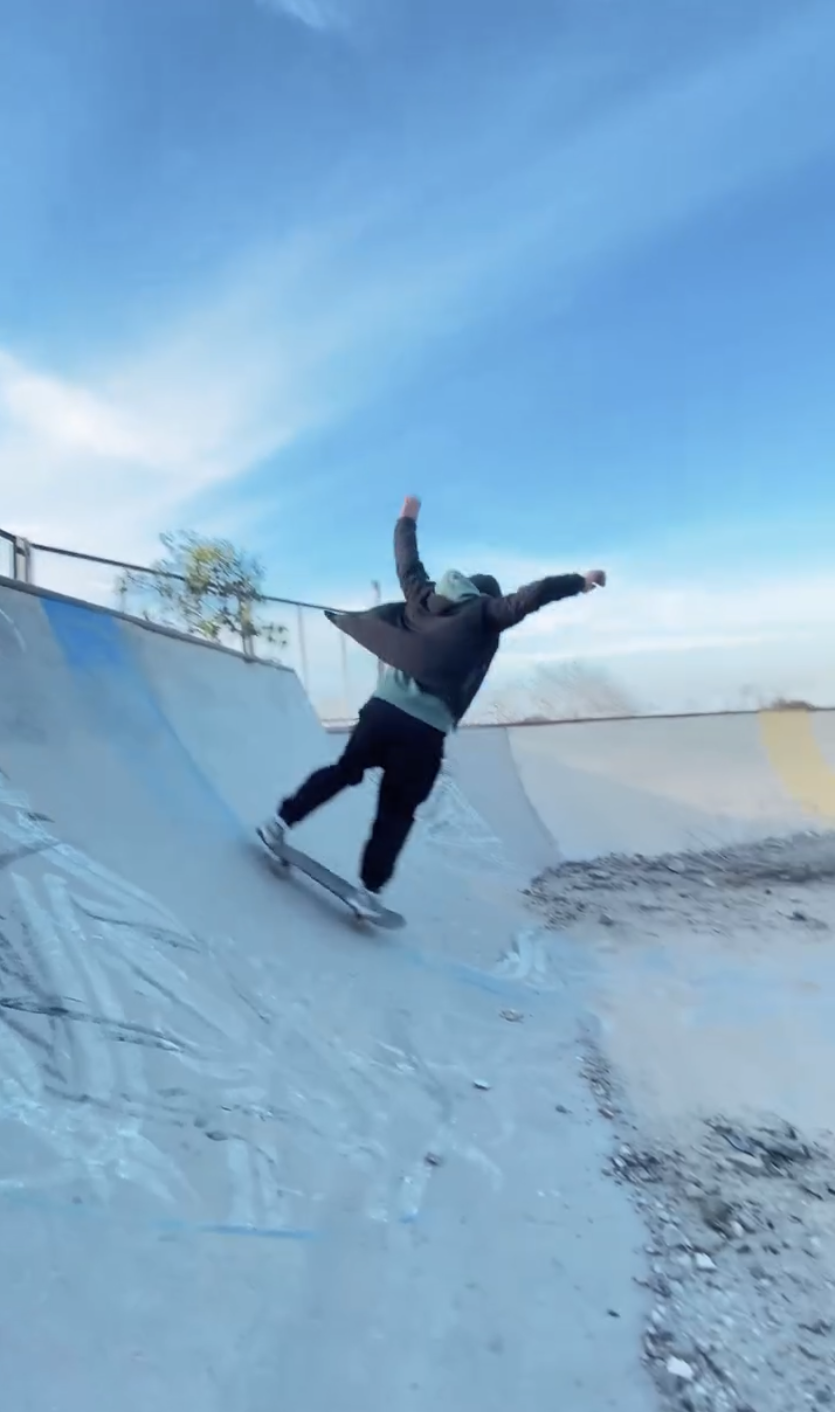
A few days later, they went back. This time, they were shot at by the Israeli occupation soldiers. They ducked, ran, and posted a new video:3 “We went to check out the skate park, but we were exposed to gunfire and we left the place without anything being done to us.” For the crew in Gaza, and for us in the West Bank, skateboarding offers a small, tangible reprieve from settler colonialism’s vise grip. It doesn’t solve anything within the system of domination, but it carves out just enough of an opening to remember what else might be possible. This possibility is embodied; vibrations felt through bruised wheels and dusty grip tape—where land theft and erasure sit at the heart of the settler colonial project, skateboarding puts a body back in place, engaged with space. It is a practice steeped in collaboration, in community.
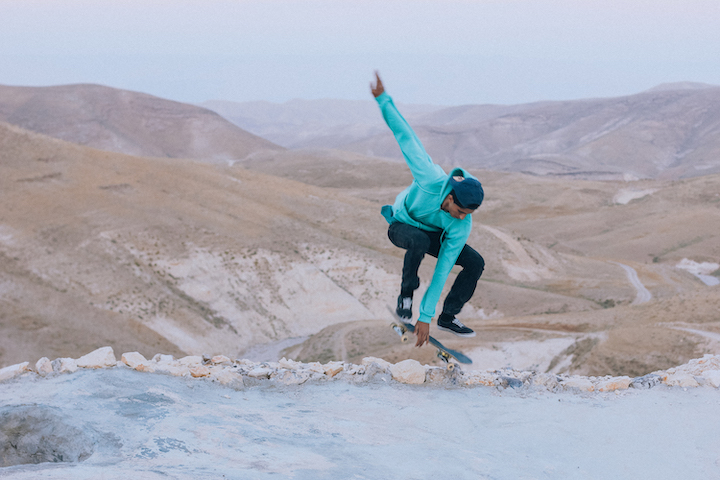
The occupied Gaza Strip continues to be bombed by the Israeli regime with the force of multiple nuclear weapons4—a metric that changes quarterly, like a grotesque scoreboard tracking the pace of annihilation. Gaza’s destruction is so vast it defies comparison. In the occupied West Bank, we instead operate in a delusional survival mode, especially inside Ramallah’s decorated cage, where colonial violence is slower, but no less deliberate.5 And in some parts of the West Bank—in Jenin, in Tulkarem—the pace is catching up.6 Genocide seems to be looming not far behind.
With this scale and speed of architectural violence in mind, skating does not sit neatly inside any fantasy of resistance. It does not halt settler violence. It does not return stolen land. It is not spectacular. It is not the front line of armed resistance. But it is a quiet subversion to these systems of oppression. A way to stay psychically and collectively intact alongside a small cohort of others who get it. Skaters definitely get it. Under the weight of a regime that suffocates, restricts, and murders from every angle, skating keeps a corner of the mind open, agile, searching for the next ledge. It offers a shared breath under siege.
Skateboarding as Purposeful Escape
Across the fragmented geographies of Palestine, I’ve observed skateboarding become a ritual of purposeful escape. It doesn’t undo the settler logic that surrounds us—it instead moves through it, loosening its grip, allowing a body under siege to slip for a moment, free from the daily choreography of colonial control. For whatever it’s worth, it offers a small teleport into an unclaimed margin—a counterdesign shaped by a youth-driven imagination of both individual and collective liberation.
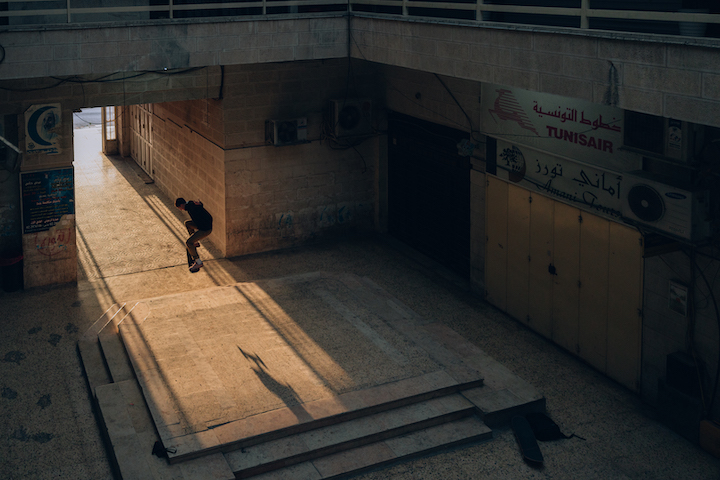
Skateboarding will not free Palestine. Bombing a hill won’t stop a Merkava. Kick-flipping over the ruins of a skater’s home in Gaza won’t end the siege. And unlocking a new ledge in Ramallah won’t bring back the millions of refugees. Anyone tempted to read this as a “hope story”—or as lazy defiance—is missing the point.
This “freedom” is at a much smaller scale. I’ve been mapping potential skate spots across Ramallah on my daily walks—and saving them in a folder on my phone. I share them with Aram or Kilani—two of the core skaters in Ramallah—and we bounce ideas often. When to hit them, if the run-up is too cutty, if the spot might get busted, or—more often—if it is too gnarly to even try. Even if we don't skate the spots, there is a list for when we will. That is my logic, at least.
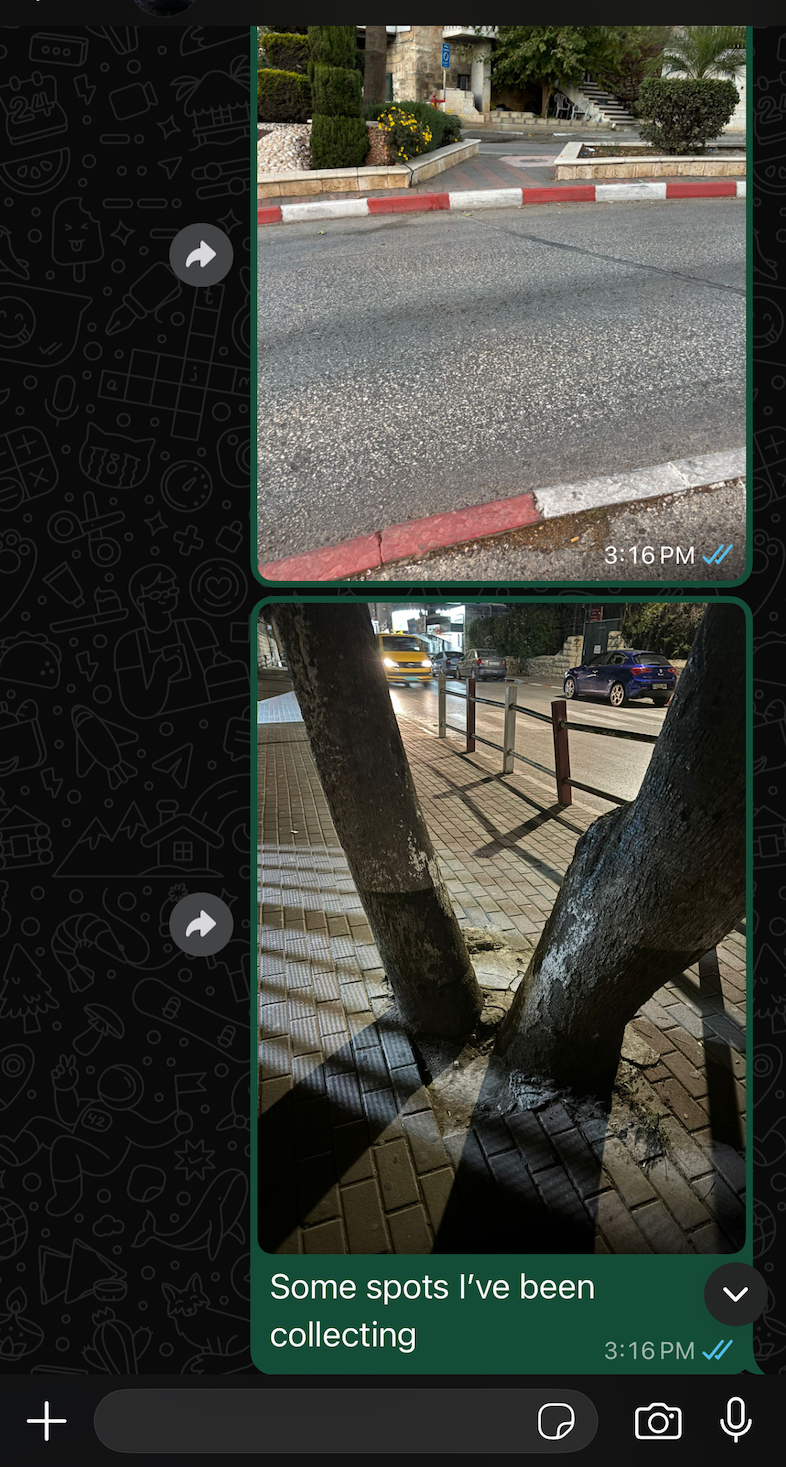
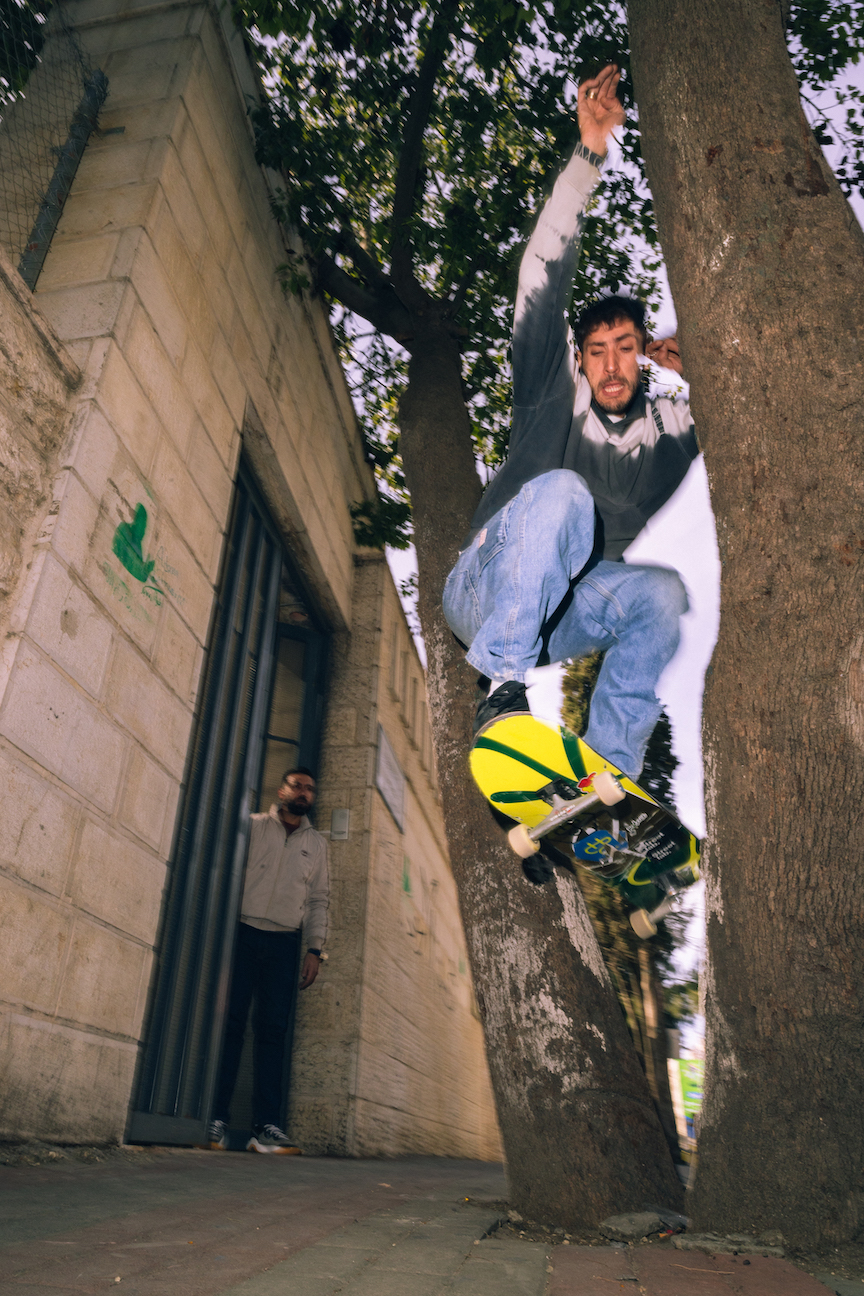
A few months back, I dropped some new spots in the group chat with Kilani and Aram. One was a photo of a tree split into two trunks just wide enough to ollie through—right next to the Friends School. We pulled up the next morning at 10 a.m., before the day got swallowed by work. Aram didn’t even warm up—he just went for it. Five or six committed tries in… then on the seventh, as the security guard came out of his booth to kick us out, Aram landed it clean. He rolled away with the satisfaction that only imagination can manifest.
Aram got the trick, I got the photo, and Kilani saw it done. The formation of a street skate crew, assembled.
We left and ended up at another spot, another image from the group chat. A ledge on a limestone traffic island between two packed roads, right by the municipality of Al-Bireh. I got a few 50-50s in before we all had to go back to work. Kilani saw us skating the spot and it unlocked something in his head.
Skaters in Palestine are obsessed with skate parks. I don’t blame them—they’re usually how a scene starts. But there’s no skate park in Ramallah, and that gap often stunts the growth of a sustainable skate culture. The skaters here are left to find a flat piece of asphalt to learn how to skate and simple skate spots to develop. It is not how it works in most skate scenes around the world. Perhaps I am projecting, but at the spot, I saw Kilani realize something: maybe Ramallah’s streetscape is the skate park. Maybe the last thing we needed was another bounded space, designated just for skating. Maybe the occupied city, this suffocating concrete grid—the one that usually controls us—can be ours to bend, to imagine against. Radical.
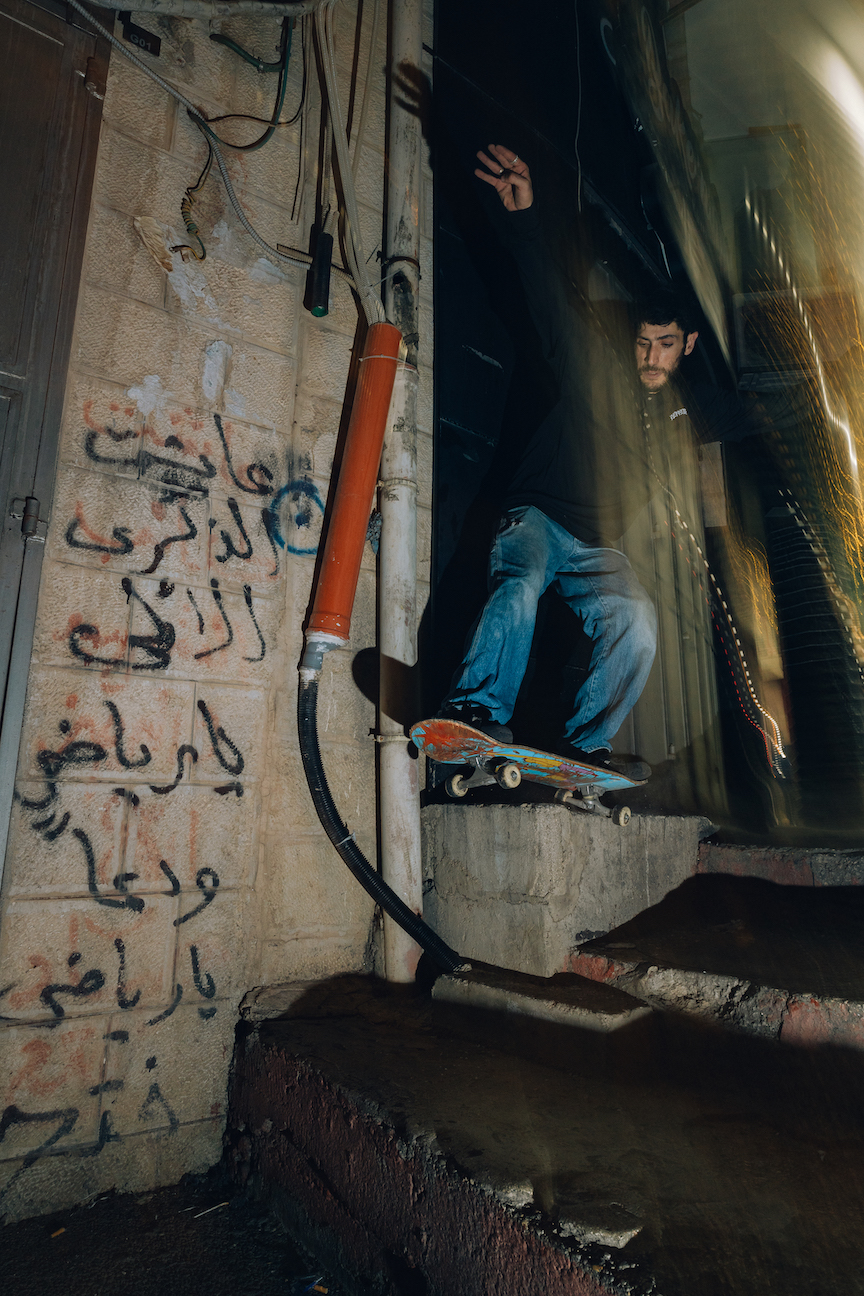
To believe the built environment can bend is a prerequisite to any decolonial imagination. Skating makes that belief tangible. Pulsating imagination—one that insists, again and again, that the regime is not the only force shaping the ground we move on.
One Skate Solution: A Spatial Critique
Two years into the genocide in Gaza—after watching our friends starve… skaters becoming martyrs—we’re still trying to make sense of it. And here in Ramallah, inside this airless bubble, we’re trying to bring the scene back to life. Again. The cycle of necessary reinvention.
The skaters in the West Bank recently paused to think through what is necessary to nourish the scene here. To reflect on what’s missing, how to support the Gaza skate scene, and how to connect again with the global skate community that once felt more within reach. They organized a weeklong workshop to do bits of this recalibration.
The work was practical and grounded. Kilani and some of the crew built a kicker from scratch in the SkatePal office. I would have preferred a ledge, but we agreed that could be next. Aram is navigating the asinine bureaucracy of a long-overdue skate park build in Ramallah—nearly a decade in the making. All of us are figuring out how to get funds and support for Rajab and the Gaza Skate Team.7 Somehow, despite the blockade, bombs, and famine, they’re skating more than us. They’re still running classes in Gaza, boards in hand.
We talk about that a lot in Ramallah. When the shame of stillness creeps in—when the guilt and stagnation threaten to kill off the scene altogether—someone always brings up Gaza. If they’re skating under genocide, what’s stopping us?
So—we skate, or try to. Weekly sessions at Istiqlal Park have become a kind of ritual. Kilani and the young heads always show up. New skaters roll through—some fresh to the craft, others returning after years away. It’s beautiful to witness this thread of skaters weaving in and out of solitude. We meet by the playground at the park’s lower entrance, always under the gaze of dozens of curious kids.
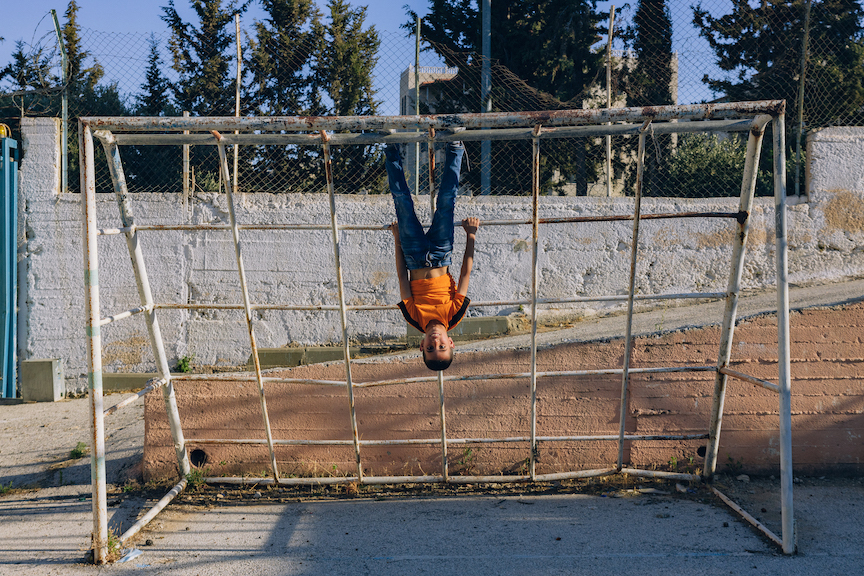
Most still have no clue what the hell we’re doing.
It feels important to be skating at least twice a week again. I spent most of my childhood skating almost daily in Midwestern US suburbia. During some formative years in DC, I was lucky to find a community with the Statue crew. Those years cracked something open for me, revealing a possibility of movement building that I hope can happen for some of the younger skaters in Palestine. Skating wasn’t just something we did—it was how we moved through the city. How we read the streets, formed relationships, built a kind of politics of space. Skateboarding shaped how we navigated—and subverted—the spatial violence of Washington, DC, a city designed to stage imperial power.8
Skateboarding offers a different script.
Here in Palestine, we don’t yet have the numbers to match that kind of scale. But I’m still lucky to be part of what’s forming. Now, perhaps, I’m one of the old heads and my body aches and hurts in new ways. I don’t mind. If anything, it feels more important. Skateboarding is one of the few constants in my life, and especially in my “partial” return to my homeland. Documenting the skate scene over the last decade hasn’t been just a project; it feels like sustenance.
A few months ago, security stopped me at Istiqlal Park after they saw my camera. I wanted to shoot the ledge and hubba9 tucked at the edge of the park to send to the group chat. They told me the Palestinian Authority’s intelligence offices were nearby—therefore, no cameras were allowed. As if anyone cared to photograph the subcontractors to our surveillance state.
Security asked what I was photographing.
I wanted to say: a portal to another imaginary. A world without the need for intelligence officers. An urban playground tucked into the concrete corner of your prison-state. My next clip. A crack in the grid—maybe the only place I’ll feel free all week.
Instead, I said: “a staircase.”
I put the camera away.
But all I could think about was Ryan Lay switch shuv fifty-fiftying10 that same hubba a few years back during a three-hour session. The spot deserves to live on.
Instead, what’s keeping Ramallah afloat is necro-capitalism, debt-driven construction, and consumerist delusion dressed as a glossy promise of luxury under siege. Those cosmetic freedoms and the fictions we hold on to for survival. A pseudo-capital propped up by the ruins of the Oslo Accords, the Paris Protocol, and all the other backdoor choreography keeping complicity alive and its criticism at bay. Ramallah’s terrain is perched on the hills that were once a small Christian village, now buried under malls, banks, and a borrowed illusion of sovereignty. A bubble carefully inflated to distract from the violence surrounding it—and rooted within. Down the street from the newest mall opening11 is Jalazone, Qalandia, Qadura, and Al-Amari refugee camps, housing tens of thousands of fourth-generation displaced Palestinians. Around the corner is an illegal settlement—or the next Israeli battalion entering for an arrest campaign or rehearsal for the new occupation reservists before heading to Gaza.
Even Istiqlal Park—one of our few public spaces, our go-to skate spot—is rife with contradictions; a site haunted by the layers of theft and deceit. Istiqlal Park translates to “Independence Park.” Before this once-restricted piece of land was transformed into a park, it was part of Al-Muqata’a, the headquarters for the Palestinian Authority. Prior to the Palestinian Authority’s establishment of Al-Muqata’a, it was a Zionist prison. Before its use as a Zionist prison, it was the site of the notorious Tegart Fort during the British Mandate in Palestine. Liberatory myths such as “independence” are deliberately misused. When we speak of “Independence Park,” we must ask, independence from what or from whom, exactly?
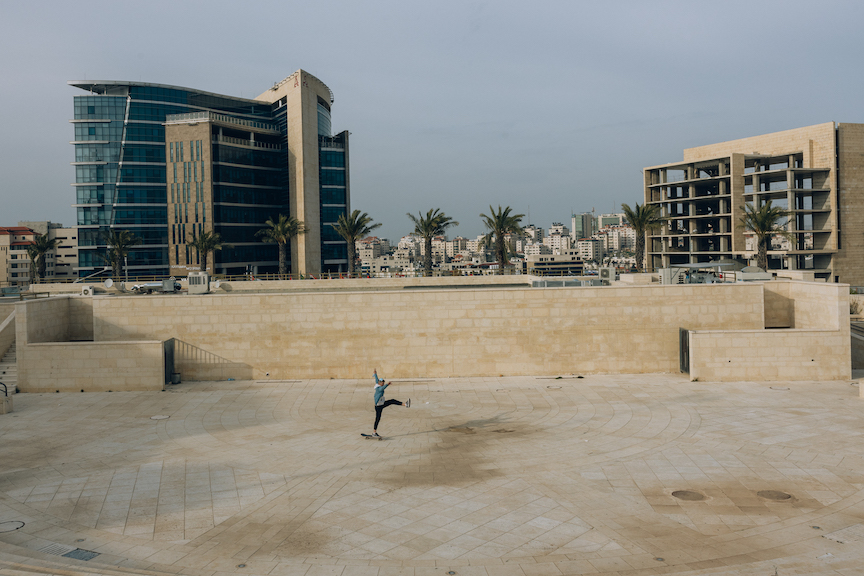
Skating in Palestine is not glamorous and it shouldn’t be romanticized. For me, it is my small enactment against absurdity and participation in the theater of failed state-making.
Do It Yourself
A few weeks ago, Rajab—still in northern Gaza—posted that another skateboard snapped. He and Beelal were running a class for displaced kids and made a DIY manual pad, filming a short session on the worn-out piece of plywood.
There are only a handful of skateboards left in Gaza. Rajab got those boards into the besieged strip by leaping across the bureaucratic hurdles that colonial siege demands. Before Israel’s current genocide, it took a whole underground network: skaters donating gear or funds from outside Palestine and skaters in the West Bank finding an NGO, journalist, or humanitarian worker willing to smuggle it through. Before this genocide began, a few duffel bags worth of gear had made their way to Rajab—a yearslong process. He distributed them with the kind of care only a skater would understand.
Even months before October 2023, not a single wheel, board, or bearing had entered Gaza for nearly a year. Rajab and the Gaza Skate Team have been sharing the same few boards ever since. When they skate, they set a timer—each skater gets ten minutes before handing it to the next. In Gaza, those boards are worth more than anything fungible—the crew holds on to them like gold. They’re the last portals to a world they refuse to lose.
You can now imagine the absurdity of building a skatepark under siege. The park in northern Gaza—the one the crew returned to the day after the so-called ceasefire—was laid by Rajab, his team, and a few Italian volunteers in 2020. Because of the scarcity of materials and restrictions imposed by the Israeli regime,12 it took them two years to complete the project. With their own hands, they poured the same concrete that cages them in this besieged land, shaping it into inclines and dressing it in coping, creating a watering hole for all Gaza’s skaters.
That park is now cratered and half-destroyed. Sometime in 2024, an Israeli pilot in an F-35 warplane pressed a button, likely killed a family. The bomb destroyed Gaza’s only skatepark, the one that took years to build: its ruination another achievement of Israel’s strategy of cultural genocide.13 A heartbreak, yes—but Rajab says it’s nothing compared to the many young skaters killed in Gaza by Israel’s bombardments or bullets. No ruin compares to that. On August 4, 2025, Raid, one of the Gaza Skate Team’s most beloved skaters, was murdered by the Israeli regime as he was going to collect food at one of the humanitarian kill zones.
The Gaza Skate Team says they’ll rebuild when they can. They’ll fix everything themselves; Rajab’s learned the basics over the years. They’re just waiting for a chance to go back and do it. For now, scavenging for food to find the bare minimum to survive Israel’s forced starvation takes priority.
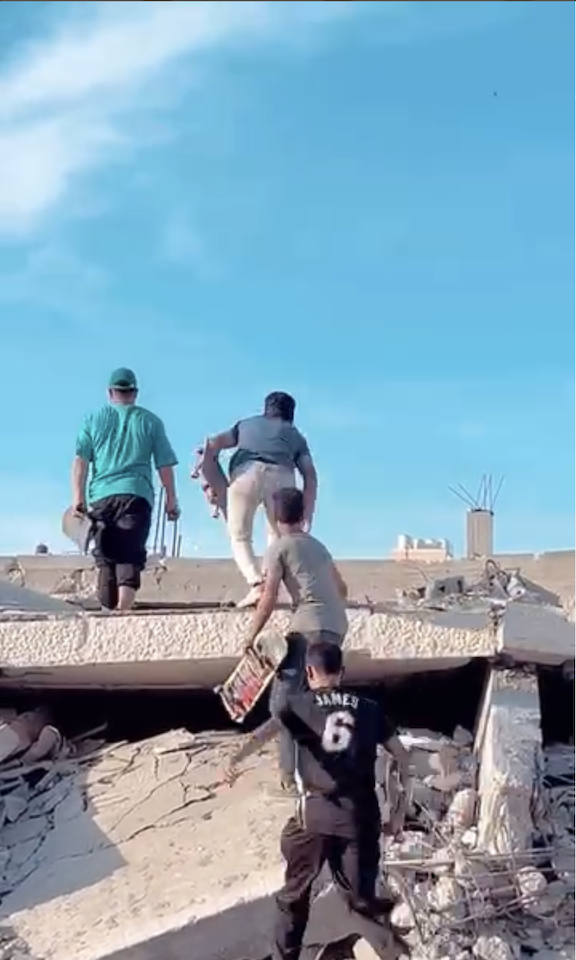
Back in the bubble, the Ramallah municipality stays busy dreaming up shopping centers, wasting what land we have left to inflate capital and dress up this bootleg Dubai. We keep skating the streets when there’s will or inspiration. But it’s hard. Morale sinks. At least for me, it has. Maybe that’s why I always hesitate to call this a reliable escape. When the violence feels heaviest, I lose hold of the very thing I lean on for freedom.
After watching that video of the skateboard that snapped in Gaza, I messaged Rajab. He told me that of the four skateboards left in Gaza, two had to go south, when, in the middle of extermination, two skaters were forced to flee to Rafah. They let him know that there were no skateboards anywhere in the south of the strip. Rajab sent two boards with relatives who were escaping north Gaza to Rafah. They carried them by donkey and carriage across the length of Gaza. Both impossible and necessary. A small act of freedom under occupation and genocide.
-
Gaza Skate Team (@gaza_skate_team), “Today we went to check out the skate park,” Instagram, January 23, 2024, link. ↩
-
Gaza Skate Team (@gaza_skate_team), “We went to check out the skate park, but we were exposed to gunfire and we left the place without anything being done to us,” Instagram, January 24, 2024, link. ↩
-
“Fourth Committee Highlights Continuing Destruction in Gaza, Heightened Settler Violence, Emphasizing Need for Ceasefire, End to Illegal Occupation,” United Nations, November 18, 2024, link. ↩
-
Kareem Rabie, Palestine Is Throwing a Party and the Whole World Is Invited: Capital and State Building in the West Bank (Durham, NC: Duke University Press, 2021). ↩
-
Mariam Barghouti, “State of Siege: Israel Is Conducting Its Largest Mass Expulsion Campaign in the West Bank Since 1967,” Dropsite News, link. ↩
-
Much of Washington, DC’s civic core follows a Neoclassical template, drawing on ancient Rome and Greece to project imperial continuity and “civilized” democracy. See Dell Upton, Architecture in the United States (1998); as architectural historian Swati Chattopadhyay emphasizes, spaces are never neutral. They are “material documents of history,” shaped by power yet always contested through “ephemeral acts and artifacts” of daily life. Swati Chattopadhyay, “Architectural History and Spatial Imagination,” Perspectives on History (January 2014), link. ↩
-
A “hubba” is a type of ledge that runs alongside a staircase — usually wide, angled, and low enough to grind or slide down. The name is synonymous with the iconic “Hubba Hideout” spot in San Francisco, which became legendary in skateboarding culture. See This Old Ledge: Hubba Hideout, Thrasher Magazine (video), YouTube, uploaded by Thrasher Magazine, link. ↩
-
Ryan Lay in Palestine Video, Thrasher Magazine (video), YouTube, uploaded by Thrasher Magazine, link. ↩
-
“New Luxury Mall Opens in Ramallah, Redefining Shopping in the West Bank,” Arab Times Kuwait, April 16, 2025, link. ↩
-
Moustafa Bayoumi and Mona Chalabi, “Toys, Spices, Sewing Machines: The Items Israel Banned from Entering Gaza,” The Guardian, June 24, 2024, link. ↩
-
United Nations Human Rights Council, Joint written statement submitted by Al-Haq, Law in the Service of Man, Human Rights and Democratic Participation Center "SHAMS," Palestinian Centre for Human Rights, Palestinian Initiative for the Promotion of Global Dialogue and Democracy (MIFTAH), A/HRC/55/NGO/377, February 26–April 5, 2024, link. ↩
Maen Hammad is a documentary photographer, writer, and researcher. Born in Palestine and raised in the suburbs of Michigan, he is currently based in Ramallah. Maen has exhibited his images internationally, and his work is part of the permanent collection at the Museum of Fine Arts, Houston. Maen has had his thoughts and images published in TIME, Huck Magazine, Dazed MENA and Caravan Magazine. He was awarded the Magnum Foundation’s Counter Histories Fellowship, selected for the Joop Swart Masterclass, and is a recipient of the Arab Documentary Photography Program. He holds a MA in international affairs from the George Washington University. Besides Maen’s work in documentary photography, he is also a human rights researcher and campaigner.