
This conversation took place on August 1, 2025. It was edited for length.
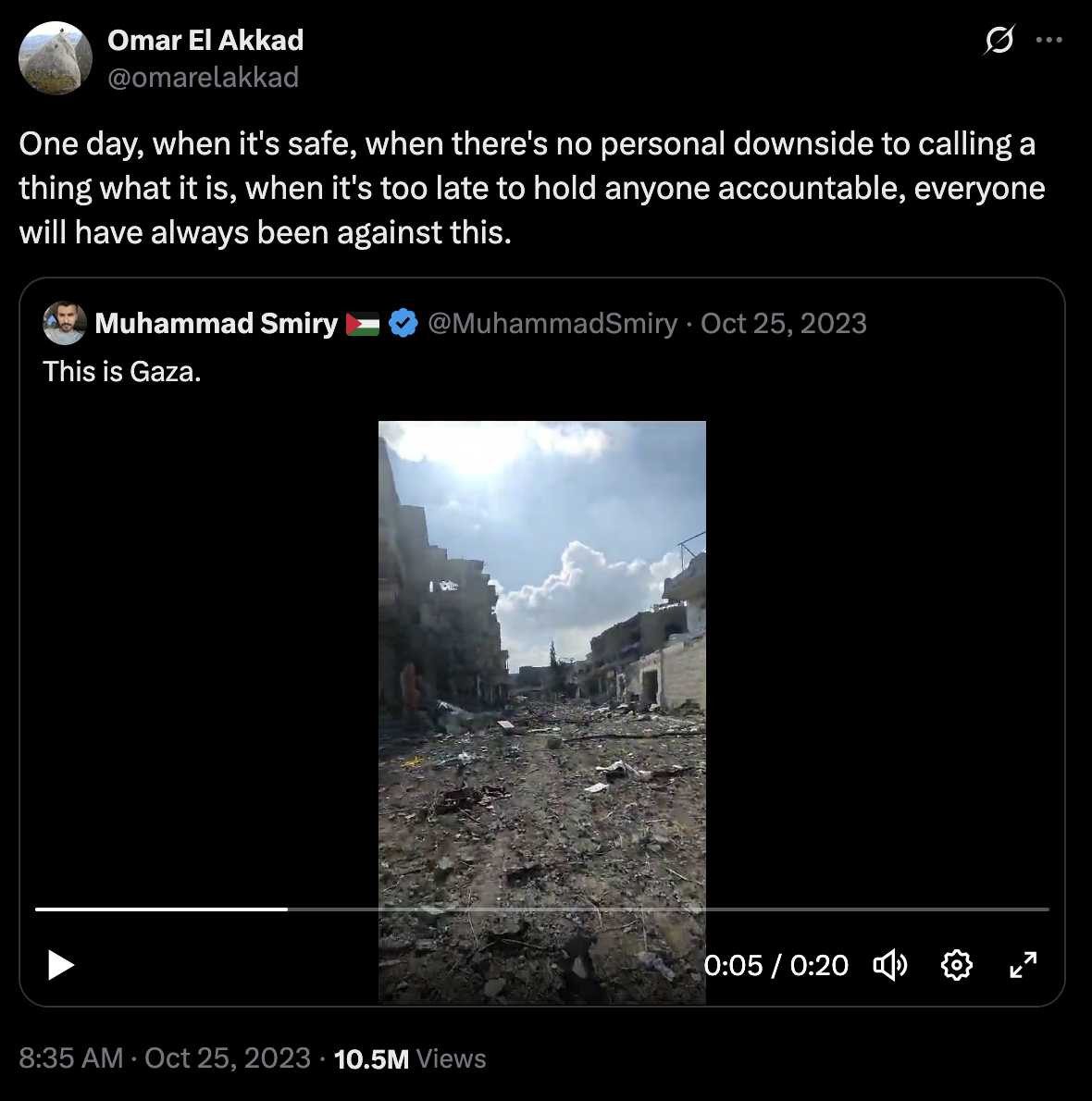
Taylor Miller (TM): Omar, I want to start by reflecting on the this in Muhammed Smiry’s video, “This Is Gaza,” from October 25, 2023. What was it about this video that resonated and sparked your own contemplation? Because when I look back on this video, it’s really an architectural moment. It’s utter ruination—a totalizing vignette of the world’s complicity, of what has been live-streamed and hyper-consumed and profited from… of what people have manufactured consent for and performatively protested in spite of everything these twenty-two months.
What did you see in this video?
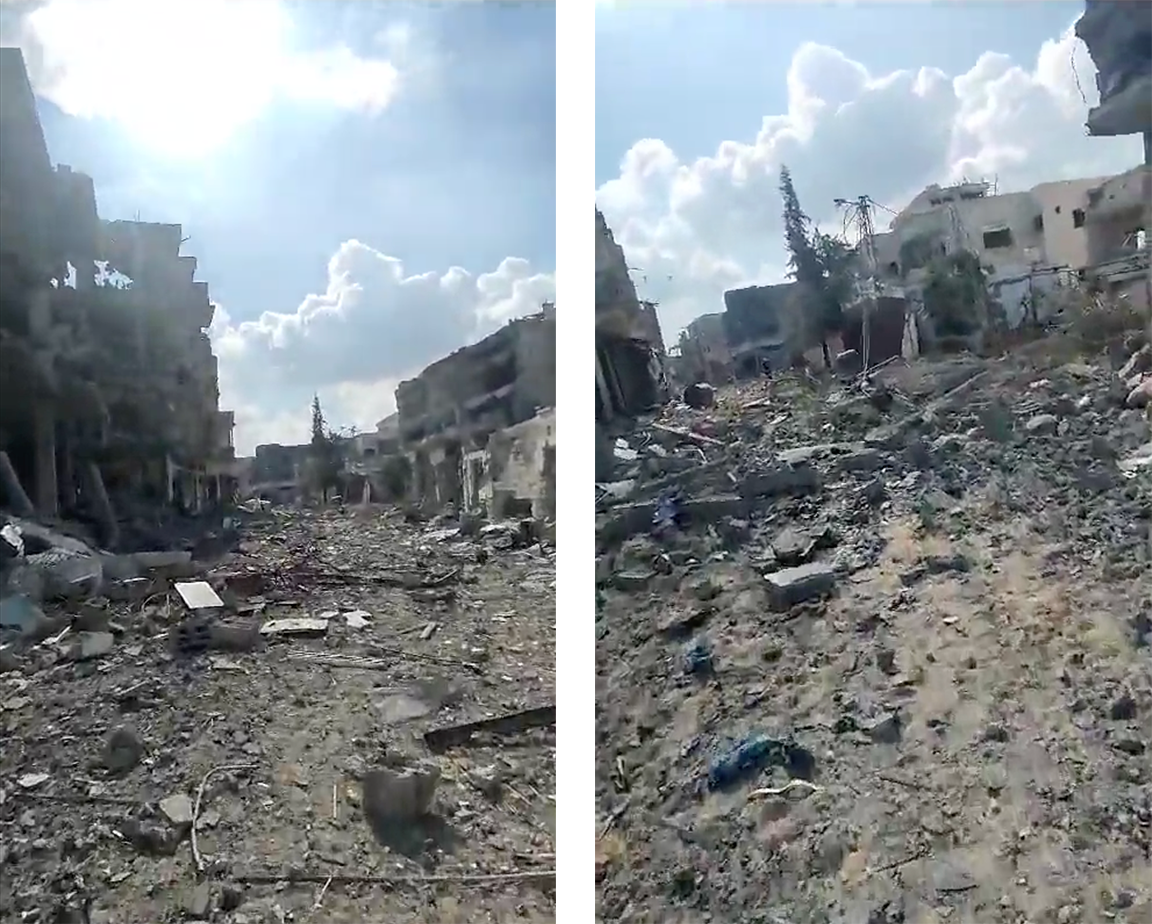
Omar El Akkad (OEA): I tend to think most of the time in pattern recognition. And one of the patterns that I saw that day, and have seen every day since, was about the power of enforced fraudulence. I’m not certain about many things. But from very early on I, and many, many people, were certain that this was a genocide. The goal of any colonial endeavor is always genocidal in nature. The difference is whether you do it slowly, headlined by men in nice suits, or whether you do it quickly with bombs and bullets. And so there was never any doubt in my mind as to what I was looking at. What was fascinating to me—and I use fascinating in the most horrific sense possible—was the ease with which a completely fraudulent narrative could be overlaid onto this destruction. And be fully bought—hook, line, and sinker—by people whose own privileged existence is very, very dependent on the same narratives in different contexts.
If you are benefiting from a system of endless taking, you will always find common cause with any other system of endless taking. And so, I think what I saw was not just destruction but the logical conclusion of a much grander system—one that, in the case of Palestine, has been in place for more than three-quarters of a century. Again, I’m not certain about many things. But I was very certain about what it was I was watching in this video.
TM: Related to this pattern, over the last twenty-two months and counting, I’m thinking about how repulsive and how routine this type of documentation has become. The circulation of these videos on Twitter and elsewhere. We’ve seen and continue to see them every five minutes. And at least from afar—and I am speaking for myself here given how unfamiliar I am with the exquisite nuance and beauty that was and is Gaza—it is hard to distinguish that video on October 25, 2023, from today, August 1, 2025. I’m thinking about the shade of blood, and the shame-stained concrete. I’m thinking about the streets in that scene. They were already, just two weeks into the genocide, entirely illegible. They were drowned in broken glass, in sewage lines, in rebar, in specklings of children’s clothes. And, as co-signers of this atrocity in our various degrees of complicity, I’m thinking about that temporal collapse; about how difficult it is to differentiate the devastation, day after day, year after year. Every day is just a new version of this bottomless depravity.
I have to remind myself constantly: this is Day _____ of this. I’m curious to hear you describe this collective psychosis.
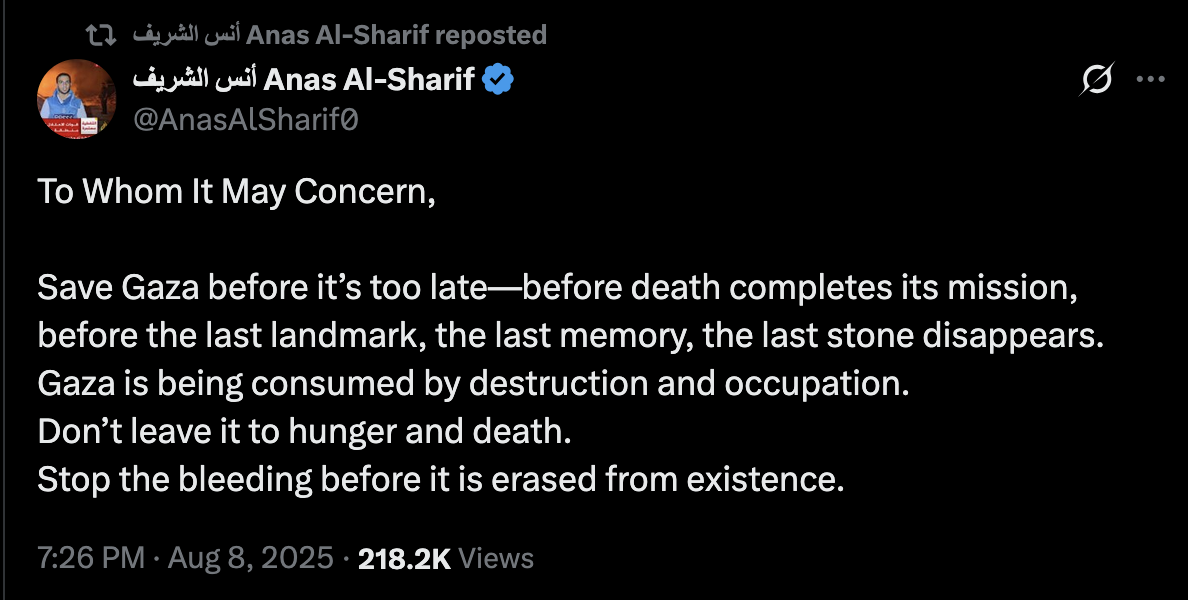
OEA: You know, of the many forms of grotesque education that I’ve received over the last two years, I think the most reorienting one is about the many, many facets of enforced nonexistence. I think, just as a human being with a remotely functioning conscience, the headline atrocity is always going to be the destruction of lives. As it should be. But there is such a vast spectrum of enforced nonexistence that includes the destruction of infrastructure. Includes the destruction of memory. So much of the narrative of colonialism is built on erasing a root system, and that root system is not just bodies—it’s the memory of the place, it’s the name of the place. It’s not very difficult to find maps of Palestine that are already missing the names of places that still exist today. And so you get into this fundamental contradiction of colonialism, which, I think, is the notion that the people being erased have to be erased in order to sustain the illusion that they never existed in the first place. And the ability to hold on to that antagonistic binary, I think, requires or induces a dissociation that makes people very, very angry.
Some of the most heated conversations I’ve had over the last two years have not been with people who are firmly celebrating what’s happening right now but with mainstream liberals, who have to walk around now carrying the functionally disjointed notion that apartheid is bad, except in this one case where it’s good and necessary. That segregation is bad, except in this one case where it’s good and necessary. That collective punishment is bad, except in this one case where it’s good and necessary. And you can see it taking a psychic toll. And I think all of this relates to how you enforce nonexistence. You can’t just kill human beings. You have to kill their infrastructure. You have to kill their societal underpinnings.
TM: There was clairvoyance, prophecy, in your text and in the timeline of how your book unfolds. And I’m thinking of the passage:
Words exist only in hindsight; time passes over and around them like water along a canyon floor. In the year or so between when I write these words and when they are published, perhaps so many innocent people will have been killed, so many mass graves discovered, that it will not be so controversial to state plainly what is plainly known. But for now we argue, in this part of the world, the part not reduced to rubble, about how words make us feel. It’s a kind of pastime. Almost every day an influential opinion columnist or think tank expert or spokesperson for the president of the United States himself will feign outrage at how hurtful words such as “genocide” and “occupation” are, how disparaging, how uncouth.
I’ve seen, almost daily, for months, images of children mutilated, starved to death, executed. Bodies in pieces. Parents burying limbs.
In time, there will be nothing particularly controversial about using these words to describe the things they were created to describe. (The very history of the word “genocide” is littered with instances of the world’s most powerful governments going to whatever lengths they can to avoid its usage, because usage is attached to obligation. It was never intended to be enough to simply call something genocide: one is required to act.) Once far enough removed, everyone will be properly aghast that any of this was allowed to happen. But for now, it’s just so much safer to look away, to keep one’s head down, periodically checking on the balance of polite society to see if it is not too troublesome yet to state what to the conscience was never unclear.1
I force myself, and whoever will listen, to keep tabs on the passage of time; in the perfunctory failed “pauses” and fake “ceasefires.” Our conversation here in early August likely won’t be published until mid-October 2025. I am haunted by all that will happen between now and then. In the media, they always use the same phrases for months at a time—on the brink of famine, on the cusp of collapse, on the edge… and I think about how an infant can’t wait. On any of this. How can it get worse over these next weeks? Of course, it can and presumably it will. Two full years of genocide by then. How do we continue to move through time knowing that there is no bottom, while also retaining the hope of an end?
OEA: It’s something I think about all of the time. I say without hyperbole that a lot of joy has left life for me in the last two years. And I say this knowing full well that I’m not on the receiving end of a bomb, that my bloodline has not been wiped off the face of the earth. So, relatively speaking, I am experiencing nothing. Nothing. Compared to the suffering that I’ve seen every day for two years, and in various other forms for the entirety of my life. Because it's been ongoing in one form or another for the last seventy-seven years.
And yet it’s very, very difficult to derive any pleasure from anything whose purchase price includes an element of obliviousness. For example, through my work, I engage with a lot of literary organizations, where everybody is very nice to me. There are grants, fellowships, nice dinner parties. But it's become difficult for me to take the same kind of pleasure that I once did in those spheres, because I know that it requires a kind of obliviousness. It’s also very, very difficult not to be hopeless most days—both due to the magnitude of the horror and the ongoing genocide, and to the fact that I am contributing to this very directly.
My tax money is paying for it. I am killing people. I am doing that. What I tend to tell myself in order to continue functioning, on any level, is that I have no right to abdicate responsibility on someone else’s behalf. The central lure of the world that I live in is that the privilege of obliviousness is always available to me. At any point, I can stop caring about any of this with almost no personal consequence. In fact, the consequence exists if I do the opposite. And I can’t tell you how many people I know who’ve effectively wrecked their careers. I know that I’ve lost all sorts of seemingly meaningless deals and various work opportunities. But also, who gives a shit? We’re in the middle of the worst thing I’ve seen in my lifetime. And so, however dejected I might feel on any given day, and God knows I feel dejected most days, I have an obligation to use what little privilege I have to continue advocating for an end to this. In every arena possible. Because right now, the defining mantra that exists throughout the course of my days is—nothing is enough, and everything matters.
When I sign an open letter knowing full well the institute or the individual might never read it, it's not enough, but it matters. When I call my elected representatives who could not give a shit what I have to say, it’s not enough, but it matters. When I try to pressure the literary organizations, which are the only organizations where I have any kind of leverage—it’s not enough, but it matters. And so that’s how I’ve been trying to continue doing what little work I actually do, to stop this. But I can’t sit here and tell you I engage with hope in any healthy manner. Because I don’t and I haven’t for the last two years.
TM: I’m reminded of psychotherapist Lara Sheehi’s idea of “psychic intrusions.”2 How moving through our everyday life, for example, we can’t look at a plastic grocery bag the same anymore. Because it has become a vessel for holding a dismembered body. The horror and the grief and the overwhelm is so totalizing. And I feel often alone in what I see. Unless I am in a “site of dissent,” whatever that may be, nobody is saying, “I see what you see.”3
Just this week, though, I am seeing politicians like Jeremy Corbyn and Zarah Sultana and others reposting the cover of your book, or its title. It’s almost a gesture towards SEE?? Or maybe it’s in lieu of seeing, or a laziness to search for their own words or summation or anger. It’s this chance to synthesize, with a click, this stage of genocide and of total starvation across besieged Gaza. Folks reposting to a BBC or AP or New York Times comment as a way to say, SEE?? NOW EVERYBODY IS AGAINST THIS. Starmer and Clinton and scores of influencers and millions of otherwise apathetic folks—just this week alone—are finally saying, “Okay, this is it. This threshold of violence, we will no longer accept.” Is it because we can see every single rib on a three-year-old’s body?
Do you think we’ve reached the “One Day…” yet?
OEA: Short answer is no. In fact, I think your interpretation of this moment is far more generous than mine. I don’t think that the Hillary Clintons of the world decided they saw enough ribs on a starving child to draw a line. I think they started to see a projection of where their legacies and careers might be headed, and the public interpretation of what they did—or, more to the point—didn’t do during a genocide of historic proportions. I think that’s the motivating factor here, and I don’t have one iota of sympathy or respect for these positions.
We’re talking about people whose political careers necessitate a deep understanding of narrative power. And I think within the circles they’re concerned about—which are the circles of their donors—there’s an entirely different narrative than the one that hundreds of millions if not billions of humans are engaging in right now. And so I think what we’re witnessing is an incredibly contrived attempt to find a narrative bridge between these two places… a bridge that allows someone to escape unscathed with their reputation intact—when, in a just world, we would not give a shit about their reputation and they would be held to account for allowing this to happen.
But setting all this aside, I think the reason my short answer is no is because when I wrote this book, I was thinking of historical precedents. I was thinking of the declaration by the United States under the Obama administration in which the government apologized for Indigenous genocide, which was the subject of a collection of poetry by Layli Long Soldier called Whereas.4
That was the passing of time I was considering. I wasn’t thinking about next week. And so, maybe I’m wrong, and I truly, truly hope to be wrong—because this isn’t just some abstract theoretical practice for me; people are being murdered wholesale. And getting to a point where some kind of societal framing doesn’t allow this to happen anymore is a point I want to reach, as soon as possible. I’m thinking of the number of people I’ve seen, like you said, just in the last week or two, completely switching their tune… and I’m thinking of how fundamentally disingenuous they are. If you can flip the switch this way, right now, because you think it looks bad, then tomorrow when somebody blows themselves up on a bus in Tel Aviv, you will switch it right back.
I’m also thinking of the proposed “remedies” that are being presented alongside these expressions of great “concern,” and they are the most performative, empty, in many cases deliberately counterproductive measures that I’ve seen in all of my time reading on and witnessing from a distance—the erasure of the Palestinian people. This notion that we are going to maybe recognize a Palestinian state in several months’ time—so long as there’s a ceasefire and also that they are demilitarized, so that they can always be brutalized at any moment, for any reason—is genuinely one of the emptiest political statements I’ve ever seen.
But a final reason why I think we haven’t reached the “One Day…” is because this recognition cannot simply exist in a vacuum. Even if we take these people, these Hillary Clintons of the world, at face value, that they have now suddenly developed a conscience, and are deeply concerned—what must come next, beyond acknowledgment of atrocity, is some kind of justice. And I have zero faith that any of these humans who’ve expressed this concern are going to carry that over into calls, for example, for the people who committed these atrocities to be taken to The Hague… to any court… to be held to any account. Israeli soldiers fired at least 355 bullets5 into the car that Hind Rajab was sitting in, terrified, with her dead relatives. They killed her. They killed her relatives. And they killed the medics that came to try and save her. I don’t give a shit if that causes anybody concern, I care about real accountability. Who is going to be held to account for that?6 And so my reason for thinking that we haven’t reached that day is because I have no faith that any of these human beings are going to carry their performative concern into what must come next: Which is, someone or something being held to account for this violence.
When that happens, I think I will begin to consider the possibility that we have learned anything from this horror.
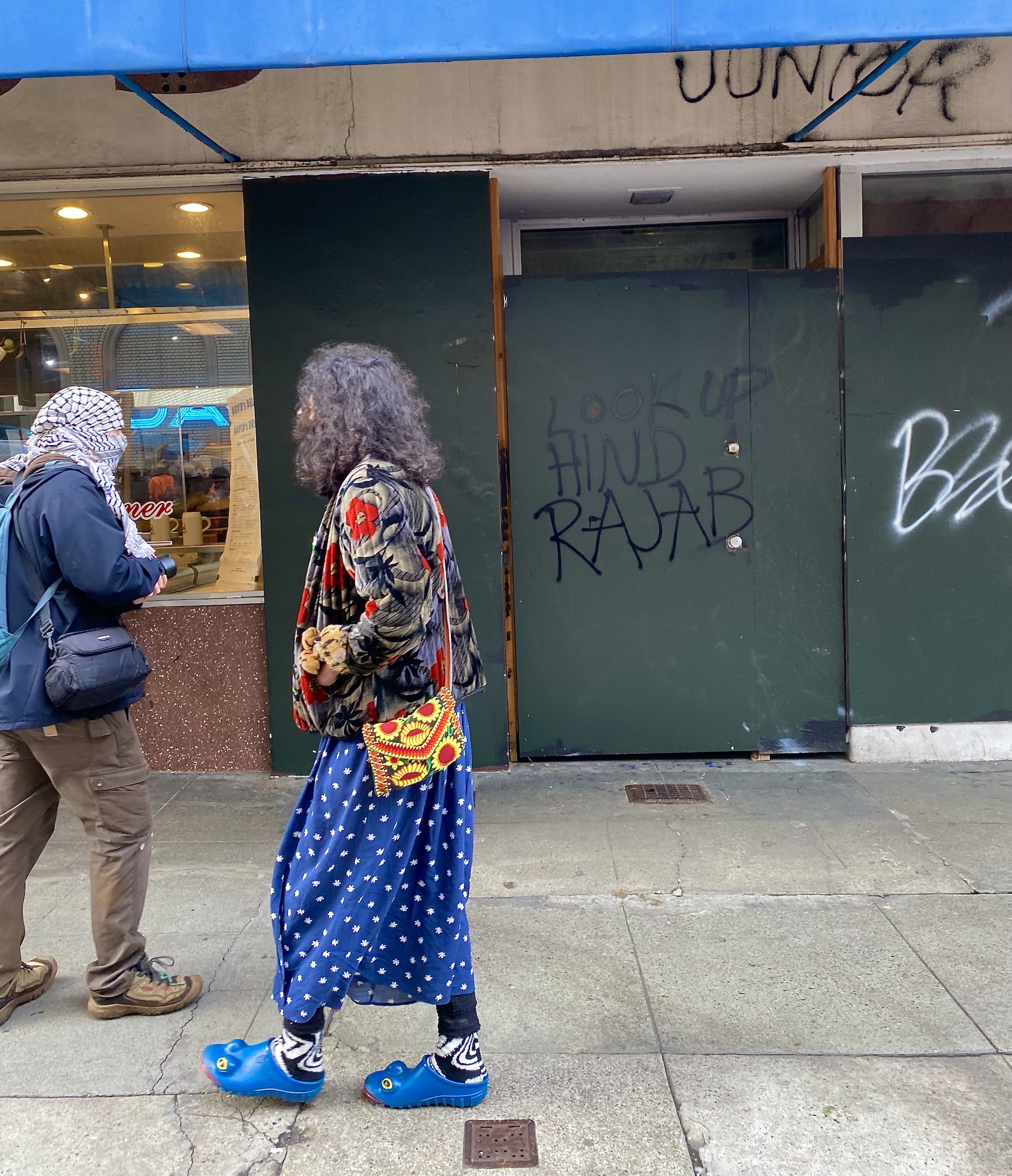
TM: Hind is always on my mind, too. We are parents above all else. She was almost the exact same age, same size, as my daughter. Even with the immense privilege of having spent quite a bit of time in Palestine and witnessing the horror of the occupation and its carceral logics firsthand, what we’ve seen people do, without any modicum of shame, is unimaginable to me—even in my most obscene, violent nightmares. What we’ve seen done to this earth… to the flesh of Palestinians… to these children…
In your book, you write about the “art” to the spineless coverage of these past two years—or rather, of the longue durée of the US- and UK-funded and armed occupation of Palestine, from the Balfour Declaration through today. “Of all the aftereffects of the War on Terror years, the most frequently underestimated is the heightened derangement of language for the purpose of sanitizing violence.”7
I am not a media studies scholar, nor do I have a journalism background, but I read. I read incessantly. And I’ve studied these patterns and their opacities throughout this genocide, attempting to find through lines to the histories my schooling danced around, to what the textbooks purposefully ignored, to what the shows playing in my childhood home never addressed. I don’t think of it so much as an unlearning, but a vigorous dive into what was intentionally obfuscated from these spaces I came of age in—and in the academic spaces I currently move through, too. I fixate on this derangement of language—circulated in defense contracting, at the State Department podium, in the press releases by chancellors and presidents. Personally, I believe the only real writing that’s speaking truth to the full scope of this devastation is that of The New York War Crimes, and of Palestinian poets. Whose writing has most moved you, informed you, challenged you in these recent months? And what do you believe still needs to be written?
OEA: That’s a really fascinating question, especially the second part. I can give you a litany of writers and writing that’s brought me great comfort, and made me feel less alone. The work of Noor Hindi, Lena Khalaf Tuffaha, Adania Shibli, for example.8 I still think that Minor Detail is my novel of the decade. It’s surgical. But I’ve been thinking a lot about the writing to come, for better or worse. You know, in the very first interview I gave for this book, I said—and I still believe it—that I don’t think this book is going to be remembered. Or, I think it’s going to be remembered as one of the tamest of its kind, for a variety of reasons. One of which, and I can’t discount this no matter how much I want to, is that I’m the angriest I’ve ever been in my life. And I’m cognizant that as a Muslim guy named Omar, there is a real ceiling in this part of the world on how angry I can appear before the public imagination. And so there’s an element, that I’m not proud of, of self-constraint. But I’m thinking of the much better books that are arriving now and are to come. I’m also thinking of the books that will never arrive. I was doing an event at the Hay Festival, and one of the questions from the audience was, “How do we become better at magnifying the voices of peaceful Palestinians?” I think the person was trying to ask it in good faith. But nonetheless, my instinctual reaction, and I felt bad for doing this, was, “You know, probably a lot of those Palestinians are buried under the rubble right now.”
And so, it’s very difficult for me to think of the work that is coming in the future without thinking of the work that is not coming in the future. Because those people whose voices were so necessary have been wiped off the face of the earth. And then there’s the flip side of that coin— and I honestly can’t tell you which one enrages me more—is that I know that in the coming years, there will be so many white Western authors that write the most beautiful, dulcet prose about a terrible thing that happened all those years ago. And they’ll win awards for it. And they’ll be praised for their delicate care and handling of the subject matter. And when anyone complains about it, it will be the natural counterattack of “Oh, stop censoring people. Everybody should be able to write about everything.” I know this horseshit is coming.
And what’s worse is that I know that it’s going to have an effect. I know that the first time a white Western journalist from a well-respected major media entity ends up going to Gaza, and writing their version of Hiroshima, it’s going to have this incredible impact—because finally, a white guy is telling you this. When Palestinian writers have been telling you this for years and decades. So it’s been very, very difficult for me to maintain a healthy relationship with the work that I do. And with the industry I’m in, and the arena I operate in. Because I know that these things are coming and it’s infuriating.
TM: This brings us to the circuits of promotion for your book. The friction points, the calls for boycott, the blind eyes turned by the global, broader literary-scape and festivals... I am thinking of what connected us: the Tucson Festival of Books and your immediate (very mensch!) withdrawal from it when we called for a disruption.
You found out that the bomb-makers were bedfellows with the booksellers; that Raytheon Missiles & Defense, who has a manufacturing site in Tucson, Arizona, was (and has been for years) a lead sponsor of the book fest you were booked for. And not only that, they specifically sponsor the children’s STEM area in the festival, where the youngest among us are duped into building “toy rockets” with their families to normalize and routinize Raytheon’s brand and outreach efforts in the community.9 You didn’t waste a second telling me you would withdraw your participation. I’m going to hold that for the rest of my life.
As an author, but also as a parent, how did this make you feel? And more generally, I suppose, what does it say about the literary landscape? The medusae of these monsters who weave their ways, their influence, into what should otherwise be innocuous (?), wholesome (?), critical and dynamic (?) spaces. Obviously, we don’t need munitions manufacturers sponsoring book festivals, but I’m curious what you make of it.
OEA: I was reading this piece a while back about the financial downturn in the nonprofit sector. How more and more of these charitable initiatives and nonprofits were having a hard time just keeping their doors open. Money was running dry, et cetera. There was a quote from a director of one of these organizations that stuck with me. They described (and I’m paraphrasing) the fundamental problem is that they’re asked to use scraps from the table of capitalism to solve the problems created by capitalism. I’ve thought about that a lot, almost every day for the last two years, because I’ve found myself, metaphorically speaking, fighting air pollution while breathing the air.
And I can’t find a way out of that paradigm.
With respect to something like the Tucson Festival of Books, I don't know if I made the right decision. Maybe the right decision would have been to attend and raise hell about this in a public forum, and make everybody uncomfortable. I will never know. I made that decision based on instinct, and conscience, but those aren’t usually 100 percent aligned with what is pragmatic.
There’s not a day that goes by that I don’t wish for a kind of algorithmic approach to these situations, that would produce the outcome most likely to swing all the way back around, and to somehow stand in the way of an ongoing genocide. I don’t know what the right answer is, in any situation. I’m currently on the board of a literary organization here in Oregon, and another writer in town just published an open letter10 asking the organization to no longer include two major banks as sponsors of the Portland Book Festival because they’re heavily involved in weapons manufacture.
I co-signed that letter, and I know that the next time I go into a board meeting for this organization, it’s going to be deeply uncomfortable. And that’s not what pisses me off. What pisses me off is that this is what has made it uncomfortable. Not two years of wholesale slaughter. This.
It has become very, very difficult to believe that there is an inherent sacrosanct value to being in the room. I’m at a stage in my career where I’m in a lot of rooms. And I don’t know that I’ve changed any of them. And so, I’ve never judged anyone for what they want to engage in, or with; what they want to attend or not. Whether they want to keep writing for The New York Times, or not. That’s a personal decision for everyone to make. But increasingly, I find myself in a place where—if not pragmatically, then morally—it’s very, very difficult to believe that my engagement is doing anything to improve the situation. Whereas at least my disengagement affords me a kind of lightness, one that doesn’t cause me to flinch when I look in the mirror. Maybe that’s a selfish way to behave, but a lot of this is about selfishness, anyways.
TM: Thinking about other moments I wanted to bring forward from your book… you write about negative resistance. You texted me: “This book is going to kill my career anyway, so it's not like I've got a lot to lose.” And I’ve thought about that a lot. I can’t land a job because of this outspokenness. And yet I think that being against the wholesale destruction of a place and people—and against in its infinite iterations—is part of this negative resistance.11
But more centrally, thinking about how you’ve moved through the world since the book’s release—the rooms that you’re in, the rooms you aren’t. How you boycott, how you don’t. Thinking of others you’ve been talking with—like Hala Alyan, for her latest,12 and Max Porter,13 who I greatly admire. There’s proven to be this very solid group of people now who get—Okay, we’re all having a similar conversation here. We know what we’re talking about, and what the assignment is.
But why isn’t this assignment catching fire?
OEA: I think there’s a couple of things at play. Generally speaking, it’s much easier to navigate individually, than organizationally. It’s easier for me to sit down and write an op-ed alone or write a book than it is to try and organize people who feel the same way into a wider grouping, that is then able to have institutional power. Which is why I have immense respect for those doing that work. Some of the most civil, polite people I’ve met, not just over the course of the last two years but in my life, have been people whose civility is informed by obliviousness. They don’t look at that starving kid. They don’t look at the child who’s torn to shreds by a bomb. And they are able to be so nice to you as a result. Whereas the person doing nothing but, has a pretty good reason to be an asshole. I think organizationally, it’s a much more difficult task than individually. Also, in a normal, halfway decent world, it should take a lot of time and effort to produce something organizational, because you’re thinking with a kind of deliberation and you’re spending time considering the aftereffects, and the constitutional load-bearing beams of this organization, and how it will function, et cetera. That’s how it should be. Unfortunately, we’re in a situation where time isn’t a privilege anyone has.
TM: It’s triage.
OEA: Right. When people are being murdered by the hundreds or thousands every day, the pressures of responding as quickly as possible collide with the calculation or deliberation needed to build effective and lasting organizations. Despite all of that, we’re starting to see this all happen, in very organic ways. People at fairly high levels of government are starting to abandon the traditional paradigm, and are trying to start something of their own. Will it be successful? Probably not. If it succeeds, will it just become another facsimile of what we already have? Maybe. I don’t know. But the fact that there’s any kind of impetus to try and build these organizations—among people who would otherwise probably not associate with each other—is both depressing and hopeful at once. I’m inclined to believe that something is happening. But not nearly fast enough. And it’s not going to bring back any of these Palestinians who’ve been murdered. But something is happening.
TM: In everything I do, every space I move through, I’m nothing if not mom first. As we’re both parents to young ones, I’d love to hear your thoughts on how we parent, teach, nurture, resist, et cetera in the throes of this barbarity? What do you see as our task as we navigate the speed and scale of annihilation and raise daughters amidst this ecocide? How do we grapple with the fact that our girls inhabit the same planet as these men? The weight of the capitalist orderings of our days—the bills, tasks, chores, back-to-school—of feigning function while things are so dysfunctional is crushing. Something, in all of this for me as a parent, isn’t squaring. You know? And yet it has to. You have to raise a healthy human being. What a privilege. It disgusts me that I have a full fridge right now. And at the same time my daughter is not hungry and will, hopefully, never know the hunger—the starvation we’re seeing. How do you and your family navigate this, the contradictions of this collective psychosis we’ve spoken about?
OEA: Short answer: I don’t know. Every day I wake up and have a different half answer. By the end of the day, I don’t believe it anymore. I’ve been thinking a lot lately about my own upbringing with respect to my religion. I’m Muslim, and the environment I grew up in—and this is not even specific to my parents—was shaped by a very easy mechanism of morality; reward and punishment. Be a good Muslim and go to heaven, be a bad Muslim and go to hell. I don’t think that this is by any means confined to Islam, or even religion in general. There’s always been some sort of reward–punishment equilibrium within every individual, household, society.
Right now, though, I feel this equilibrium falling apart. It used to be the case, at least up until my generation, that if you kept your head down and didn't rock the boat, if you didn't raise too many ethical questions about going to work at Raytheon, for example, there was a reward. You got the house in the suburbs and the two-car garage. Conversely, if you did raise shit, there was real punishment. Like what we’re dealing with right now. And I’m seeing this in younger generations—that equilibrium is falling apart.
Not only are you still being asked to look away from genocide, to look away from the climate catastrophe and insatiable greed destroying the fabric of the society, but there is no reward on the other side of this denial. You will never afford a house. The planet might still become uninhabitable.
There’s an immense power to no longer being be bound to this reward–punishment matrix. And so one of the things I’ve been trying to do—especially with my daughter, who is older (she’s eight, my son’s four)—is disentangle the way I talk about what it means to be a good person from the idea of punishment and reward.
Because right now, if I’m honest with my daughter, I’d have to tell her two things, both of which shame me greatly to say. But nonetheless I’d have to tell her: first, that one of the central privileges she’ll have in life if she continues to live in this part of the world, is that she looks more like her mother than me. She passes for white. And second, that she will be rewarded immensely the more she’s able to sever herself from the idea of caring about other people. Because everywhere I look within the halls of power—not just political power but corporate power, organizational power, economic power—it’s the people who care the least that are afforded the most. These are the people who think of empathy, and of even the most benign obligation to one another, as a form of weakness. And I don’t want to tell her these things.
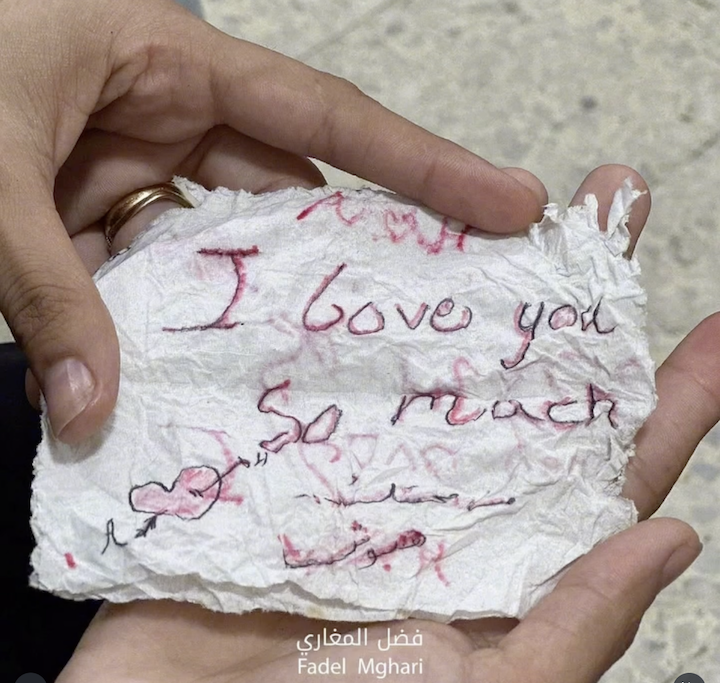
And so, instead, I’ve been trying to tell her that the reason to care about one another has nothing to do with how you will be rewarded for it. That it is something intrinsic; that we do it because we have an obligation to one another. And that you need to hold on to that. And it’s a very difficult conversation to have. I know deep down that if she actually listens to me, her life is going to be more difficult than it otherwise will be. And I hate that I live in a world like that. But I don’t know any other way to change it.
TM: Yeah, I feel this deeply. And while this is nothing new, we’ve been seeing it so acutely in the last two years: how our current world strips children of all of that softness, all the inherent generosity and tenderness they have. We see this deprivation in their skeletal bodies, of course, well documented and circulated. How do we heal and repair the tenderness we’ve stolen from our children, from ourselves, from generations to come? I guess, for now, I keep writing. Which, I suppose, leads me to my last question…
I’ve been returning to this bit by Moroccan poet and journalist Abdellatif Laâbi, from “Writing and the New World Disorder” (1995):
Does not your writing resemble that simple and unostentatious gesture?
So write, for as long as you have the strength. What leaves your fingers will not feed the hungry, nor give life back to a child fooled by a bomb that he took for a toy, nor convert the predators of this world to virtue. Your writing will not repair the planet, nor reduce inequality, not put a halt to wars or to ethnic, moral, and cultural cleansing. But you can be sure of one thing: it will never be a lie piled on other lies, a spark of hate feeding the firestorm of hate, a sprinkle of intolerance spicing up the chill smorgasbord of intolerance, or a speculator’s share placed in the stock market of corruption.
If you write, it is to honor the pact made with yourself as soon as you became fully conscious. The greatest failure would be to lose face some day—your human face. And in the end, why in the world ask yourself all these questions, why torture yourself with all this accounting? For you writing is a sort of prayer begging life to keep visiting you. So if you write it is because you are still alive. Who could hold that against you?14
And I’ve been thinking about this so much, because people love to say that a poem or an essay does nothing. That they do not stop the bombs from being made. But thinking about his writing, here, up against what you’ve written this year—what does the act or the actual process of writing mean to you?
OEA: It’s the only thing I know how to do. And more of my self-worth is tied to it than is healthy. But those are relatively minor points, I think. I say I specialize in stone-cold bummers. My books are super depressing. And yet I always tend to think of my writing as being inherently hopeful, because the act itself necessitates hope. Every atrocity that I’ve witnessed in my lifetime has depended, almost in an existential sense, on the external enforcement of silence. Massacres don’t need cheerleaders, nearly as much as they need people who are willing to look away.
And so, I can tell you that this book has in fact changed people’s opinions on the issues it discusses—people reach out and tell me so. And I can also tell you that I don’t think that really matters. Both because I’m not selling millions of copies… nobody knows who I am, nobody cares. But also because, if you make that the axis along which you operate, then you are playing by the rules of the very same system responsible for these atrocities in the first place. I definitely don’t want to think about my writing in terms of the quantitative, in terms of output—I’ve changed six people’s minds today. I don’t want to be that person.
We write, I think, in opposition to the external enforcement of silence.
Because fundamentally, the things that make me angriest, the things that send me to write in the first place, are not so subtle and nuanced and secretly virtuous that I have to mount a counterargument against them. Their central armor is not rhetorical. Their central armor is silence. And so when I sit down to write, it’s to pierce that silence. Whatever happens afterwards is completely outside of my control. And if I thought for a second that there was some sort of quantitative metric of change that I was responsible for as a writer, I’d stop writing tomorrow. I do this because otherwise, my relationship with my own soul falls apart. And I do it because otherwise, I am engaged in that enforcement of silence. Which makes me complicit in this atrocity, even more than I already am. And I don’t think I could handle that, as a human being.
-
Omar El Akkad, One Day, Everyone Will Have Always Been Against This (New York: Alfred A. Knopf, 2025), 24–25. ↩
-
Sina Rahmani, host, The East Is a Podcast, “Tankie Group Therapy #27: Predict What You Want, the Precondition Is Liberation,” November 24, 2024, link. ↩
-
Hala Alyan, “Bearing Witness,” The Meteor, December 12, 2023, link. ↩
-
Layli Long Soldier, Whereas (Minneapolis: Graywolf Press, 2017). ↩
-
“The Killing of Hind Rajab,” June 21, 2024, Forensic Architecture, link. ↩
-
El Akkad, One Day Everyone Will Have Always Been Against This, 71. ↩
-
See, for example, Noor Hindi (https://noorhindi.com/poetry-essays/); Lena Khalaf Tuffaha, Something About Living (Akron: University of Akron Press, 2024); and Adania Shibli, Minor Detail (London: Fitzcarraldo Editions, 2020). ↩
-
Taylor Miller, “A Cautionary Statement Regarding Forward-Looking Statements,” Weird Economies, September 24, 2024, link. ↩
-
“An Open Letter to the Portland Book Festival,” Lit Hub, July 29, 2025, link. ↩
-
“Negative resistance—refusing to participate when the act of participation falls below one’s moral threshold—matters… every derailment of normalcy matters when what’s becoming normal is a genocide… every small act of resistance trains the muscle used to do it, in much the same way that turning one’s eyes from the horror strengthens that particular muscle, readies it to ignore even greater horror to come.” From El Akkad, One Day, Everyone Will Have Always Been Against This, 166. ↩
-
See Hala Alyan, I’ll Tell You When I’m Home (New York: Avid Reader Press, 2025). ↩
-
“One Day, Everyone Will Have Always Been Against This, with Omar El Akkad,” February 11, 2025, The Conduit, link. ↩
-
Abdellatif Laâbi, In Praise of Defeat: Poems Selected by the Author, translated by Donald Nicholson-Smith (Brooklyn: Archipelago Books, 2016), 824. ↩
Omar el Akkad is the author of One Day, Everyone Will Have Always Been Against This (Alfred A. Knopf, 2025).
Taylor Miller is an editor-at-large for The Avery Review.