
A series of conversations with family members. Conversation methods include face-to-face interviews, WhatsApp texts, and phone calls. Edited for length and clarity.
Family members:
Abbu (اَبُّو) – Father
Ammi (امّی) – Mother
Obaid (عُبيد) – Brother
Hera (حرأ) – Sister
Najah (نجاح) – Twin sister
A Deposition
A cool entry foyer. A freshly ironed uniform, the school logo branded against my chest. A brief illusion of composure.
...The smell of the house would hit you, like this is what other people smell when they come over. It wasn’t a bad smell but a realization that this is what others experience. —Obaid (عُبيد)
The front door opens, and Bahrain’s air is waiting. Thick, heavy, inevitable. By the front gate, the starch of my uniform has surrendered to the humidity. By the time I reach the bus, so have I. Exasperation at the broken air-conditioning. I look out the window. The yellow and beige landscape is holding its breath amid the dryness. Pops of subtle greens from desert shrubs and palm trees. Shiny cars catch the sun and throw it back without apology, blinding.
I remember our station wagon. My Ammi (امّی) recently shared that those drives were when we’d talk together as a family—about our days, about what we’d learned in school. Four kids folded into the back. Seatbelts not mandatory.
...You would come up to the native villages, but we would always turn. So, remember Midway Supermarket? Right after that you would keep going down and we would always take a right turn. We never continued straight. —Obaid (عُبيد)
The route wasn’t arbitrary. I would watch my Abbu (اَبُّو) drive, melodic clicks of the turn signal. The decisions made at intersections were his to navigate, and I’d paint the movements into a scribbled mental map.
...Back then we didn’t dream much. [laughs] Because I was young, I knew after I got married, I wanted to stay in Karachi… because I thought, “How could I leave everyone?” —Ammi (امّی) (shared in Urdu)
Summer vacations to Karachi throughout the 1990s, the only time the world seemed to expand into my Ammi’s (امّی) side of the family. Rickshaws darting through the noise of busy streets. Families of six forming impossible human towers atop rusted motorcycles, stumbling along unpaved roads. Our car would stop, and young children would come. Small, appearing from nowhere. Their fingers find the glass, tapping it gently. Torn chappals, kurta shalwars covered in dust, eyes begging for something I didn’t yet have the language to interpret. My upbringing had no framework for this, for families and children living like this.
...When people would ask where we were from and be shocked that we spoke English so well. I always thought that was so weird. —Najah (نجاح)
There were mornings when none of that applied. In Bahrain, weekends fell on Thursdays and Fridays, and I’d sink into the couch with the Cartoon Network. A state of pure, unthinking presence.
The last name is Fakhruddin. F as in Frank - A - K - H - R as in Romeo - U - D as in David, D as in David - I - N as in Nancy. My first name is Isra. Sure, like Israel, but without the “-el.” No, it’s an Arabic name. No, I’m from Pakistan.
I’ve spelled myself out more times than I can count.
Nourishment at Depths We Cannot See
...What made me uncomfortable about them, in their military uniforms, was how they walked around like they owned the place. —Hera (حرأ)
I used to think they were large amusement structures, planted without explanation in the middle of the desert. One was painted a bright yellow, spotted with black dots, large doe eyes fixed on either side of its head. A giraffe, bowing slowly, graciously, endlessly, toward the earth.
Time passed, borders crossed, memories settled. As I aged, I understood—oil. The entire landscape, from Bahrain across the Gulf States, was a trillion-dollar portfolio that sat in the margins of my upbringing. A resource that quietly organized everything around us: schools, roadways, the residential compounds1 like our Hamala house that sat upon a pipeline.
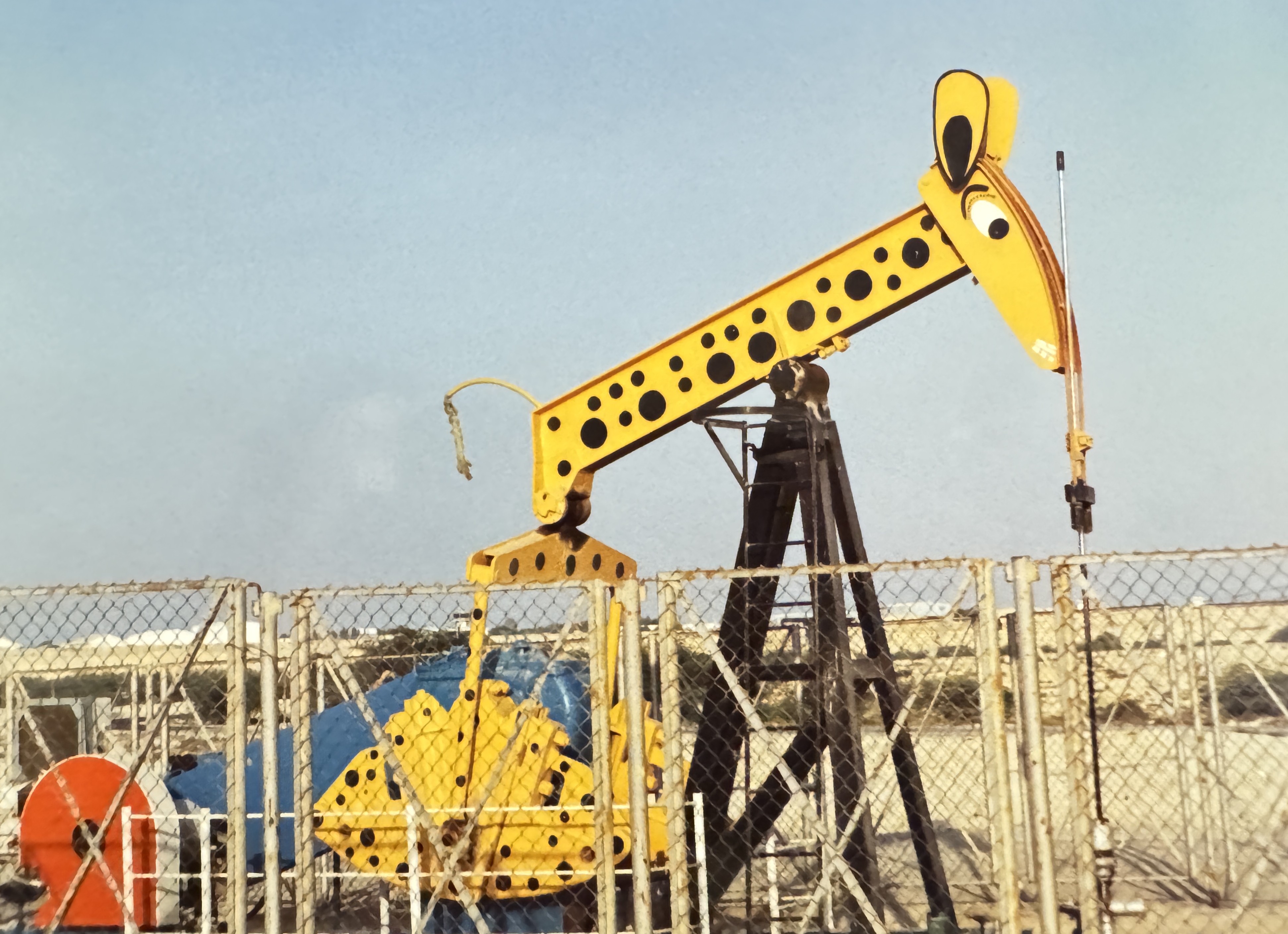
As children, we were unaware of this. All we knew was the sun, the community swimming pool, and our school’s Sports Day events. Our skin darkened from long days outside. The way we’d line up together with our family friends in front of these massive nodding donkey rigs, our adolescent limbs swaying, we’d squint and smile. The giraffe would bow behind us, several feet behind a fenced gate. Quiet and enormous, nodding up and down.
Synaptic pruning is the developmental process by which the brain eliminates weak or unused neural connections, refining itself by extracting and optimizing the patterns most relevant to the individual. There is plenty that is relevant to me, and yet my attempts to chronologically recall my past often wind up strained. Friedrich Nietzsche revered active forgetting as a crucial, healing force,2 but I didn’t volunteer to actively forget; it was more of a subjection. So, you can imagine the irony of telling my colleagues today that what drives my work is rooted in the memory of place.
I would later sit in graduate school and learn that memory is also a design problem—that the built environment encodes what a culture chooses to preserve and what it permits to decay. We studied the monuments, landmarks, and canonical landscapes of Europe. What we did not study was the environment I was a product of. The Gulf existed within, but not in the curriculum.
As a Third Culture kid, I’ve not had the luxury of a fixed sense of home; I’ve built belonging from memory, those intangible moments layered across places and time zones. My brain is a patchwork of multiple countries, cultures, politics, and traditions. The first twelve years of my life were spent in Bahrain. My roots are in Pakistan. It’ll be a quarter of a century this July (2026) since I moved to the United States. Throughout my thirty-seven years on Earth, I’ve lived in two countries, three US states, and sixteen different houses and apartments. I currently reside in my seventeenth. My family can attest to similar patterns of movement. My Abbu (اَبُّو), for instance, lived his first fourteen years in Dhaka, Bangladesh. Eight years in Pakistan. Twenty-two years in the Gulf. A quarter of a century in the United States.
I’m a citizen of everywhere and a citizen of nowhere.
کچھ کھا کے جانا / “Kuch kha ke jana”
A phrase reliant on time, which proudly resists any opportunity for depletion. For my Ammi (امّی), this phrase, which humbly translates to “have food before you go,” extended beyond physical sustenance. It became a core substructure through which she understood holistic well-being, culture passing, and bonding. Each bite is met with heart, with a love that is so clearly visible in her preparation, her labor, and execution. While my siblings and I adapted to silverware, I watched Ammi (امّی) unapologetically eat with her hands like a quiet dance, artfully sweeping the plate with honor and care. I can’t recall if I ever attempted to eat chicken saalan and rice with my hands, but if I did, I surrendered back to the easiness (and yearning of Western acceptance) of a spoon.
That surrender—for the spoon, for a grasp of a memory. A cartographic interrogation of a phrase of nourishment; its contours flow beyond a singular site or gesture. In recent years, I’ve dissected the notion of nourishment. Beyond cooking and ingesting, the term insinuates growth, safety, and repair. It replenishes, sustains, and conditions. When I analyze nourishment, I’m swept up by the emotional hospitality of my Ammi (امّی), and the intellectual embrace of my Abbu (اَبُّو). From early childhood, I’ve perceived it as a primary mode of communication—both ritual and rhythm. An anchor that establishes a sense of place despite a physical location no longer existing. An act of preservation, of holding identity intact across generations. An act of critical consciousness, cultivated over time.
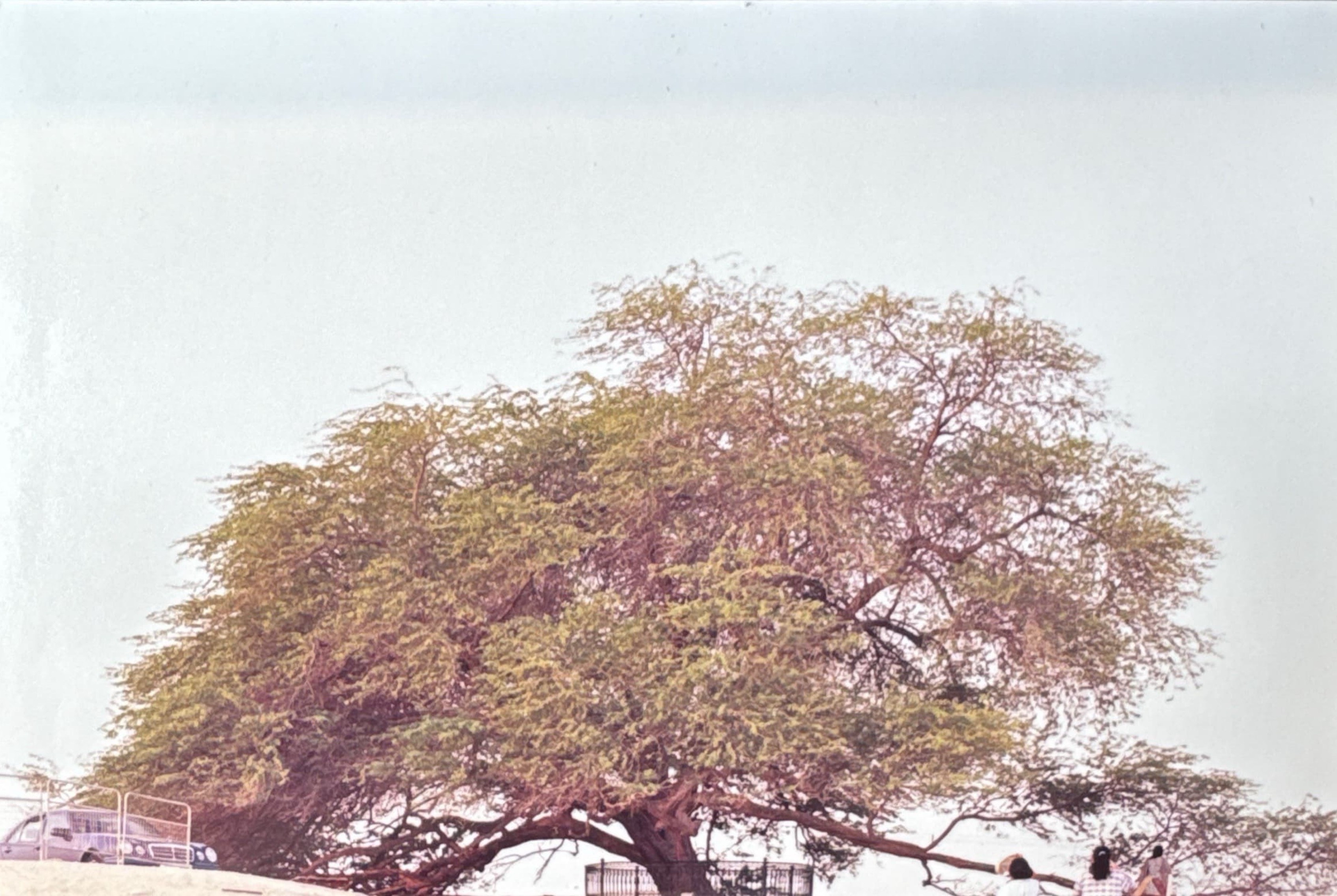
In Bahrain, there is a large Prosopis cineraria, also known as ghaf. It’s called Shajarat-al-Hayat (Tree of Life) and stands over 32 feet high. A dendrochronology analysis conducted in 1986 indicated that the tree was planted circa 1583.3
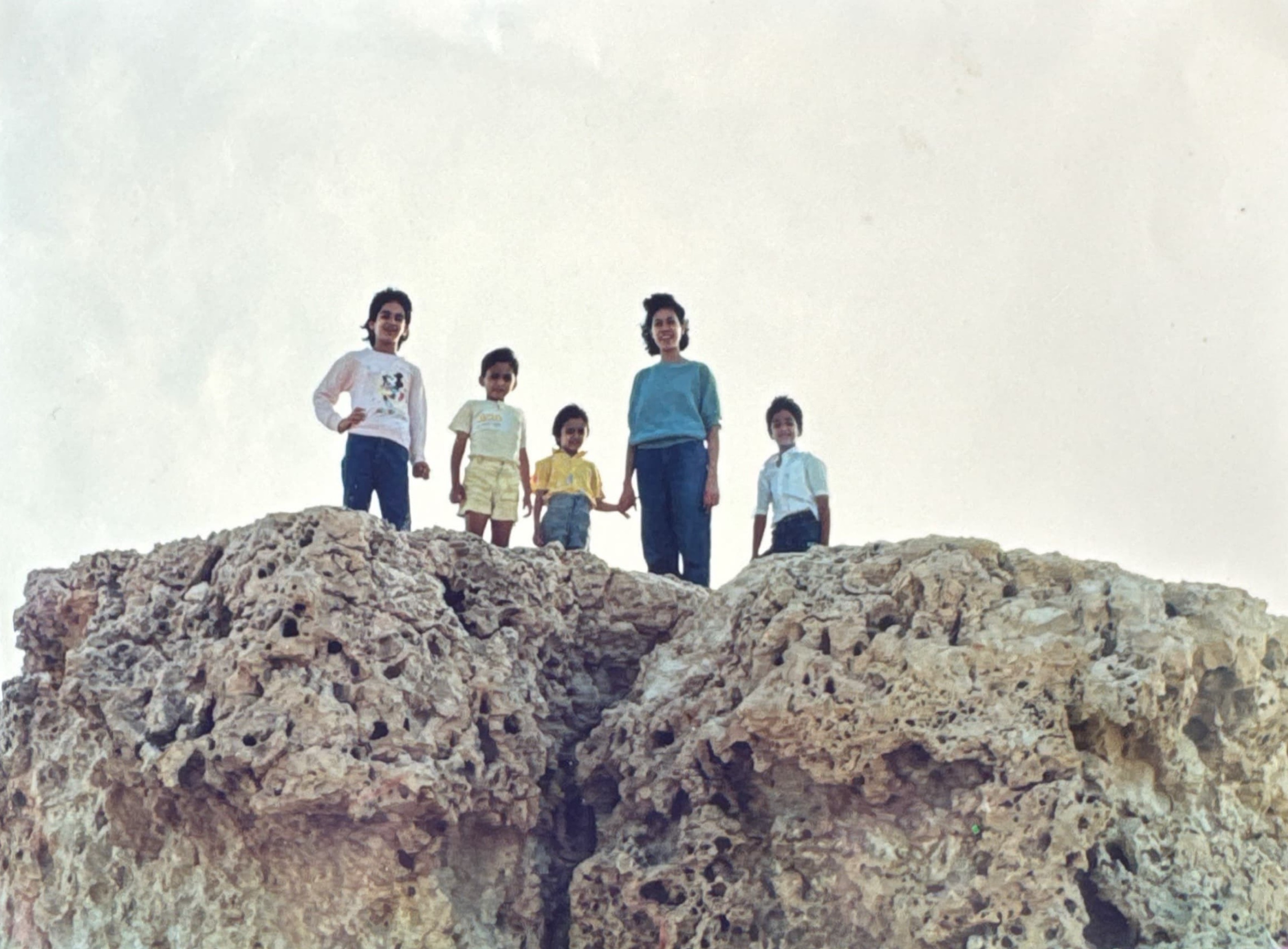
Shajarat-al-Hayat sits alone atop a sandy hill, neighbored only by scattered groupings of stubby bushes. A natural wonder, having survived harsh conditions for centuries with minimal rainfall and no nearby water sources. I have hazy memories of climbing the large porous rock formations nearby, a landscape typical of the island nation’s geology. At the time, without the vocabulary for what it made me feel, I simply marveled. Throughout the years, however, I’ve felt something beneath: a quiet recognition of survival that does not announce itself. That a tree’s roots can find its needs, even within the most inhospitable conditions. Shajarat-al-Hayat persists despite its conditions, drawing nourishment from a depth we cannot see.
This essay is an attempt to map the geography of Kuch kha ke jana (کچھ کھا کے جانا)—to follow nourishment as it moves through contradiction while shaping my upbringing: through kitchens, classrooms, and familial blueprints never built. It’s also an attempt to reckon with everything that has tried to undo it, because to examine nourishment is to confront its antagonist—the very architecture of the world my family has been asked to navigate and tolerate. Understanding what nourishes is to inevitably reckon with its opposite—that which harms, maims, dispossesses, extracts.
The Blueprint
My Abbu (اَبُّو) cannot tell a story without anchoring it first with a date, time, and place. I seem to have inherited this obsessive quality. My compulsion to chronologically sequence the past, despite my aforementioned inability to accurately do so, is why these pages exist at all—an earnest attempt at a record.4
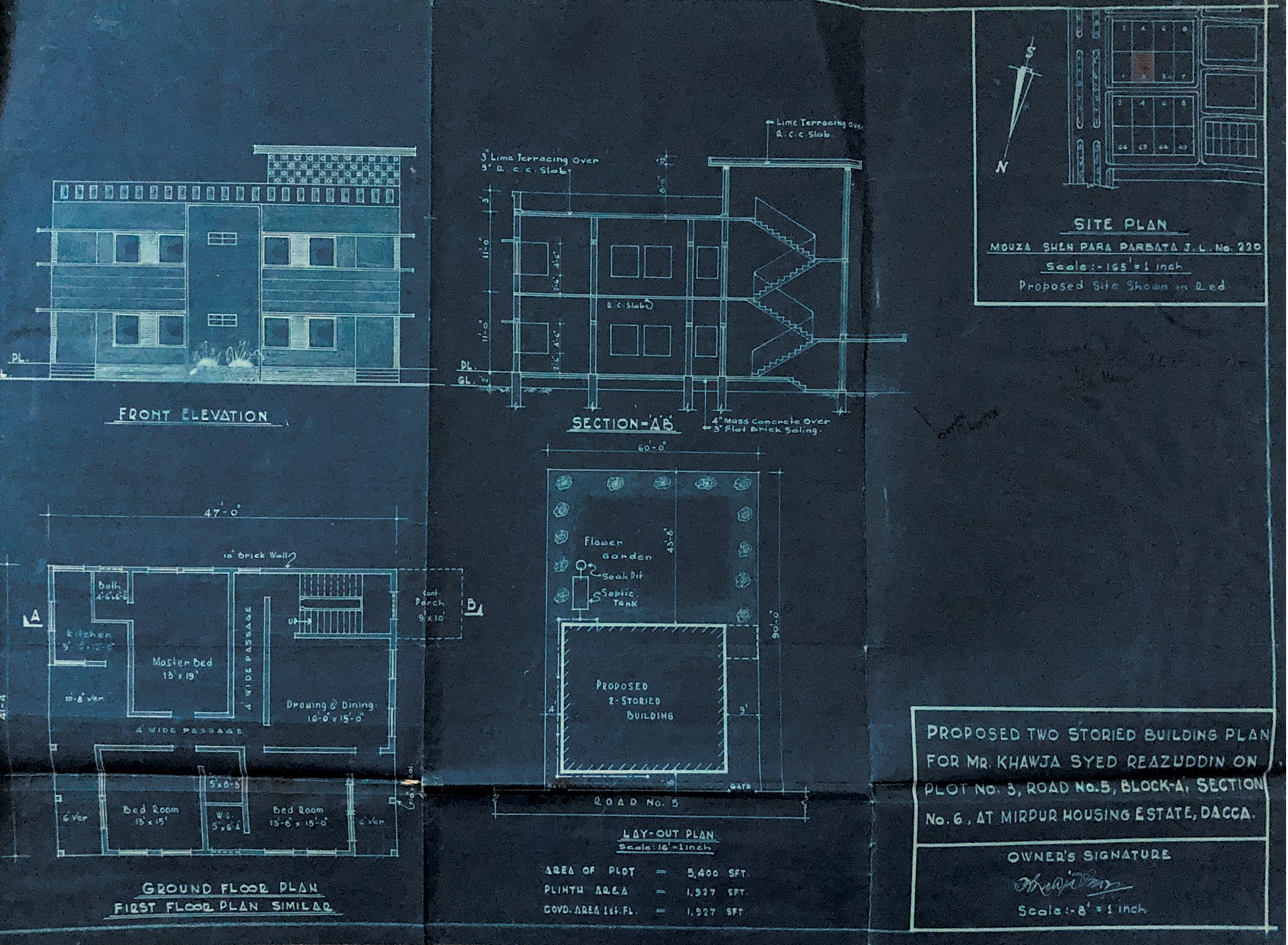
When my Abbu (اَبُّو) and his family fled Bangladesh (formerly East Pakistan) for West Pakistan, the Bangladesh Liberation War of 1971 had commenced only a month prior. Fifty-five days before the war, my Dada Abbu (دادا ابو) had begun building a two-story home for my grandmother, Dadda (ددّا), and their eleven children. The blueprint was found decades later, and is what I would describe as a document of intention: a house imagined before it existed. I would spend years in institutions that had no framework for documents like this one—that could theorize the monument but not the house that never got built, or the family that fled before the foundation was set. This blueprint was a counter to extraction, a record that survived displacement, migration, the pruning of a memory. My Dada Abbu (دادا ابو) had intended to establish the home as a site of emotional, physical, and familial enrichment. They were an expanding family, and this was a home to hold continued nourishment, a life that embraced continuity over rupture.
My Abbu (اَبُّو) was born and raised in Dhaka5 for fourteen years prior to fleeing in haste. As the eldest son, he was positioned to support the family through the agony of escape. I’m told these were the darkest days of their lives—my father’s youngest brother was only five days old. I’m ashamed to admit how little I’d known of this wretched period in Pakistan’s history. For one’s own homeland to be responsible for the ethnic cleansing of Bengalis,6 these perpetrators never facing international criminal trials. Operation Searchlight crushed Bengali resistance.7 The international community attempted to conceal the intensity of the operations by barring communication and deporting foreign journalists.8 There’s an irrefutable connection between the barbarity of the Bangladesh Liberation War of 1971 and the ongoing geno-/eco-/urbi-/scholasti-/-cide of Palestinians since the Nakba.
I was two years old when we were sent to Karachi while my Abbu (اَبُّو) remained in Bahrain during the 1990 Gulf War. The United States and a 41-country coalition launched Operation Desert Shield against Iraq following its invasion of Kuwait.9 Soon after, Operation Desert Storm, a bombing campaign (January 17 to February 28, 1991) ahead of Kuwait’s liberation. What the public record conveys is a war of stated objectives and legitimacy. (Since de-) classified records show something else: a map of manufactured civilian vulnerabilities. Defense Intelligence Agency documents10 detail the destruction of Iraq’s water treatment capabilities to induce an epidemic among civilians, knowing the country was starved for alternatives. The war that felt, from Bahrain, as defensive necessity proved catastrophic for millions deemed expendable—collateral damage—by imperial plunderers.11
...There was a huge problem for the banking sector. People began withdrawing their money to transfer to safer places like London or Switzerland. As a treasury manager, I found this to be a challenge because my job was to reassure our clients that since we were a foreign bank, their money was safe. The US gave us an increased sense of protection. We felt as though nothing could happen but simultaneously held fear speculating their absence. I sent my family to Pakistan while I stayed in Bahrain, alone, with my canned food supply, gas mask, and chemical warfare suit. That was scary. That was the first time I noticed just how many foreign soldiers were on Bahrain soil. It was then that we began hearing of Juffair12 that was recently bombed by Iran. There was a contradicting sense of security and fear, a good and bad.”—Abbu (اَبُّو)
A contradiction: Security and Fear. This inhabited us simultaneously. My parents recount this period, describing the US as an emblem of safety and security. They recall the military and economic presence so substantial; its absence felt unimaginable.
My perception was very good of the Americans because the Indian subcontinent was ruled for 200 years by the British. And we gained independence from them, not the Americans. We always thought they were the heroes. —Abbu (اَبُّو)
Our protection became contingent on appearing American. My siblings and I absorbed this through movies, fashion, and music. Long before I arrived in the US, I was already emulating its sounds. In Bahrain, I was layering an American accent over the British one I inherited.
“I remember Abbu faxed a photo of himself with a gas mask on.”—Obaid (عُبيد)
My Abbu (اَبُّو) interjects:
We had full suits with all different kinds of injections in case of a gas attack.
We’re laughing as my family reflects on this moment. When I ask whether the suits were distributed equally, my Abbu (اَبُّو) responds with a “no!”—as if that was absurd.
I was so lucky, I got mine from the Dutch embassy because I worked for a Dutch bank. They were so nice and gave the employees suits. I had a Pakistani passport and hoped my embassy would help, but it had shut down, and everyone fled! —Abbu (اَبُّو)
The laughter continues. I look at my Ammi (امّی) and recognize the expression that she is no longer there with us, but back in 1991 on the other end of the phone line, listening to my Abbu (اَبُّو) describe the gas mask and the abandonment by their own embassy. We’re sitting together, in person and via Google Meet, decades removed, laughing. A nourishment like no other. I ask if we still had the photo of my father in the gas mask. My Abbu (اَبُّو) looks to Obaid (عُبيد), who is on my laptop screen, assuming he has it.
I don’t have it. I wish I did. —Obaid (عُبيد)
My Abbu (اَبُّو) continues describing his supply of canned foods, the five-gallon Aqua Cool bottles lined up in his bedroom. Supplies duplicated in his car. A transistor radio.
Obaid (عُبيد) was eight or nine years old when he received the faxed photo:
I was just like, this is so cool. My dad is wearing a gas mask. I didn’t understand the implications… I didn’t understand the danger of a gas attack. I wanted one. —Obaid (عُبيد)
Another round of laughter (nourishment).
...It was a fax of a picture, so we’re talking very low quality, and it was him standing in his office. —Obaid (عُبيد)
My Abbu (اَبُّو) remained alone for months after sending us to Pakistan. During that time, he recalled a clear hierarchy among expatriates, meaning not all foreigners were treated the same. Western expatriates were known to receive better compensation and benefits than my Abbu (اَبُّو) did, despite equivalent seniority. The embassy of Pakistan, the country whose passport he carried, was shuttered and its staff fled. A Dutch bank, the same institution that denied him equal benefits as his Dutch colleagues, did not. The institution that extracted from my Abbu (اَبُّو) also claimed him.
Despite the long-term geopolitical challenges that followed the Gulf War, the US emerged triumphant—further entrenching its hegemony in the region and fundamentally shifting its presence throughout the Gulf States from temporary deployments to a network of permanent bases.13 In July 2001, my family left Bahrain for Illinois. I was a tween when the US manufactured consent to invade Iraq and carpet-bombed millions under the guise of “liberation.” The empire remaking the region; ceaseless theft and poisoning of land and life through the present day. Extraction, I was beginning to understand, had a geography.
The Inability to Register Danger as Danger
I asked everyone their perspective of witnessing the US military presence during our time in Bahrain:
I remember a classmate talking about how his dad was in the military and he was in Bahrain because of it. I wasn’t putting 2+2 together, it was more of just, they’re here to protect us. We were kids. We were told they serve and protect. —Najah (نجاح)
My earliest memory was at Seef Mall. I was with a friend who was dating one of them. I recall being nervous—not because they were military but because they were boys. [laughs] I didn’t think about their positions or why we had a base in Bahrain. I think I was maybe thirteen? What made me uncomfortable was how they walked around like they owned the place checking out girls. We were so young. —Hera (حرأ)
We would see them in full uniform—at the mall, sometimes stationed along the roads. I never felt uncomfortable or threatened; it felt safe. –Ammi (امّی) (shared in Urdu)
I felt indifferent. When I got older you would hear stories of kids going to clubs. These soldiers, who were eighteen or twenty years old, would go to these clubs where fifteen–sixteen-year-olds would be, and they would intermingle. Clubs were built specifically for their presence. It was like an inert entity that just existed, and as long as business ran as normal, things were fine. —Obaid (عُبيد)
My perception was very good of Americans, so the possibility of moving to the US always brought a good feeling: my kids would get a good education, live good lives. I used to think America had an egalitarian society: poor or rich, they all mingled. A poor man’s kid will go to the same public school as a rich man’s kid, that sort of thing. Not like in Bahrain, where very affluent people could send their kids to British or American schools. Those were the things I had in my head. —Abbu (اَبُّو)
Another contradiction: The Inability to Register Danger as Danger. In these margins of catastrophe, we remained protected and nourished. But this relative safety hinged on a totalizing occupation we hadn’t yet wholly understood. The US’s insatiable appetite for oil—and the violence required to secure it—made Bahrain legible to global markets and further fixed the region in subservience to American empire.
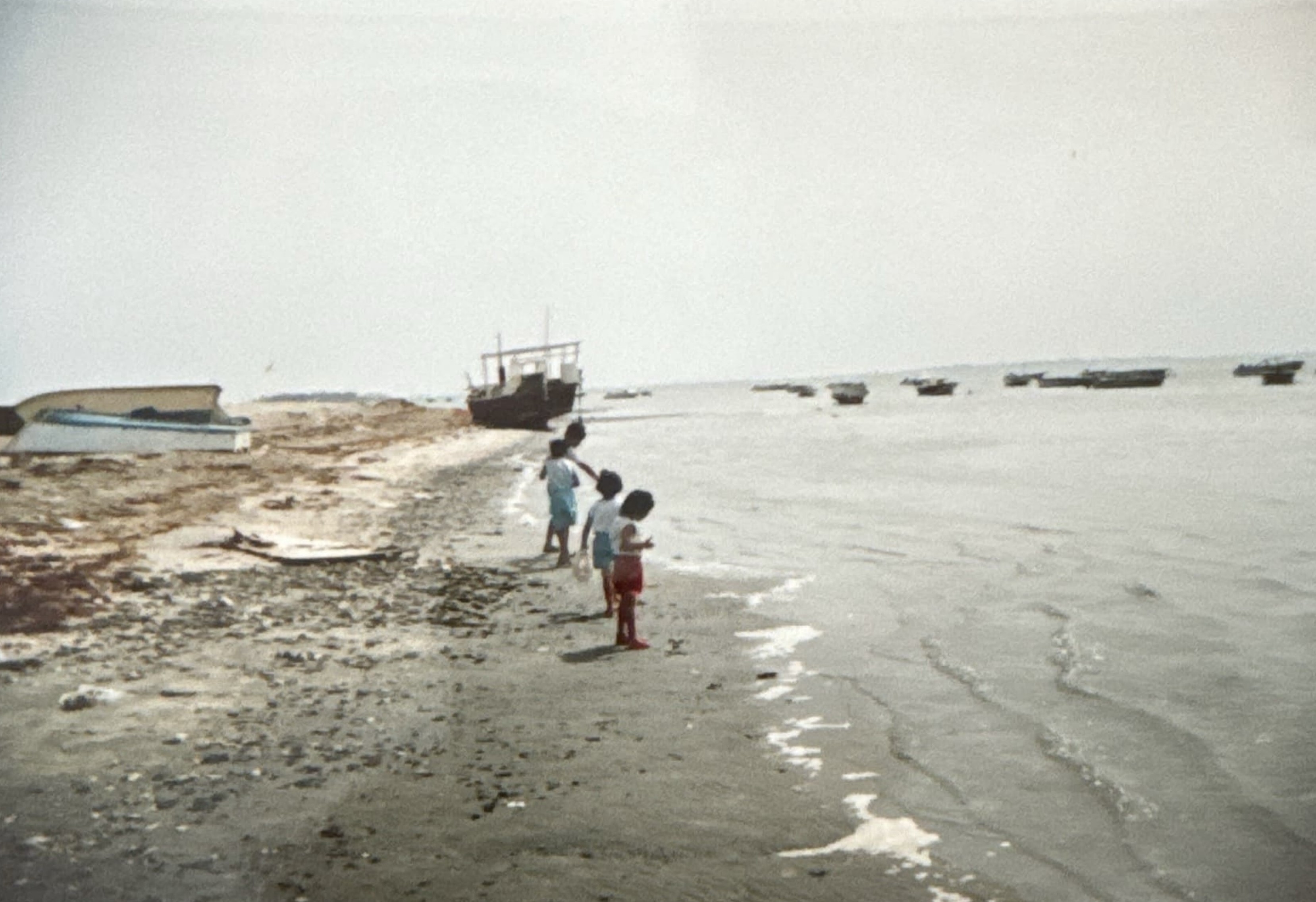
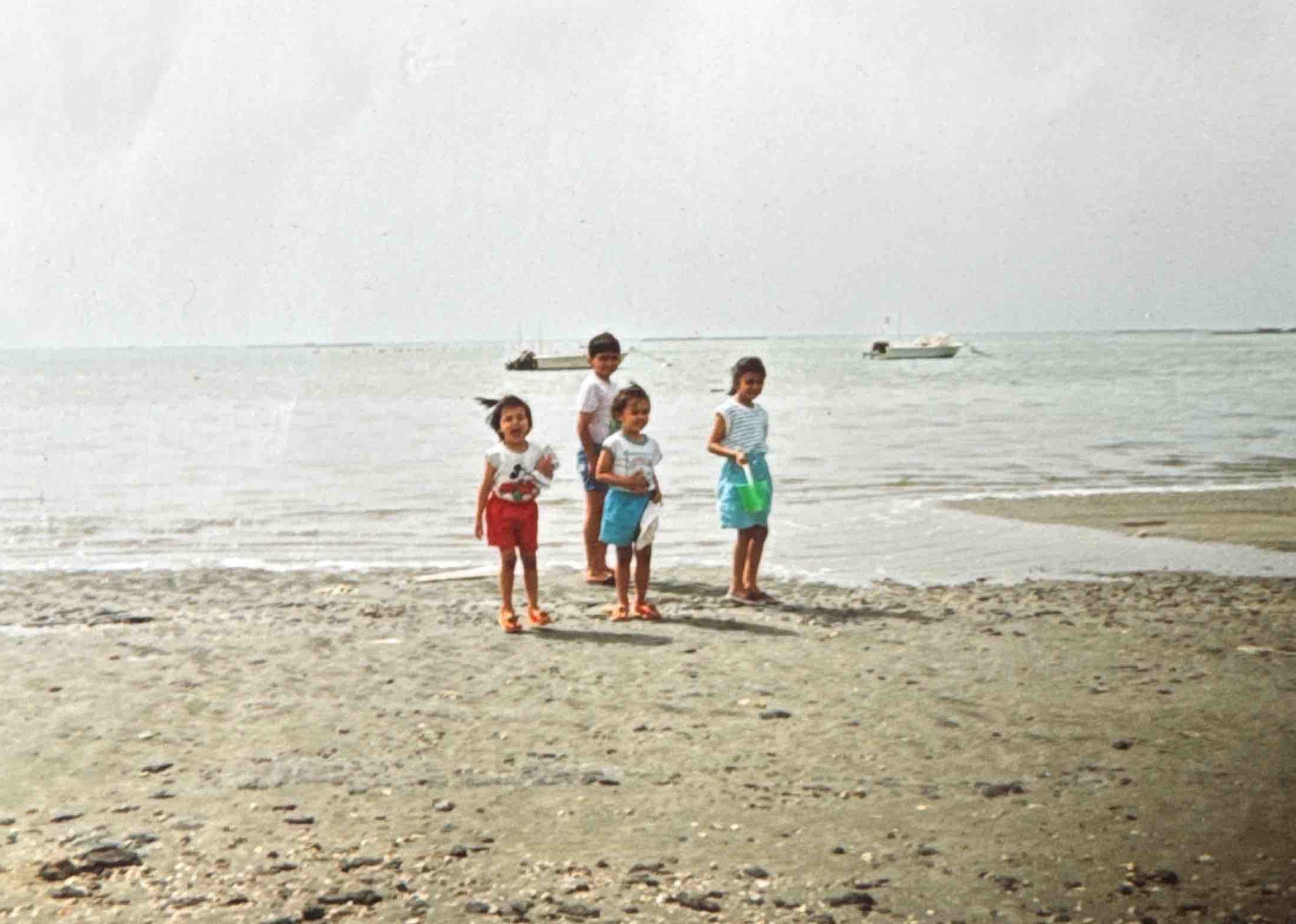
We would visit the beaches regularly in Bahrain. The water felt enormous, surrounding and defining everything. We took trips with family and friends on boats called dhows,14 the Gulf stretching in every direction. I’d cup my small hands and collect salty seawater.
When we would go to the beach, I remember finding congealed oil and I would play with it because I didn’t know what it was. It was mixed with sand, so it had this gritty texture. I would sit there and break it apart and look at it. I thought it was some part of the beach. Only when I got older, I realized it was oil, from either some slick or a leak. —Obaid (عُبيد)
Amid laughter, my Abbu (اَبُّو) and my brother together remembered:
During the Gulf War, tankers were destroyed and that was bad for marine life, so CNN would show this one duck soaked in crude oil to gain sympathy and highlight how bad things were in the Middle East. All the while, they were killing thousands of people in Iraq. —Abbu (اَبُّو)
These absurd, grotesque contradictions make my family laugh. A single oil-soaked duck works to moralize the war while obscuring the mass killing of civilians. It’s a familiar logic where spectacle eclipses scale; the invocation of selective sympathy erasing, justifying massacres. For “defense.” For profit. This same logic, live streamed from Gaza and the West Bank, where sanitized narratives and handpicked outrage continue to mediate the scope of devastation, of the ongoing Nakba.
I asked my family what “home” meant for them in relation to Bahrain, and what emerged was a casual seminar in the architecture of security and segregation:
The first house I envision is Palm Villas. That dance floor—how random it was to have that be part of the living room. I remember us using the wood surface for imagination play, and the conversations I would hear. I remember Ammi cooking in the kitchen while chatting on the landline. —Hera (حرأ)
Definitely Hisham Park, when it comes to which compound I remember most. It was the best from a community perspective; playing in the garden, at the clubhouse with friends. Walking around on the walls to get around—that was a big one. We thought it was cool to be able to walk on the walls that divided each house. I look back at that now from a personal property aspect—can you imagine doing that in the US? —Obaid (عُبيد)
I processed walls with privacy. They seemed so tall, and it didn’t feel as open as you see it here in the US. Being able to see into each other’s backyards was different because we didn’t see that in Bahrain. I’d feel more comfortable having more privacy here, which isn’t widely offered. —Najah (نجاح)
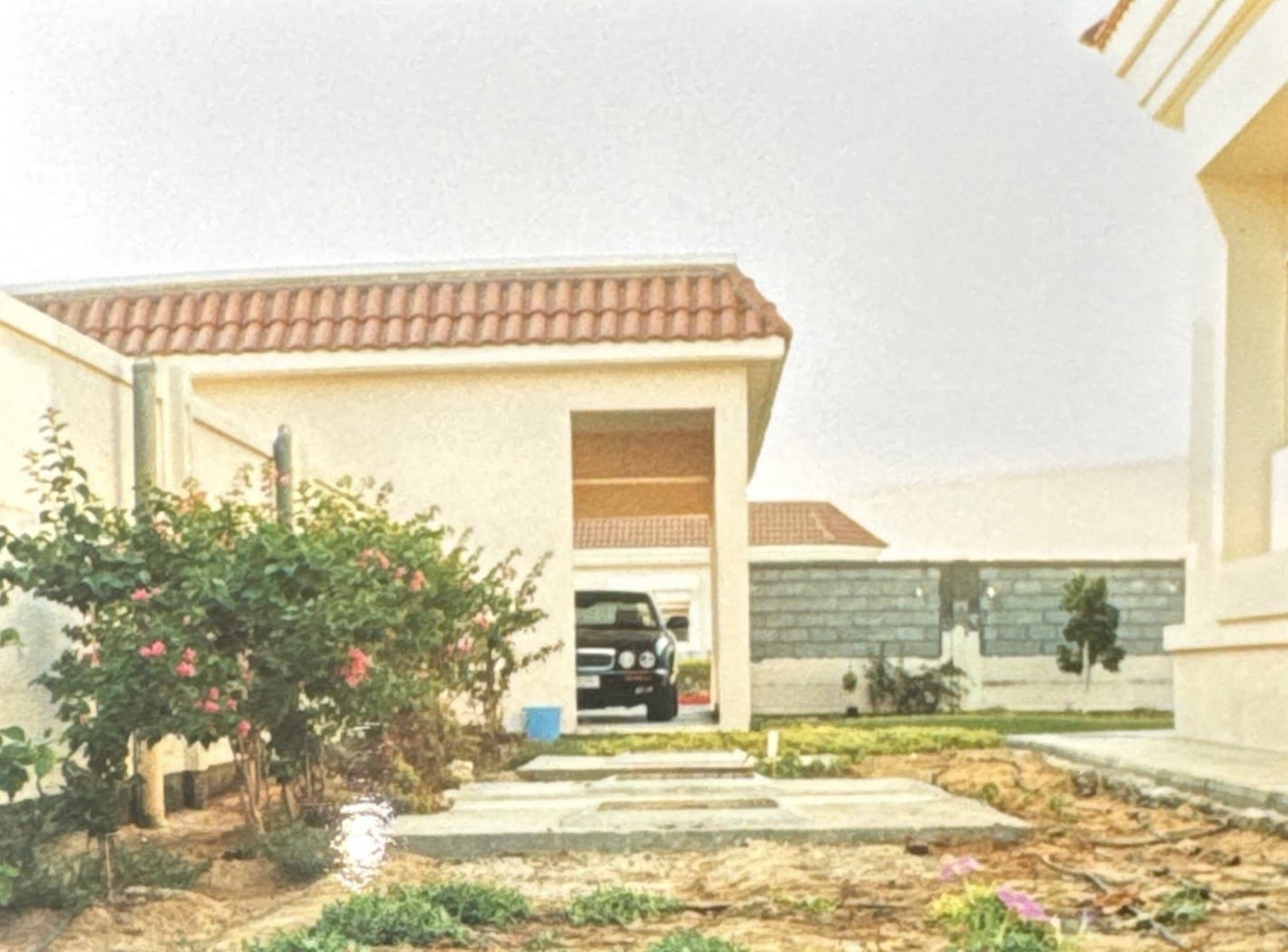
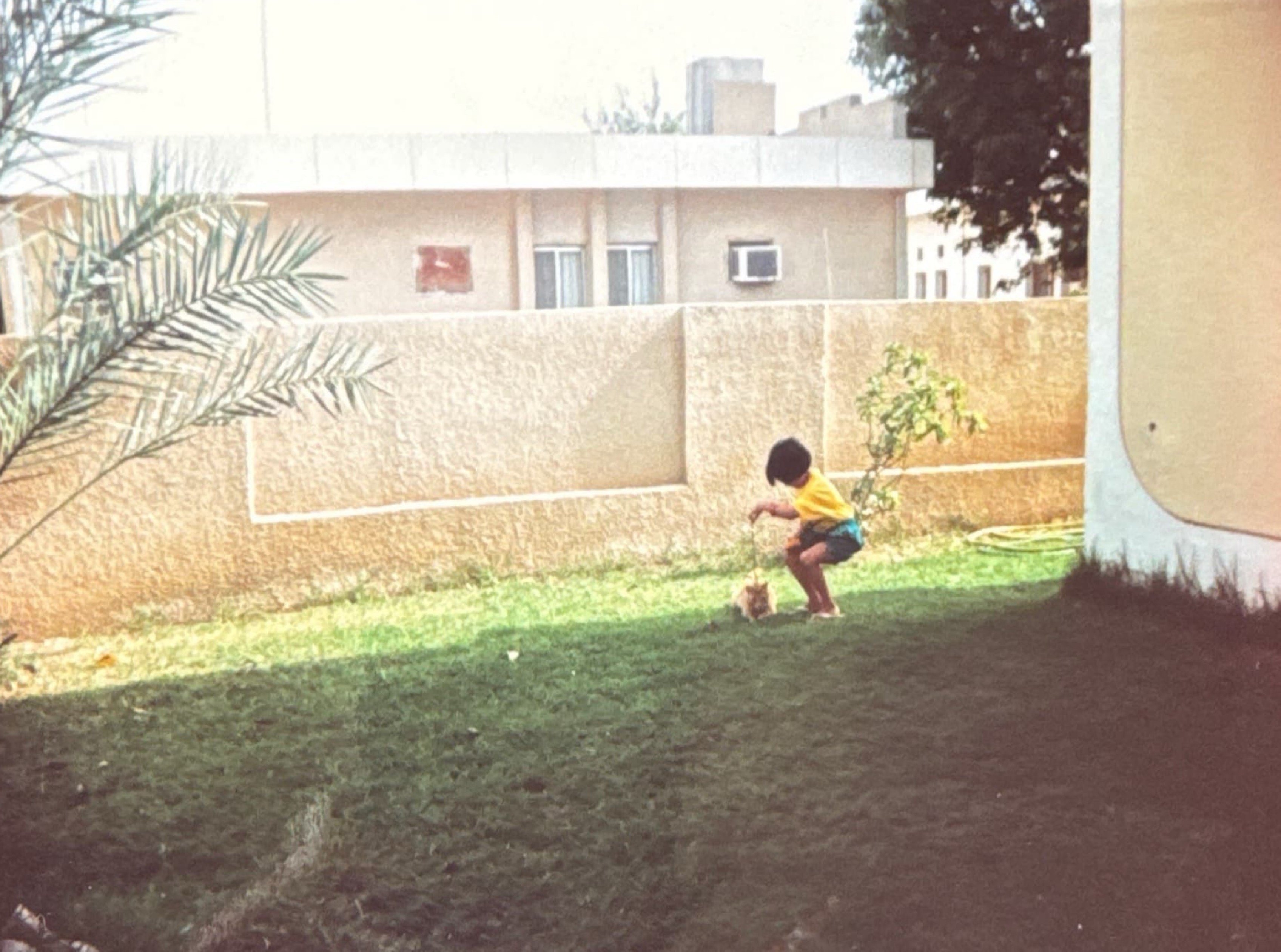
When you think of a compound, the immediate response is a military compound or private property. Whereas in Bahrain, that was considered normal, until you realize that it was to keep you detached from the native populations and villages. They were kept in the background. —Obaid (عُبيد)
Obaid (عُبيد) looks back now and reads the walls of compounds differently: as property lines, instruments of separation, the physical grammar of a system designed to keep populations within their designated areas. Najah (نجاح) processed walls as privacy; a quality of enclosure that the American neighborhood hasn’t been able to replicate. Hera’s (حرأ) memory bypasses the walls entirely and focuses on the interior; the warmth of a house that nourishes those within it.
The compound was never just a home but a spatial investigation about who belongs. And yet, within that investigation, a family makes a life—nourishment that persists despite what looms externally. I assumed those contradictions were what an architectural education could examine. The imperial contradictions embedded within the built environment were present everywhere, but attempts to connect that environment to current world affairs—I had no language for that. Rather, the gestures were hollow—feeble at best. I would sit in classrooms carrying the residential compounds and my family’s migrations within me, but found no place to set them down to begin a conversation. The contradictions were welcome, yet only as personal background. I learned to perform the separation, and present work neatly parsed from what had formed me.
The institution prunes.
For the Uprooted
Something I’d like to be precise about is that extraction is not elsewhere. It’s in the air, in the sand, absorbed into the skin of children who pick apart congealed oil on a Bahraini beach and believe it belongs there. It’s in the height of a compound wall, in the tiered benefits of an expatriate hierarchy, in the embassy that shutters and flees. The same logic that organized Bahrain’s compounds to determine which population lived behind which wall—and which passport holders received gas masks—is the same logic that enters predicting, scaffolding, self-reproducing exploitative systems. These logics decide which form of suffering warrants an oil-slicked duck on the news, and what’s dismissed, rewritten, erased.
Obaid (عُبيد) didn’t know what the oil was, yet he sat with it anyway—breaking it apart, analyzing its texture, believing it was simply an integral part of the beach. An apt analogy for a decrepit empire: The residues of extraction will be handled with playful curiosity rather than alarm. I now know what it is. This essay is, in part, the work of knowing—of going to the beach and identifying what was in our hands.
Today, the US-Israel war on Iran lays bare where our sirens should sound. And still, ignorance abounds. Cities reduced to rubble and disorder, civil infrastructure obliterated, family lines eliminated. An entire architectural memory of a people, gone. Bahrain’s Juffair neighborhood, where the US Fifth Fleet is based, is the background for the US’s and Israel’s ongoing siege of the region. Iran’s retaliatory strike on Bahrain’s desalination plant15 signals these cycles of violence on the land and its people—they are unrelenting. Ravaged across decades of this US-led occupation and obliteration—the same bodies, waters, heaved earth. The spectacle persists, working overtime to distract: international summits, press briefings, rehearsed geopolitical performances and algorithm-generated outcry. There is an insidious logic in the world of architecture, landscape, and planning where legitimacy and intellectual nourishment are narrated aloud while extraction continues beneath the surface, behind the scenes at conferences, workshops, boardrooms—coursing in ways that uphold complicity. The empire prunes; it preserves what serves it, and annihilates what doesn’t.
And yet, Shajarat-al-Hayat grows under conditions that should not sustain it. My family is similar—across Dhaka, Karachi, Bahrain, and the US—seeking nourishment, growing and tending roots in rough soils.
کچھ کھا کے جانا / “Kuch kha ke jana”
This phrase doesn’t promise safety or return, only that whatever you face, something will have been prepared for you. To be nourished is not to be protected from the malicious. It’s to be given something extraction cannot fully reach: a root system, a depth, a way of knowing what’s in your hands and what to call it. To name the violence—what legitimates it, and the infinite ways to resist it.
-
Residential compounds in Bahrain were typically enclosed with a single perimeter wall, with additional private walls dividing each plot, with a garden and a garage as common features. ↩
-
Richard Schacht, ed., Nietzsche, Genealogy, Morality: Essays on Nietzsche’s “On the Genealogy of Morals” (University of California Press, 1994). Nietzsche describes “the active forgetfulness, which is a very sentinel and nurse of psychic order, repose, etiquette,” arguing that “there can exist no happiness, no gladness, no hope, no pride, no real present, without forgetfulness,” 62. ↩
-
Mohammed Redha Ebrahim Hasan Mearaj, “Excavation at the ‘Tree of Life’ Site,” Proceedings of the Seminar for Arabian Studies 42 (2012): 183–193. ↩
-
I feel compelled to offer this as a footnote as it relates to the architectural blueprint: Dacca Property, Bangladesh: Plot No. 3, Road No. 5, Block A, Section No. 6, Mirpur Housing Estate, Dacca Area of plot: 600 square yards, 5,400 square feet; Per the sale, the deed was dated December 19, 1970. My grandfather Dada Abbu (دادا ابو) purchased the plot of land for Rs. 15,000; January 25, 1971: A payment of Rs. 425 was made to the Dacca Water Supply and Sewage Authority to establish a water connection; February 1, 1971: Dada Abbu (دادا ابو) signed a building construction contract with M/s S. M. Hanif & Co., and construction began soon after. My maternal great-grandfather, Nana Abba (نانا ابا), would commute daily by bus to supervise the work. April 25, 1971: Four weeks after the Bangladesh Liberation War began, my father and his family became internally displaced. ↩
-
My Abbu (اَبُّو) texted me the following details, further proving his affinity for historical accuracy and to acknowledge the steps his birthplace took toward a postcolonial identity: “The official change from ‘Dacca’ to ‘Dhaka’ took place in 1982. During British colonial rule and later under Pakistan, the city’s name was commonly spelled ‘Dacca’ in English. The spelling of ‘Dhaka’ more closely reflects the Bengali pronunciation. In 1982, the government of Bangladesh formally standardized the English spelling to ‘Dhaka’ as part of a broader effort to align place names with Bengali language and identity following their independence in 1971. Since then, ‘Dhaka’ has been used in all official documents, maps, and international references.” ↩
-
Lorraine Boissoneault, “The Genocide the US Can’t Remember, But Bangladesh Can’t Forget,” Smithsonian Magazine, December 16, 2016, link. ↩
-
Anis Ahmed, “Bangladesh 1971: War Crimes, Genocide and Crimes Against Humanity Operation Searchlight: The Targets,” Kean University, 2018. Ahmed describes, “Accordingly on the night of 25 March, the Pakistani Army launched Operation Searchlight to crush Bengali resistance in which Bengali members of military services were disarmed and killed, students and the intelligentsia systematically liquidated and able-bodied Bengali males just picked up and gunned down. According to various sources three million people were killed by the Pakistani Armed Forces and their accomplices in Bangladesh.” ↩
-
General Agha Muhammad Yahya Khan, “Operation “Searchlight.” ↩
-
George H. W. Bush shared an address on September 16, 1990: “I’m here today to explain to the people of Iraq why the United States and the world community has responded the way it has to Iraq’s occupation of Kuwait. Let there be no misunderstanding: We have no quarrel with the people of Iraq. I’ve said many times, and I will repeat right now, our only object is to oppose the invasion ordered by Saddam Hussein.” American Presidency Project, link. ↩
-
Graeme MacQueen, Thomas Nagy, Joanna Santa Barbara, and Claudia Raichle, “‘Iraq Water Treatment Vulnerabilities’: A Challenge to Public Health Ethics,” Medicine, Conflict and Survival 20, no. 2 (2004): 109–119. On January 18, 1991, a declassified seven-page Defense Intelligence Agency document titled “Iraq Water Treatment Vulnerabilities” was distributed to military commanders one to two days after the aerial bombing of Operation Desert Storm began. It provided evidence of disease knowingly induced among the Iraqi population, detailing that the destruction of Iraq’s water treatment capabilities would directly cause an epidemic among civilians because the country had no domestic alternatives, no substitute chemicals, or adequate groundwater resources. The document was a map of the Iraqi population’s vulnerabilities to be exploited—bombed. ↩
-
The US has routinely targeted civilian infrastructure across Iraq, Sudan, Serbia, and Afghanistan—and most recently Iran—rarely provoking international condemnation. See Jon Schwarz, “A Short History of US Bombing of Civilian Facilities,” The Intercept, October 7, 2015, link. ↩
-
Abdul-Jabbar Ismael Ibrahim, “The American Military Presence in the Arab Gulf Region,” International Journal of Research in Social Sciences and Humanities 10, no. 2 (2020): 1–11. Ibrahim writes, “The first axis: American bases in the Gulf states. First: Bahrain. American policy concerned with establishing military bases, obtaining marine facilities in the Gulf region as a tool to secure their interests, and achieving their goals. The American military presence began at the ‘Juffair’ base in the year 1949, by obtaining facilities for their fleets in that base. The United States entered into direct negotiations with Bahrain to remain in Juffair, on the pretext of ‘filling the void’ left by the British withdrawal from the Gulf.” ↩
-
Mariel Ferragamo, “US Forces in the Middle East: Mapping the Military Presence,” Council on Foreign Relations, June 23, 2025, link. ↩
-
Traditional wooden sailing vessels in Bahrain, rooted in the nation’s maritime heritage, history of diving for pearls, and coastal trade. ↩
-
Agence France-Presse, “Bahrain Says Water Desalination Plant Damaged in Iranian Drone Attack,” Al Jazeera, March 8, 2026, link. ↩
Isra Fakhruddin is a designer, planner, and interdisciplinary creative based in Chicago, IL, with Master's degrees in Landscape Architecture and Urban & Regional Planning. Her practice is rooted in the memory of place and committed to community-led outcomes—and in the unflinching recognition that design is never apolitical, but infrastructure as power: a tool that enforces genocide, segregation, and systemic violence as readily as it builds belonging.