
Colapisci Colapesce1
Cola was a boy claimed more by sea than by land. Born of a humble fisherman of Messina, he swam for hours without surfacing, wandering the seabed as others strolled past citrus orchards and olive groves. Some say that in those long, liquid days he fell in love with Scylla, who dwelled in the shadowed caves of Calabria. This love remade him: half man, half fish, his body sculpted by currents, his breath threaded with salt. He belonged to Pontus, the sea, the first bridge between all lands and peoples.
Word of this sea-born youth traveled the coasts until it reached the king, a ruler feared for governing with a steel grip. He summoned Cola, not to honor but to test him. Into treacherous waters, he cast coins, golden rings, goblets, and bade Cola to bring them forth.
In the deep, Cola beheld the island’s truth: Sicily stood upon three ancient columns:
Capo Peloro of Messina,
Capo Passero of Siracusa,
Capo Lilibeo of Marsala.
But one column trembled, fractured and gnawed by the old sea’s teeth. When Cola rose from the sea, forewarning of the dangers below, the king saw his chance to bind the boy: He commanded Cola to take the column’s place.
Cola obeyed, not for the crown but for the island and its people. He descended past swordfish and sea urchins into the dark throat of the strait. Beneath tyranny, he became Sicily’s infrastructure: a sacrifice turned to stone, a scapegoat beneath the waves, the living column that keeps the island from collapse.
Still, they say, he holds the island on his shoulders.2 When the earth quakes across the cities of the Strait, it is said to be Cola shifting the weight on his tired arms. And once in a hundred years, he rises from the deep to gaze upon beloved Scylla and his homeland of Sicily once more.3
The harbor sirens now mourn another victim of the two seas.

The myth of Colapesce is more than a fable from the Strait of Messina. It is the site where infrastructure, political power, and collective imaginaries meet, revealing myth to be rooted in material places and histories. Cola names a condition in which projected futures become active forces in shaping the present. His figure illuminates the logic of speculative infrastructure: projects sustained through expectations of future completion, even as their realization remains uncertain. Oscillating between materiality and narrative, myth stabilizes political arrangements by presenting them as necessary and self-evident, while simultaneously reconfiguring social and spatial worlds. What follows is a story of an innominate bridge, pedestrianly referred to as The Bridge over the Strait of Messina, and it traces one such configuration.
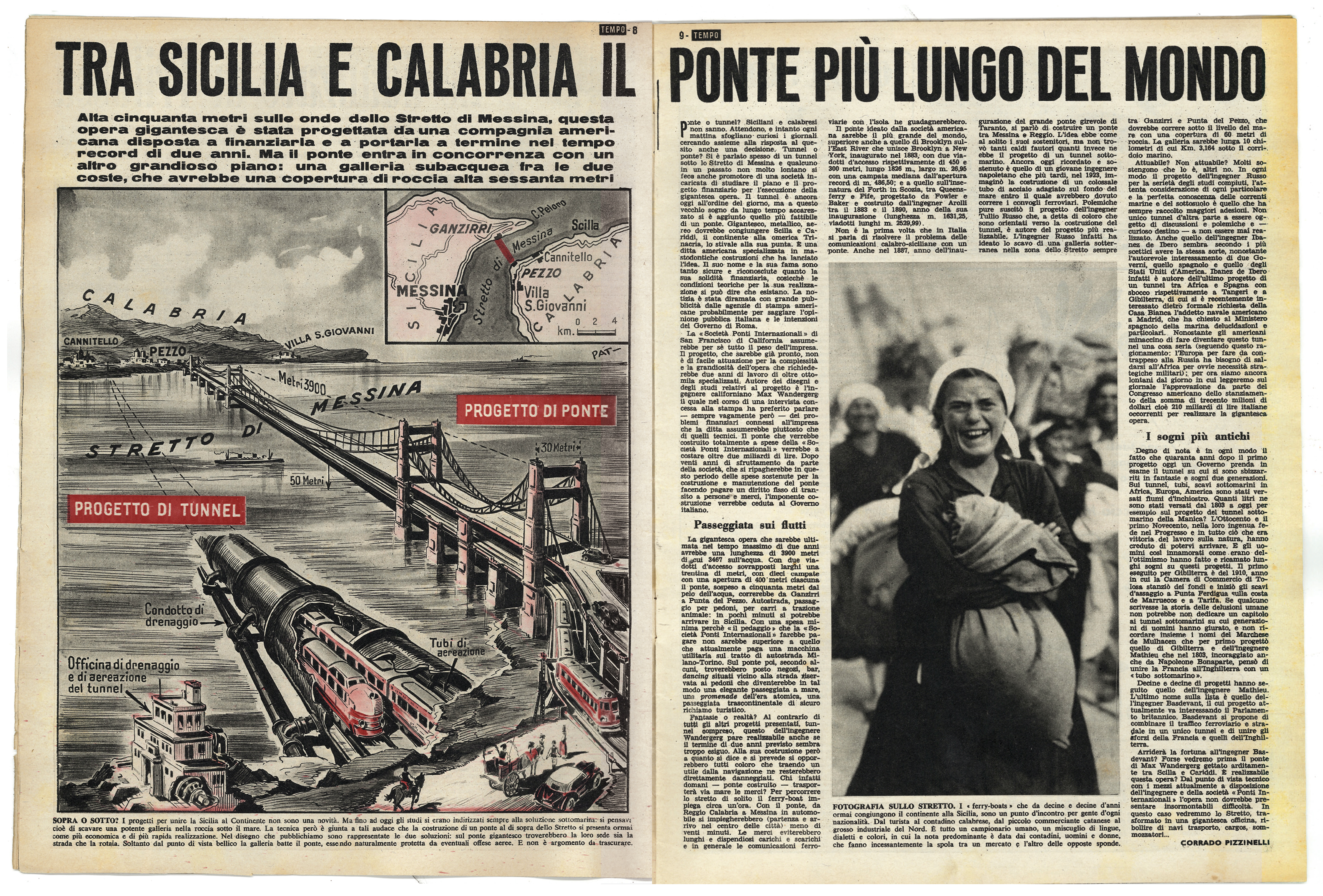
First formally proposed in the 1860s during the unification of Italy and most recently revived in 2023, the bridge has feverishly captured the political imagination of successive governments, harvesting a centuries-old Italian preoccupation with spanning the strait. In 1942, Benito Mussolini eagerly claimed, “It’s time to end this island business: after the war, I will build a bridge.”4 In 2002, Silvio Berlusconi declared, “The Messina bridge will be built this time, we guarantee it.”5 And in 2025, Matteo Salvini echoed, “We will actually build the Strait of Messina Bridge this time.”6 Set to become the world’s longest suspension bridge, the project persists as a mythical infrastructure—one that, despite never being built, has already produced territorial and social effects.
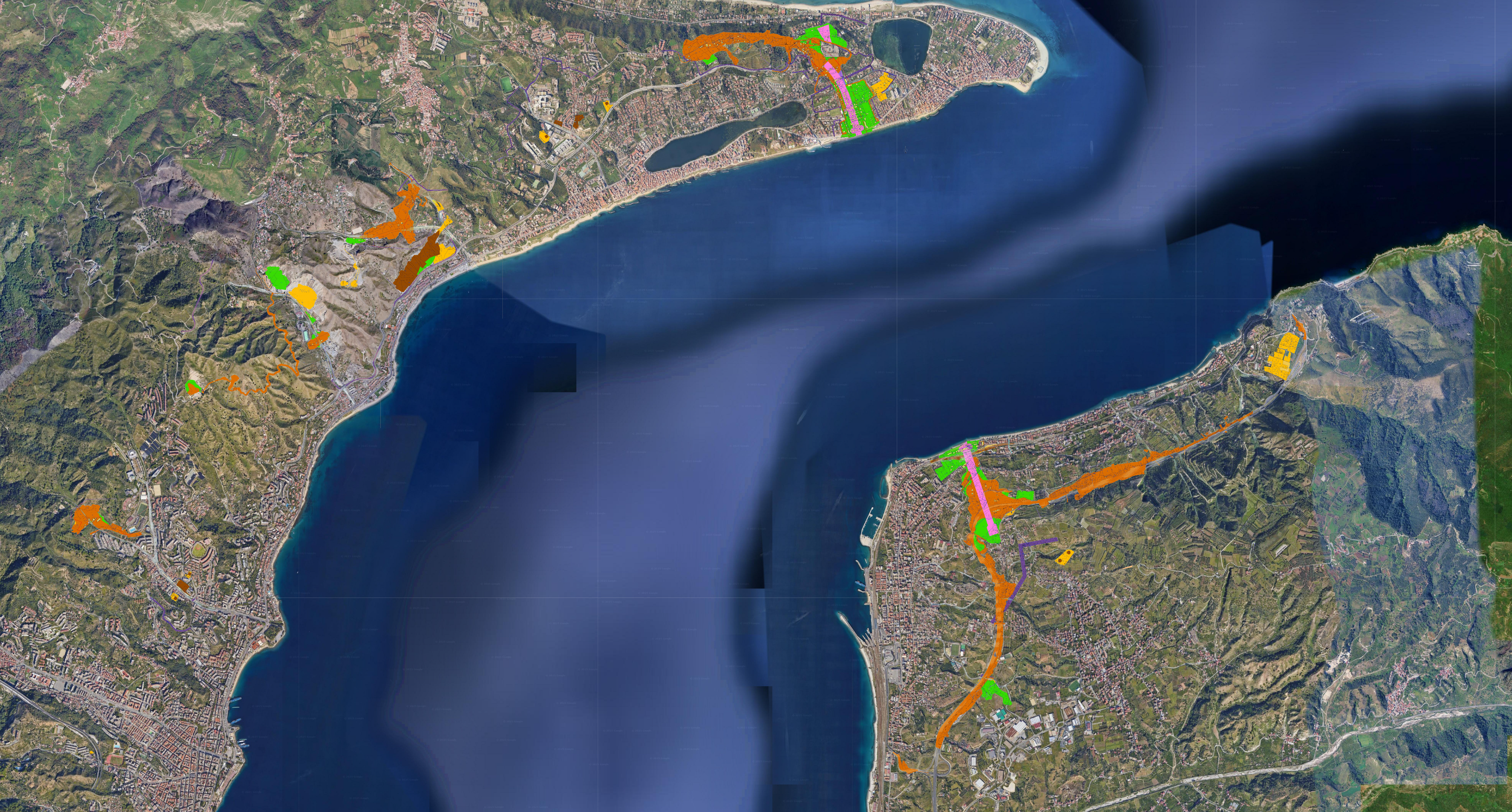
The current proposal envisions a 3,666-meter single-span suspension bridge connecting the cities of Torre Faro in Sicily to Cannitello, Calabria, on the mainland. The bridge is designed to rise on two towering 382.6-meter pylons, and would span a seismic zone where both cities were once flattened by the 1908 Messina earthquake, also known as Europe’s most devastating earthquake.7 Connecting two of Italy’s marginalized hinterlands, the bridge is repeatedly presented as a remedy for regional inequality and a symbol of the nation’s march toward modernity. Locally, the project is criticized for deepening infrastructural exclusion, straining scarce resources, and threatening the fragile storied waters of the Strait of Messina.8
Southern Italy sits within a global geography of speculative and suspended infrastructure—not as an aberration but as an exemplar of how the state-industrial complex manipulates infrastructural myth and its temporalities. Suspension here denotes the temporal stretch between the promise of infrastructure and its potential, or eventual, completion. It also refers to the conditions imposed on communities living within this interval. An architectural condition takes shape through anticipation rather than construction: reorganizing territory, freezing property, and governing space.
Myth operates not simply as storytelling or deception, but as a way of presenting the world that seems natural and unquestionable, obscuring its very construction. An orientation on the use of myth here is guided by Roland Barthes, Ernst Cassirer, and René Girard, through whom myth is understood as a machinery of cultural coding and regulating legitimacy. For Girard, “All myths have their roots in real acts of violence against real victims.”9 This observation resonates within the regional context of the bridge, where the promise of large-scale infrastructure has long been framed by the state as the cure to the “Southern Question”10 while reproducing the marginalization of Sicilian and Southern Italian subaltern communities.11
The Bridge over the Strait of Messina, underwritten by the myth of Colapesce, behaves not as a delayed or failed infrastructural project but as a form of mythical infrastructure whose power lies precisely in its speculative suspension: enabling governance, financial extraction, and legal exceptionalism without material construction. These three interconnected columns—governance, finance, and law—together reveal how myth is both stabilized and rendered legible as a constructed force. In Sicily and Calabria, myth has often been the way of interpreting mysterious or catastrophic events through divine or legendary intervention, inscribing the region’s and island’s origins in mythic causality.12
Column I. Governance
Since the country’s unification, Italy’s South has repeatedly been constructed as a “problem space,” described as an arena of perceived backwardness and a recurring target for “development” aimed at absorbing the region into national and global markets via quasi-Keynesian measures.13 Italian nation-building discourse explains the persistent economic and social disparities between North and South through long-standing narratives. Many of these political narratives locate underdevelopment not in historical occupation or damaging policy but in alleged traits of the South’s population. Working in the late nineteenth century, Italian criminologist Cesare Lombroso’s obsession with eugenics, which pathologized southern Italians and criminals within the same biological framework, helped legitimize the long-standing myth of Southerners as inherently indolent or predisposed to criminality. These narratives circulated through and were reinforced by state rhetoric, media spectacle, and everyday stereotypes contributing to forms of extralegal violence and administrative discrimination.14 The process reached its nadir in the promise of infrastructure that has used this myth of the South to allow for interventions. Funding initiatives like the Cassa per il Mezzogiorno (1950)15 and the Pacchetto Colombo (1970)16 produced a landscape of incomplete works—the so-called cattedrali nel deserto17—which, far from resolving structural inequalities, reinforced stereotypes of Southern inefficiency while enabling private profiteering. In 2023, Southern regions accounted for 70 percent of Italy’s unfinished projects,18 while Sicily’s total grows annually.19
Philosopher Ernst Cassirer offers a useful framework for understanding how myth operates politically: orienting the surrender of rational logic to political mythology. Modern political myths, he observes, are no longer “wild fruits of an exuberant imagination”20 but “artificial things fabricated by very skillful and cunning artisans,”21 manufactured much like “other modern weapons, as machine guns or airplanes.”22 Through this lens, projects such as the Strait of Messina bridge appear less as durable infrastructure than myths engineered to reproduce state authority. As Cassirer writes, the historical genealogy of myth is transformed into a medium of the state. Just as weapons shape both the physical and political terrain, pharaonic infrastructure projects discipline populations, enforce hierarchies, and create the perception of inevitability, rendering the state’s authority materially and symbolically tangible.
The Strait of Messina Bridge project is repeatedly presented as strategic and imminent, yet it remains temporally suspended—between proposal and realization. Its ceaseless horizon of becoming enables legal and political contortions that maintain this ephemeral existence. As the anthropologist Akhil Gupta writes, “Suspension, then, instead of being a temporary phase between the start of a project and its (successful) conclusion, needs to be theorized as its own condition of being.”23 Such infrastructural suspension has been imposed on the South as a generatively inert condition, managing the communities of the Strait by placing them in limbo.
Each year, some 12 million passengers and 3 million vehicles traverse the Strait through its ferry network.24 This maritime link between Calabria and Sicily is both historic and functional, even though it remains in need of significant investment. Members of the No Ponte movement, along with residents, have called for improvements such as greener ferry services, increased travel frequency, and more affordable rates, particularly for vehicles.25 The “nightmarish” route for crossing the Strait is less about the ferry itself, which takes twenty minutes, and more often about the inadequate land infrastructure on either side. Under the Draghi government (2021–2022), €57 million in European Union funds was allocated toward faster, low-emission electric ferries.
In 2022, Vera Fiorani, a commissioner appointed by Prime Minister Mario Draghi, announced “a plan that includes the construction of a fifth ship ferry-railway and the replacement of three fast ships with three modern and green ones. The modernization of the stations of Messina, Reggio, and Villa is also ongoing… Total investments of over 12 billion euros are planned to enhance infrastructures and connections in Sicily, functional to revolutionizing mobility on the island.”26 With the election of Giorgia Meloni’s government in 2022, funding priorities shifted. Matteo Salvini, appointed Minister of Infrastructure and Transport, redirected these funds towards preparatory work for the bridge. Despite the existence of functional alternatives, modernization funding has been redirected from rail and ferry upgrades to support the bridge project.27 Each successive government’s assertion of power has bound the community to a suspended reality, where the promise of mythical infrastructure restricts access to what already exists. Unlike mere ferry services, the bridge embodies modernity and national unity. Political theorist Timothy Mitchell explains: Infrastructures gradually evolve from practical necessities into ideological symbols, dislocated from their immediate utility to serve abstract purposes of national myth-making. This myth-making perpetuates itself, prioritizing ideological coherence over material reality and rendering infrastructural space into infrastructure-as-story.28
The infrastructure’s mythic promise diverges sharply from the material reality of those who are forced to await the bridge. Since the project’s revival in 2006 under Silvio Berlusconi, Stretto di Messina S.p.A.—a private company with public capital—earmarked 1,500 homes and businesses for expropriation, particularly in the areas of Torre Faro and Cannitello. In these coastal communities of fishing families, elderly homeowners, and small businesses, the company’s designation does not immediately remove people but suspends them. When the state invokes expropriation for public use, a property and its residents enter a legal limbo. Many residents have lived under the possibility of being dispossessed from their home for twenty years, receiving almost no compensation.29 Therefore, ownership rights, too, are effectively suspended: Homeowners cannot sell, renovate, or make decisions about their property. By law, state-sanctioned expropriations can remain in effect for a maximum of five years, after which the state must either compensate the owner or renew the expropriation claim.30 In (extended) practice, this cycle keeps residents in a state of uncertainty, allowing the state to exert control by limiting the community’s ability to use or develop its land.
Salvini frames expropriations as a form of “necessary violence”: “Expropriations occur wherever there is a major project, and the bridge is a development accelerator.”31 The result is a narrative in which displacement is recast as sacrifice. Read through a Girardian account of myth, social order is produced through collective violence against a scapegoat—typically a marginal figure selected by authority—and, once this violence is consummated, peace returns and order is (re)generated.32 This logic becomes legible as a form of political myth-making. The burdens of development are concentrated onto specific communities, whose loss is positioned as the condition of regional salvation. In other words, Salvini’s myth suggests that sacrificing the communities of the Strait is required—or unavoidable—to “save” the South from poverty, barbarism, crime, and other “societal ailments,” while simultaneously bringing regional development and solving the South’s financial problems.
The state’s ability to govern through suspension is embedded in the law itself. Legislative Decree No. 190 of August 20, 2002, which implements the so-called Legge obiettivo (Objective Law)—the framework legislation for strategic infrastructure and developments of national interest33—explicitly states that “notification of expropriation activities to those involved is not required.”34 In other words, the legal framework itself authorizes forms of dispossession that can unfold without direct notification to those most affected.
The Objective Law is widely regarded by the public, academics, and the No Ponte movement as a mechanism that enables further state and private profiteering through large infrastructure. Luigi Sturniolo describes the law as “precisely designed” to facilitate projects like the Strait Bridge through the “disempowerment of local governments and the verticalization of political decision-making.”35 Expropriation policies deprive the community of vast tracts of land and further distance them from decision-making over their own territory, regardless of whether the project is ever completed. “We have a huge fear they are going to start the project, realise they can’t finish and abandon everything.”36 This condition of suspension is working as a method of intimidation, exhaustion, and with an aim to disarticulate subaltern attachment to place, leaving many locals in anticipation and irritation, as further disruptions are always expected to follow. “We will be hostages of these works for many years.”37
Column II. Finance
The Messina Bridge has drawn immense resources, attention, and state apparatuses. From the 1970s to the 2020s, the project’s legal and financial scaffolding has continued to expand. Economically, the bridge’s functionality does not depend on its completion; rather, speculation and public-private entanglements render its suspension itself productive. Each termination increases the financial cost of abandoning the project. Following the previous termination in 2013, the state was required to pay approximately €700 million in damages to the Eurolink Consortium38 against a tender value of €3.8 billion. Given that the current project is estimated to cost more than €13 billion, the financial repercussions of failure are now even greater. As of August 2025, government contracts include a termination clause that could trigger a penalty of over “one million euros per day of delay.”39
This contractual mechanism formalizes suspension as a functional component of financial production. As Matteo Salvini cheerily states, “It costs more not to do it than to do it.”40 While the termination clause is intended to safeguard private investment and ensure project continuity, locals and public legal critics argue that it instead exposes the state to escalating financial risk while guaranteeing returns for private contractors regardless of whether construction proceeds. Essentially, it enables the looting of state coffers. According to writer and theorist Nicholas Hildyard, such plunder demonstrates the fundamentality of infrastructure: its ability to generate profitable channels for surplus capital and facilitate global resource extraction, frequently at the expense of local populations.41 As he stresses, “Yield, not physical characteristics, becomes the determinant of what is or is not an infrastructure asset.”42 The emphasis therefore shifts away from delivering infrastructure and toward producing financial instruments, what Hildyard terms “infrastructure-as-asset-class.”43 These penalties show that infrastructure’s promise can be treated as capital, even if it never materializes.
According to a 2023 investigation by Italian journalists Milena Gabanelli and Massimo Sideri, more than €1.2 billion has already been spent on the bridge.44 This estimate includes decades of feasibility studies, administrative and management costs dating back the 1980s and 90s, and factors in hypothetical penalties should the state lose legal disputes with contractors.45 Moreover, the promise of infrastructural investment in the South functions as a myth in the sense of a false promise: Much of the capital generated by the project ultimately flows northward. Of the 253 companies involved—including WeBuild, Lambertini Group, Anas S.p.A., IRI, and Stretto di Messina S.p.A.—all are headquartered in Northern Italy.46 The organization of global capital thus ascends to mythic status, becoming naturalized through this process. As Gupta points out with reference to Karl Marx’s Das Kapital, “The organizational forms in which production takes place are as much a part of the production process as the tools and machinery.”47
Again, the scapegoat mechanism becomes apparent: Authority figures render the communities of the Strait administratively and politically incapable. This paternalistic logic functions to legitimize the people’s exclusion from their territory’s governance while remaining fully responsible for financing the project through taxes. Through this subjugating ritual, land and community are recast as objects of discipline, a process justified as a means of restoring “peace” to the territory. Within the logic of project finance, this is derisking: Uncertainty is not eliminated but systematically redistributed away from private capital and toward the state and its territories.
Salvini proudly states, “As a Lombard, I know that many businesses throughout Italy will be involved, and the region with the most businesses involved in this major project will be Lombardy.”48 Volatility on the ground is transformed into manageable financial categories, securing predictable returns even as the bridge endures in a state of mythic suspension. Suspension itself becomes productive: No longer a failure of execution, it stabilizes financial anticipation and enables value extraction through delay rather than completion. Myth, in turn, operates not as narrative excess but as an infrastructural supplement to this process, naturalizing uneven distributions of risk and return that further widen financial asymmetry between Northern and Southern Italy.

Column III. Law
As Cassirer observed, modern political myths no longer seek merely to direct action but “to change the men, in order to be able to regulate and control their deeds,”49 operating, he suggested, “like a serpent that tries to paralyze its victims before attacking them.”50 Today, the repertoire of tools that sustain the modern state’s myth has only grown, with law playing a central role in reshaping subjects and legitimizing authority.
The Strait of Messina Bridge project—announced, canceled, revived repeatedly for decades—is less an engineering feat than a legal-political spectacle. Its legislative foundations date back to 1971 when, in the wake of the Reggio Revolt, protesters demanded investment and political recognition for Reggio Calabria.51 In response, the state sought to pacify unrest with promises of industrial and infrastructural investment. From its inception, law functioned as a mechanism through which infrastructural futures were authorized, deferred, and made operative as tools of governance. In this sense, legislation does not merely regulate the possibility of the bridge; it actively produces it as a horizon of development through which Southern discontent is managed.
Special infrastructure legislation is not new for the Meridionali.52 It has often taken the form of extraordinary legal regimes that establish “special commissioners”—state-appointed officials endowed with exceptional powers to act in derogation of ordinary administrative and planning procedures. Produced through law rather than outside it, these mechanisms suspend ordinary legal guarantees in the name of infrastructural urgency. Presented as forms of assistance to local institutions in the South, they instead further centralize authority and erode southern political autonomy through the law’s own exceptionalism.
Researcher and activist Roberto Sciarelli reveals that these recurring legal interventions are animated by a persistent “logic of exceptionality” that has shaped the history of major public works, urban transformations, and industrial development across Southern Italy. He writes, “The need for ‘progress’ at the cost of environmental degradation presents the extractive economy of Southern Italy as a neocolonial economic aggression, proposed in the guise of a great development opportunity.”53 The Italian Parliament legitimized these special legal frameworks for Southern Italy, drawing on, and in turn reinforcing, the myth of the Mezzogiorno as a regionally “backward” space.54
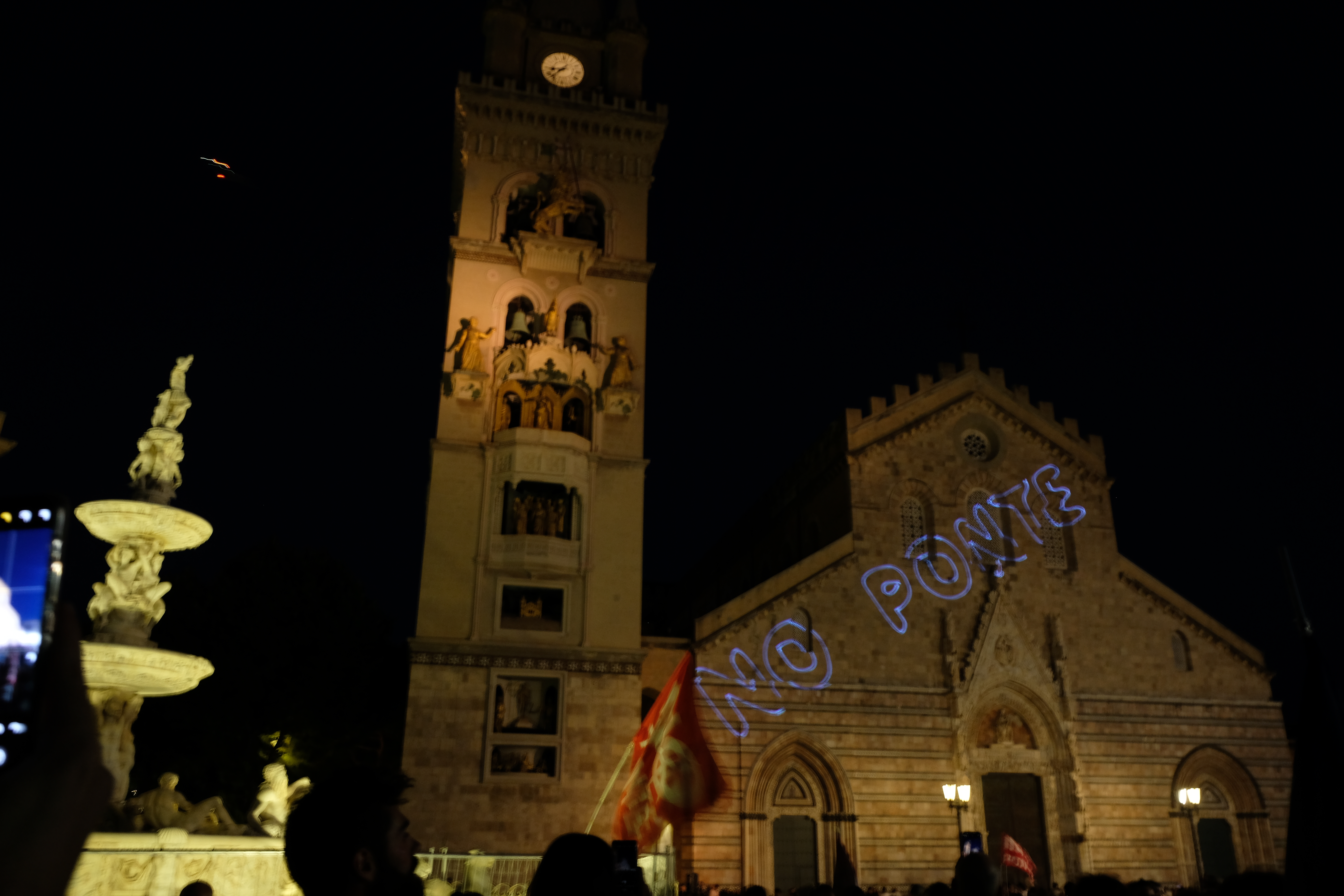
Despite rhetoric casting the region as politically apathetic,55 opposition movements sustain a commitment to organized dissent. Resistance to the bridge project takes many forms, from organized protests, marches, and legal appeals to public awareness campaigns and civic society mobilization. Yet, the state has increasingly responded not with democratic negotiation but with suppression. As Daniele Ialacqua, a longtime organizer in Messina, recalls:
From 2002 to today, we’ve held 24 marches, with around 100,000 participants cumulatively. In 2006 alone, over 20,000 people took to the streets. The bridge issue acts as a driver, as a point of convergence, even though the territory is fragmented.56
The Italian state is escalating a regime of legal exceptionalism that delegitimizes this resistance. In 2025, the Meloni government converted Legislative Decree No. 48/2025 into Law No. 80, referred to as the “Security Decree.”57 The government is using this new package to intensify the criminalization of dissent, explicitly targeting protests against large infrastructural works. Its provisions allow the Italian state to circumvent constitutional checks with emergency security mandates, effectively codifying the repression of speech. The decree recasts protest as criminal conduct, directly targeting activists and community groups opposing the project. In doing so, it authorizes the state to exercise extraordinary powers, militarizing the area through mythical infrastructure. Authorities have extended liability to forms of passive resistance and normalized the routine recording of public order operations, consolidating criminalization and surveillance in practice.58 Critics, including the Italian Supreme Court itself, have raised serious concerns: in Report No. 33/2025, the Court highlighted the security decree’s heterogeneity, lack of proportionality, and risk of violating constitutional guarantees.59 This friction between grassroots opposition and state pre-emption is the locus of legal myth in action.
Special tribunals and extraordinary commissions do not resolve disorder but reorganize it through juridical form, producing a managed legal excess that both incites and legitimizes structural violence. Within this framework, mimetic theory frames myth as emerging from a “contagious process of disorder that culminates with the death or expulsion of a victim.”60 This logic is symptomatic of what law and colonialism theorist Nasser Hussain termed “hyperlegality”: the proliferation of legal codes and procedures that function not to deliver justice but to normalize exceptional governance.61 Hyperlegality thus is producing disorder through legal excess, mirroring myth’s operation: Both arise from crisis, multiply narratives to contain it, and legitimize the sacrifice of a community in the name of order.
Rather than remaining epistemic, hyperlegality is enacted through legal contestation, where juridical scrutiny effectively blacklists certain forms of dissent. In early 2025, 104 residents of the Strait brought a class action against Stretto di Messina S.p.A. opposing the bridge’s construction.62 The case was rejected as inadmissible, and the appellants were ordered to pay approximately €340,000 in legal fees, in addition to fines of €3,000 per signatory.63 Their request for anonymity was also denied, on the grounds that the alleged harm was deemed hypothetical, as the project had not yet received final approval.64 Beyond the severity of the ruling lies its symbolic function; the judgment operates as a spectacle of punishment. Crucially, more than a procedural decision, spectacle publicly stages the cost of dissent. It turns legal challengers into examples and procedural dispute into a narrative of deviance so that the public must witness the costs of contestation. By denying confidentiality, the court reinforces the familiar myth of Southern obstructionism: Southerners irrationally resisting progress and modernity. In this way, punishment exceeds its corrective function and becomes pedagogical, circulating as an exemplary warning that binds juridical authority to public perception.
Fissures in the columns
Resistance continues under increasingly precarious conditions. As Ialacqua highlighted, the decades-long suspension of the bridge project has exhausted communities on both sides of the Strait, draining energy from collective action and stunting resistance.65 This combined atmosphere of resignation and mobilization is itself symptomatic of infrastructure suspension. Although prolonged uncertainty has weakened the movement’s momentum, it has not extinguished opposition. Suspension therefore remains a contested political terrain rather than a settled instrument of control.
The No Ponte movement inhabits this terrain by converting suspension into preparation. Through accumulated scientific, legal, and environmental expertise, and in collaboration with environmental protection organizations like the World Wildlife Fund and Legambiente, activists have developed fluency in the state’s technical language, opening limited emancipatory possibilities within this uncertain temporality.66 Just as the No Ponte activists appropriate the state’s instruments of knowledge, they also mobilize myth itself as a political resource. References to Colapesce, Scylla,67 Charybdis,68 and Fatamorgana69 appear across protest banners, murals, pamphlets, public speeches, and local storytelling practices. These figures are not invoked merely as symbols of a cultural heritage; they frame the Strait as a living territory whose dangers, rhythms, and forms of knowledge exceed the technical rationales with which the bridge is justified. Myth becomes a way of translating generations of lived experience into a language capable of contesting expert knowledge and state planning.
Rather than functioning as symbolic embellishment, these myths participate in what Gilles Deleuze calls fabulation. For Deleuze, fabulation refers to a process through which a people comes into being by inventing new modes of expression, perception, and possibility.70 The myths mobilized by No Ponte activists articulate new collective identities and political imaginaries beyond existing structures of domination. By linking emancipatory politics to inherited narratives of the Strait, they generate alternative ways of understanding territory, risk, and collective life. Fabulation presumes that what a social collective holds to be true or considers fact is neither arbitrary nor set in stone.71 In this way, myth smuggles knowledge across temporal scales, preserving lessons, warnings, and forms of collective memory for future people.
The political efficacy of No Ponte’s fabulation lies not only in bringing new political possibilities into being, but in exposing the sacrificial myths through which existing orders sustain themselves. Here, myth functions as counterpower; the scapegoat embodies René Girard’s paradox, “the double transference of the sacred which appears both a source of disorder and a source of order.”72 Thus, the scapegoat emerges as both a dangerous cause of chaos and a sacred bringer of peace. The task is therefore not to redeem the scapegoat, but to unmask the myth that renders sacrifice necessary. The truth-seeking, justice, and solidarity of resistance expose the columns of power for what they are. This is at service to, as Deleuze would say, “people to come,”73 a collectivity that may not yet exist. Through myth, the scapegoated actors of the Strait have claimed agency and shaped fate for those who follow. As Cassirer writes,
In politics we are always living on volcanic soil. We must be prepared for abrupt convulsions and eruptions. In all critical moments of [hu]man’s social life, the rational forces that resist the rise of the old mythical conceptions are no longer sure of themselves… For myth has not been really vanquished and subjugated… This hour comes as soon as the other binding forces of [hu]man’s social life, for one reason or another, lose their strength and are no longer able to combat the demonic mythical powers.74
His admonition extends beyond the Strait of Messina. Political myths persist wherever institutional bodies fabricate narratives that convert political ambitions into seemingly inevitable realities. The established repertoire of othering, scapegoating, and naturalization reveals that systems of knowledge and material conditions do not simply reflect one another but recursively produce the worlds they claim to describe. The power of myth lies not in its permanence, but in its capacity for endless reenactment.
The bridge over the Strait of Messina is one such myth. A genealogy of speculation, legislation, financing, and political performance has assembled a mythical infrastructure, which persists by producing a culture of its own. Infrastructure no longer appears as a singular, bounded object; it is a rhizomatic love child that comprises a dispersed system of relations. Held in this limbo by institutional powers, suspended infrastructure constitutes an uncertain territory, the perfect stage for speculation and political drama. Actors behave as if it exists: they organize around it, profit from it, resist it, legislate for it, or are governed by its anticipation.
Beneath the Strait, the condemned Colapesce holds a fractured column, still preventing the island’s collapse. Delays, funding gaps, expropriations, and legal battles perform a similar mythic labor in service to the bridge promise. These calcified columns keep the myth afloat amid turbulent waters and gusty defiance. Yet, unlike Colapesce's eternal curse, the conditions of suspension sustained by the Italian state reveal the fissures of their inevitable collapse.
-
ENG – Colafish; IT – Colapesce; SICILIAN – Colapisci. My rewriting of an ancient myth from Messina using songs, poems, and written interpretations: Colapisci (Colapesce), “Home,” link; “Colapesce di Ignazio Buttitta tra cunto, leggenda e lotta civile,” Poesia del Nostro Tempo, link; Federico Guastella, “Colapesce di Ignazio Buttitta,” SoloLibri.net, January 5, 2018, link; Roberto Murolo with Nuova Compagnia di Canto Popolare, “Italian Folk Music / Canzone Napoletana…,” link; Otello Profazio, “La Leggenda di Colapisci (1966),” YouTube video, December 2012, link. ↩
-
Our strong sympathetic figure echoes a recurring motif in Italian folk and mythic traditions, where masculine bodies are cast as burden-bearers of the collective order, sustaining communities through strength and extreme acts of hegemonic masculinity. ↩
-
This is a myth locals use to explain why the Strait of Messina experiences a major earthquake each century; a big one is said to be due soon. A big one, of 6.2 magnitude, struck on June 2, 2026, off the coast of Calabria, about an hour’s drive from the Strait of Messina. ↩
-
Mario Alizzi, “Il Duce ed il sogno del ‘Ponte sullo Stretto di Messina’, dagli antichi romani ad oggi,” Sicilia Occidente, April 8, 2025, link. ↩
-
Editorial Staff, “Silvio Berlusconi e il pallino per il Ponte sullo Stretto, nel 2002 annunciò la posa della prima pietra,” Messina Today, June 12, 2023, link. ↩
-
Matteo Salvini, “Ponte sullo Stretto, Salvini: ‘Questa volta lo facciamo davvero,’” Finanza Repubblica, August 27, 2025, link. ↩
-
Yannay Spitzer, Gaspare Tortorici, and Ariell Zimran, “International Migration Responses to Modern Europe’s Most Destructive Earthquake: Messina and Reggio Calabria, 1908,” The Journal of Economic History 85, no. 3 (2025): 617–663. ↩
-
“The Strait of Messina: A Bridge Too Far?,” The Week, August 17, 2025, link. ↩
-
Richard Joseph Golsan, René Girard and Myth: An Introduction (New York: Routledge, 2002), 62. ↩
-
The Southern Question (Questione Meridionale) refers to the economic and social disparities between northern and southern Italy following the country’s 1861 unification. Emerging from a broader post-unification debate that frequently depicted the South as backward or uncivilized, the Questione Meridionale became a central concern of Italian political thought. In his 1926 essay, “Some Aspects of the Southern Question,” Antonio Gramsci rejected these essentialist explanations, arguing instead that regional inequalities were historically and politically produced through uneven development and the unequal relationship between the industrial North and the agrarian South. See Antonio Gramsci, ”Some Aspects of the Southern Question,“ in Antonio Gramsci: Pre-Prison Writings, edited by Richard Bellamy, translated by Virginia Cox (Cambridge & New York: Cambridge University Press, 1993). ↩
-
Amy Kazmin, “Why Sicilians Hate Meloni’s Bridge,” Financial Times, August 17, 2025, link. ↩
-
Siciliastoriaemito, “La Nascita della Sicilia tra Mito e Leggenda,” Sicilia tra Storia e Mito, August 2, 2019, link. ↩
-
Antonio Liguori, La vicenda della Cassa per il Mezzogiorno tra passato e presente: L’Italia e il Sud dopo la crisi (bachelor’s thesis, LUISS Guido Carli, 2017), 21, link. ↩
-
Phoebe Anderson, “Eugenics, Phrenology, and the Concept of ‘Other’ in 19th and 20th Century Italy,” NU Italian, April 28, 2021, link. ↩
-
Italia. Legge 17 marzo 1950, n. 1170, Istituzione della Cassa per le Opere Straordinarie di Interesse Pubblico nel Mezzogiorno d’Italia (“Establishment of the Fund for Extraordinary Works of Public Interest in Southern Italy”), Gazzetta Ufficiale della Repubblica Italiana, March 17, 1950, link. ↩
-
Translation: Colombo Package. ↩
-
Translation: Cathedrals in the desert. Large, unfinished structures that served more as vehicles for political patronage and capital circulation than for public utility. ↩
-
Francesco Chindemi, “Opere Incompiute, il 70% è al Sud: Ecco dove sono in Calabria,” Avvenire di Calabria, December 15, 2023, link. ↩
-
Laura Musumarra et al., “I numeri dell’incompiuto italiano,” TRADIMALT blog, March 9, 2023, link. ↩
-
Ernst Cassirer, The Myth of the State (New Haven, CT: Yale University Press, 1974), 3. ↩
-
Cassirer, The Myth of the State. ↩
-
Cassirer, The Myth of the State. ↩
-
Port Authority of the Strait of Messina, Porti dello Stretto, link. ↩
-
No Bridge – English translation. There are multiple mobilizing groups on either side of the Strait that ask for different things, but this remains a consistent demand. ↩
-
Rete Ferroviaria Italiana (CEO statement), “Strait of Messina, RFI (FS Group): The New Green Train Ferry Arrives,” FIRSTonline, March 9, 2022, link. ↩
-
Legambiente, Il grande bluff: La verità sul ponte dello Stretto (Rome: Legambiente, July 20, 2023), link. ↩
-
Timothy Mitchell, Rule of Experts: Egypt, Techno-Politics, Modernity (Berkeley: University of California Press, 2002), 19–53. ↩
-
“Il Ponte che non c’è: La vita sullo Stretto di Messina all’ombra della politica,” YouTube video, 1:23:45, posted by La Repubblica, September 1, 2024, link. ↩
-
Presidenza della Repubblica, D.P.R. 8 giugno 2001, n. 327, art. 13, comma 6 (“Where the expropriation decree is not issued within five years from the effective date of the declaration of public utility, the declaration becomes ineffective” [author’s translation]); see also Italia Ius, “Occupazione d’urgenza senza successivo esproprio” [discussion on the unchanged regulatory framework], link. ↩
-
“Salvini contro i no al Ponte: «Anche nel ’400 c’era chi si opponeva alla Cupola del Brunelleschi. Più indennizzi per gli espropri»,” Corriere della Sera, August 7, 2025, link. ↩
-
Golsan, René Girard and Myth, 152. ↩
-
Italia, Legge 21 dicembre 2001, n. 443, “Delega al Governo in materia di infrastrutture ed insediamenti produttivi strategici ed altri interventi per il rilancio delle attività produttive” [Framework law for the construction of strategic infrastructure and developments of national interest], Gazzetta Ufficiale della Repubblica Italiana, no. 299 (December 27, 2001), link. ↩
-
Italia, Legge 21 dicembre 2001, no. 443, 16. ↩
-
Luigi Sturniolo, Il ponte sullo Stretto nell'economia del debito (Ragusa: Edizioni Sicilia Punto L, 2013), 55. ↩
-
Amy Kazmin, “Why Sicilians Hate Meloni’s Bridge,” Financial Times, August 21, 2025, link. ↩
-
Kazmin, Why Sicilians Hate Meloni’s Bridge.” ↩
-
Eurolink Consortium was contracted to carry out the design and engineering work for the Strait of Messina Bridge project by Stretto di Messina S.p.A., the state-controlled company responsible for managing the project on behalf of the Italian government. ↩
-
“Ponte sullo Stretto, accordo società-Eurolink prevede penali: ‘Così tuteliamo al massimo l’interesse pubblico,’” StrettoWeb, August 2025, link. ↩
-
Matteo Salvini, translated statement on the Strait of Messina Bridge, 2022, link. ↩
-
Nicholas Hildyard, Licensed Larceny: Infrastructure, Financial Extraction and the Global South (Manchester: Manchester University Press, 2016). ↩
-
Hildyard, Licensed Larceny, 23. ↩
-
Hildyard, Licensed Larceny, 9. ↩
-
This concerns not the bridge as such but the institutional structures and flows already expended in order to sustain the myth. ↩
-
Milena Gabanelli and Massimo Sideri, “Stretto di Messina: Il ponte che non si è mai fatto è costato già 1,2 miliardi,” Corriere della Sera, April 23, 2023, link. ↩
-
Mostly from Lombardy, but also from Veneto and Piedmont. “Via libera al Ponte sullo Stretto di Messina, Salvini e Meloni entusiasti: ‘Attraversamento entro 2033, tre fermate metro e 120 mila posti di lavoro,’” Il Riformista, August 6, 2025, link. ↩
-
Nikhil Anand, Akhil Gupta, and Hannah Appel, The Promise of Infrastructure (Durham, NC: Duke University Press, 2018), 65. ↩
-
Cesare Treccarichi, “Per Salvini è ora, costi confermati: ‘Il progetto del Ponte sullo Stretto verrà approvato entro una settimana,’ ” Today, July 29, 2025, link. ↩
-
Cassirer, The Myth of the State, 286. ↩
-
Cassirer, The Myth of the State. ↩
-
The Reggio Revolt (1970–71) began as a mass popular uprising against the government’s decision to designate Catanzaro as Calabria’s regional capital, mobilizing workers, students, trade unionists, and civic groups before being increasingly co-opted by the neo-fascist Italian Social Movement (MSI). The Italian state responded by deploying the Army to suppress the unrest, marking its first use on the Italian mainland in the postwar period. ↩
-
Southerners; the region is also known as the Mezzogiorno. ↩
-
Roberto Sciarelli, “Subaltern Ecologies in Southern Italy,” Revista Ambiente & Sociedade (Sao Paulo) 24 (2021): 8. ↩
-
Sciarelli, “Subaltern Ecologies in Southern Italy,” 8. ↩
-
Luciano M. Fasano and Paolo Natale, Blank Voting: The Rising Tide of Abstention (London: Palgrave Macmillan, 2018). ↩
-
Daniele Ialacqua, interview by author, Messina, July 18, 2025. ↩
-
Senato della Repubblica, Disegno di legge C. 1660, XIX Legislatura, “Disposizioni in materia di sicurezza pubblica, di tutela del personale in servizio, nonché di vittime dell’usura e di ordinamento penitenziario,” presented January 22, 2024, link ↩
-
Senato della Repubblica, Disegno di legge C. 1660, arts. 10, 12, 19. ↩
-
Paolo Frosina, “La Cassazione boccia il decreto sicurezza,” Il Fatto Quotidiano, June 27, 2025, link. ↩
-
Golsan, René Girard and Myth, 152. ↩
-
Nasser Hussain, “Hyperlegality,” New Criminal Law Review 10 (2007). ↩
-
TGR Calabria, “Ponte sullo Stretto, inammissibile il ricorso dei 104 cittadini. Salvini: Sconfitti i signor no,” RaiNews, January 9, 2025, link. ↩
-
CIPESS – Comitato interministeriale per la programmazione economica e lo sviluppo sostenibile (Interministerial Committee for Economic Planning and Sustainable Development); Redazione, “Ponte, respinto il ricorso presentato al Tribunale delle imprese per fermare il progetto,” LetteraEmme, January 13, 2025, link; Lucio D’Amico, “Azione collettiva contro il Ponte sullo Stretto: Rigettata la prima istanza a Roma,” Gazzetta del Sud, January 9, 2025, link. ↩
-
Redazione, “Ponte, respinto il ricorso presentato al Tribunale delle imprese per fermare il progetto.” ↩
-
Daniele Ialacqua, interview by author, Messina, July 18, 2025. ↩
-
Legambiente, Il grande bluff: La verità sul ponte dello Stretto (Rome: Legambiente, July 20, 2023), link. ↩
-
Scylla: A sea monster from Greek mythology, first attested in Homeric epic, traditionally located on the Calabrian side of the Strait of Messina and used to personify the dangers of narrow navigation and rocky coasts. ↩
-
Charybdis: Likewise attested in Homer, imagined as a destructive whirlpool opposite Scylla on the Sicilian side of the Strait, symbolizing violent currents and tidal turbulence. ↩
-
Fatamorgana: A complex atmospheric mirage observed in the Strait of Messina, generating optical illusions of distant forms; the term has been used metaphorically in public and scholarly commentary to characterize the Messina Bridge as a persistent illusion rather than a material reality. ↩
-
Gilles Deleuze and Félix Guattari, What Is Philosophy? (New York: Columbia University Press, 1994), 109. ↩
-
Gilles Deleuze, Bergsonism, translated by Hugh Tomlinson and Barbara Habberjam (New York: Zone Books, 1991). ↩
-
Richard J. Golsan, René Girard and Myth (1993), 151. ↩
-
Deleuze and Guattari, What Is Philosophy? 109. ↩
-
Cassirer, The Myth of the State, 280. ↩
Sofia Rudi Kent (b. 1998) is an Irish-Calabrian visual artist, researcher, and curator based in London. Her work examines cultural and political constructions through which systems of power take shape, exploring how they produce conditions of violence, marginalization, and inequality. She studied Fine Art Media and Critical Cultures at the National College of Art and Design in Dublin before completing an MA at the Centre for Research Architecture at Goldsmiths, University of London. Her current research draws on subaltern studies, maritime infrastructure, and myth theory to investigate questions of governance, resistance, and collective memory. Her work has been exhibited and published by The Avery Review, Radio Alhara, the Irish Museum of Modern Art (IMMA), the Douglas Hyde Gallery, SET Kensington, Goldsmiths, University of London, and the Liverpool Underground Film Festival.