
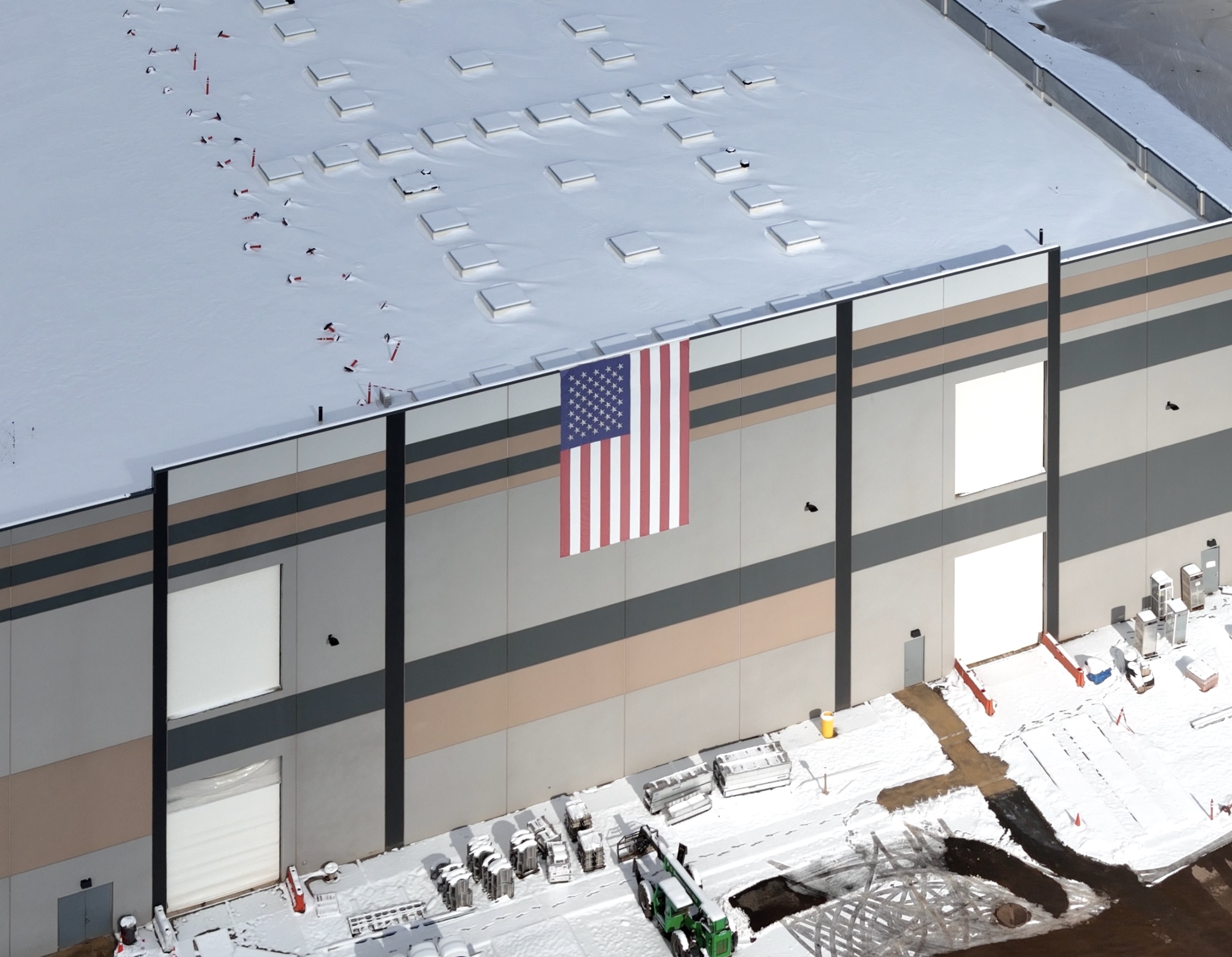
Loudoun County, on the outskirts of the US capital, lies at the edge of suburban development. It is a landscape of redbrick townhouses clustered along highways and cul-de-sacs lined with manicured lawns and “Patriot Disposal” garbage bins. Its new-build homes, featuring six-pane windows, navy shutters, and white columns, embody a deliberately crafted “American” architectural identity that has taken shape across Northern Virginia (NOVA).
Loudoun has the highest median income of any county in the nation.1 Each newly developed neighborhood bears a name like Lenah Mill or Nicholson Farm, invoking a recent rural past defined by traditional forms of agricultural labor that still persist less than a mile away. Contrary to the pastoral imaginaries these names conjure, Loudoun’s incorporated towns—including Aldie, Ashburn, and Purcellville—are highly commercialized sites, characterized by dramatic landscaping, water features, paved walking trails, artificial beaches, and golf courses.
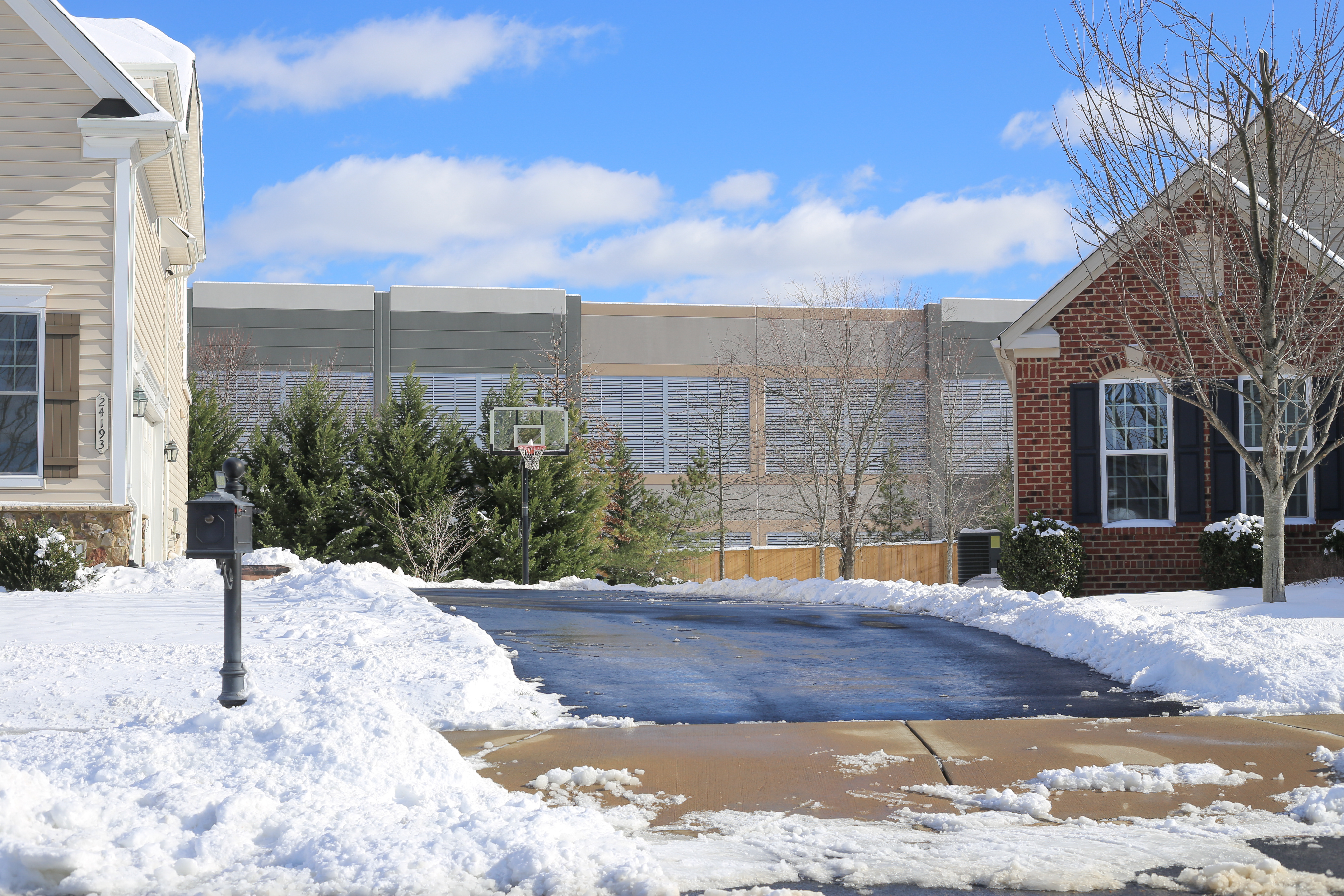
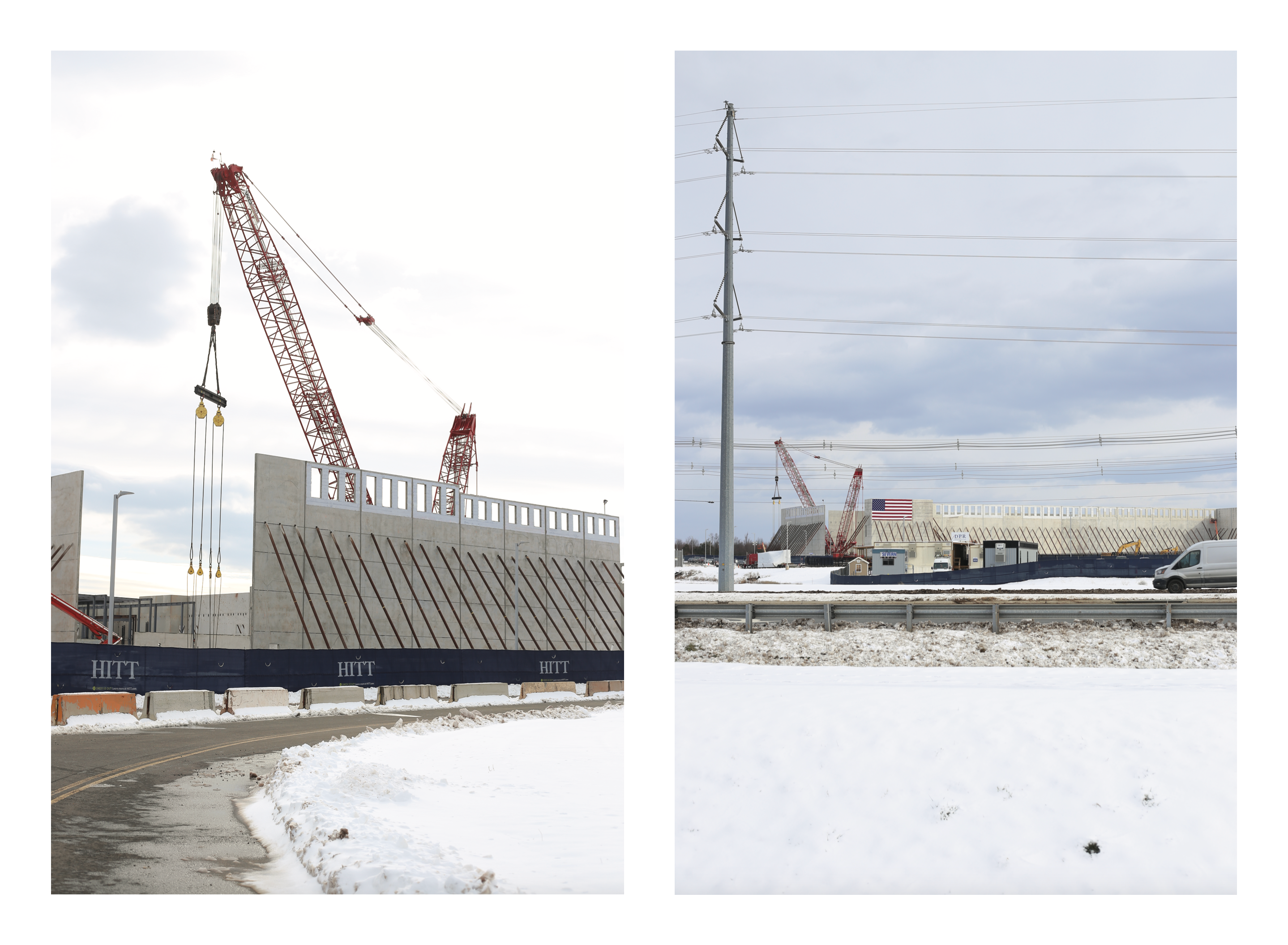
Completed in 2015, Loudoun Meadows in Aldie is one of hundreds of similar subdivisions rapidly sprawling west of Washington, DC.2 Less than one hundred feet from Loudoun Meadows, Amazon Web Services (AWS)—a subsidiary of the near-trillion-dollar American multinational technology company Amazon—is expanding its data center campus to meet the growing demand for cloud computing services and application programming interfaces (APIs) provided to companies, governments, and institutions worldwide.3 Built alongside new streets such as “Growth Mindset Lane,” these sites signpost the expansionist logics of suburban Northern Virginia and the ambitions of tech conglomerates like Amazon and Microsoft, which have consolidated infrastructure and influence in the region over the past decade.
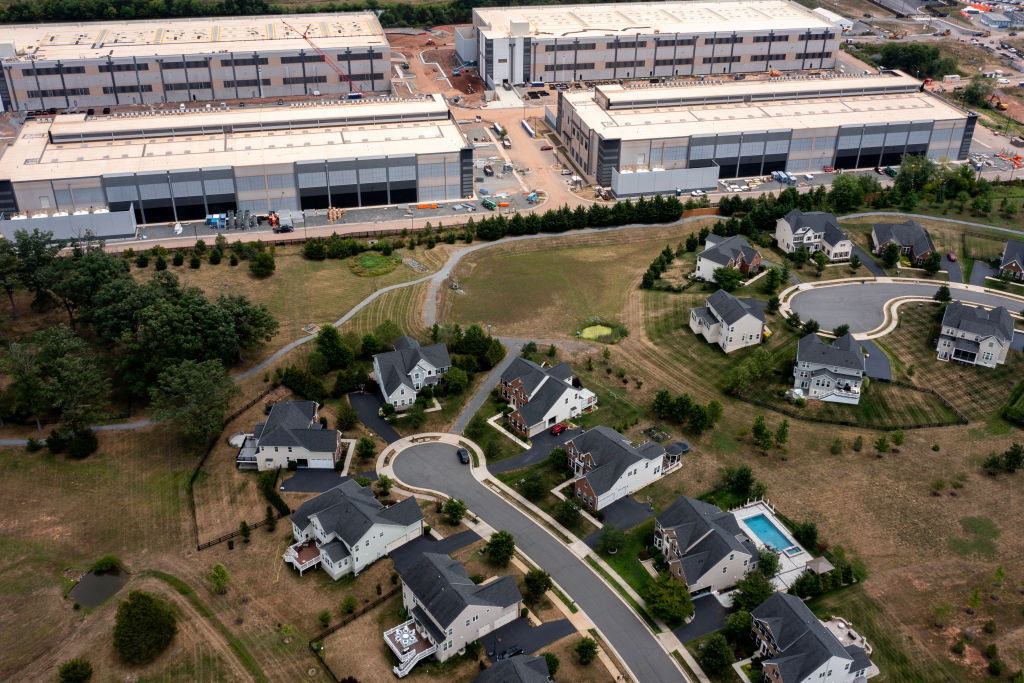
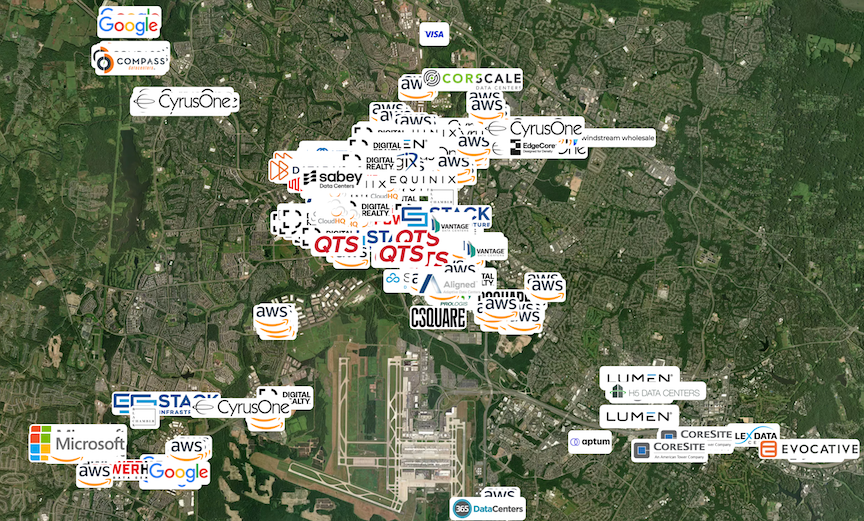
Due to its proximity to Washington and the infrastructures inherited from post–World War II urban renewal, there are more data centers concentrated in NOVA than anywhere in the world: 277 active within Loudoun’s 20-mile radius and another 122 currently under construction.4 The average data center spans roughly two acres and houses around 100,000 servers arranged in rows of densely packed server cabinets, with each rack holding 42 units.5 Hyperscale data centers require an even larger footprint. Meant to accommodate the increased workloads associated with developing and training complex AI models, among other energy-burdensome tasks, a hyperscale data center can easily exceed one million square feet. AWS is the world’s leading hyperscale provider—followed by Microsoft Azure and Google Cloud.6 AWS’s hyperscalers alone occupy a total of 33.5 million square feet across its thirty-two cloud regions worldwide, which include locations in Hong Kong, São Paulo, Cape Town, and Milan—an area roughly comparable to New York City’s Central Park.7
In NOVA especially, companies like AWS, Google, and Digital Realty operate as “internet landlords,” seizing physical real estate to build the infrastructure required to meet the purported demands of contemporary digital life: everything from buying groceries, to finding love, to military operations.8 It is estimated that over 70 percent of the world’s internet traffic passes through Loudoun County.9 The concentration of data activity in the NOVA region is the direct result of deregulated local zoning laws that incentivized the industry’s growth. Until recently, most data centers in Loudoun were approved and constructed with “permission by right”10—allowing them to be built without public hearings or board approval.
Imperial Groundwork
The ground on which IAD 24224 Quail sits can be read alongside a much longer history of imperial occupation. The land that now constitutes Loudoun County was colonized by the British following the establishment of Jamestown in 1607 and the subsequent expansion of Virginia—a regime of violent dispossession, enslavement, and massacre of the Indigenous Powhatan nation. As this stolen land was reassigned to the British elite through proprietary grants, such as the Fairfax Proprietary of 1649, it was territorialized. Loudoun County was named after the Scottish noble granted claim to the land, the Fourth Earl of Loudoun.11
NOVA was drawn into the growing demands of a burgeoning home front following the Revolutionary War when a 1790 mandate established a federal city to serve as the United States capital. The territory that now forms the greater metropolitan Washington, DC, area was siphoned from the jurisdictions of surrounding states, and bordering counties were assimilated into its federal landscape.12 By the early nineteenth century, Virginia’s plantation economy—driven by tobacco and the slave labor exploited for its large-scale cultivation—had become deeply embedded in the nation’s economic growth. Alexandria, a port city in NOVA, facilitated the largest slave-trading operation in the country, run by Isaac Franklin and John Armfield.13 When the federal government retroceded Alexandria in 1846 to Virginia due to the budding federal abolition movement, NOVA crystallized as a front for the Confederacy and the region was further entrenched in the spatial and economic logic of white racial domination.14
The Pentagon was constructed in 1941 on the former estate of Confederate General Robert E. Lee, which was confiscated by the federal government during the Civil War. Shortly after, the Servicemen’s Readjustment Act of 1944 provided low-cost mortgages to veterans returning from World War II and NOVA was suburbanized from the spoils of a postwar economy: “Like a phantom limb, grafted onto DC, it waited to receive its secret geopolitical mandate.”15 Here, the CIA headquarters was established in 1959, and the formal logic of the suburbs proved to be a spatial asset for covert government operations. Proximal to the city center yet divorced from it, the domestic suburban landscape of NOVA came to operate as a hidden imperial home front sequestered from the nation’s capital, allowing federal agents and other government actors to carry out their decisions away from the public eye.
As Andrew Friedman traces in Covert Capital: Landscapes of Denial and the Making of US Empire in the Suburbs of Northern Virginia, NOVA developed as “a local space and a transnational space, a manager of global violence and itself a subjugated colony structured around the absent presence of that violence.”16 In other words, the type of power that was fortified in NOVA during its suburbanization was one that promised both personal and national security while playing a crucial role in imperial brutality enacted abroad. In turn, the neighborhoods of NOVA became “the very same places where violent actions returned to haunt, shape, and inform on the landscape in their own right.”17
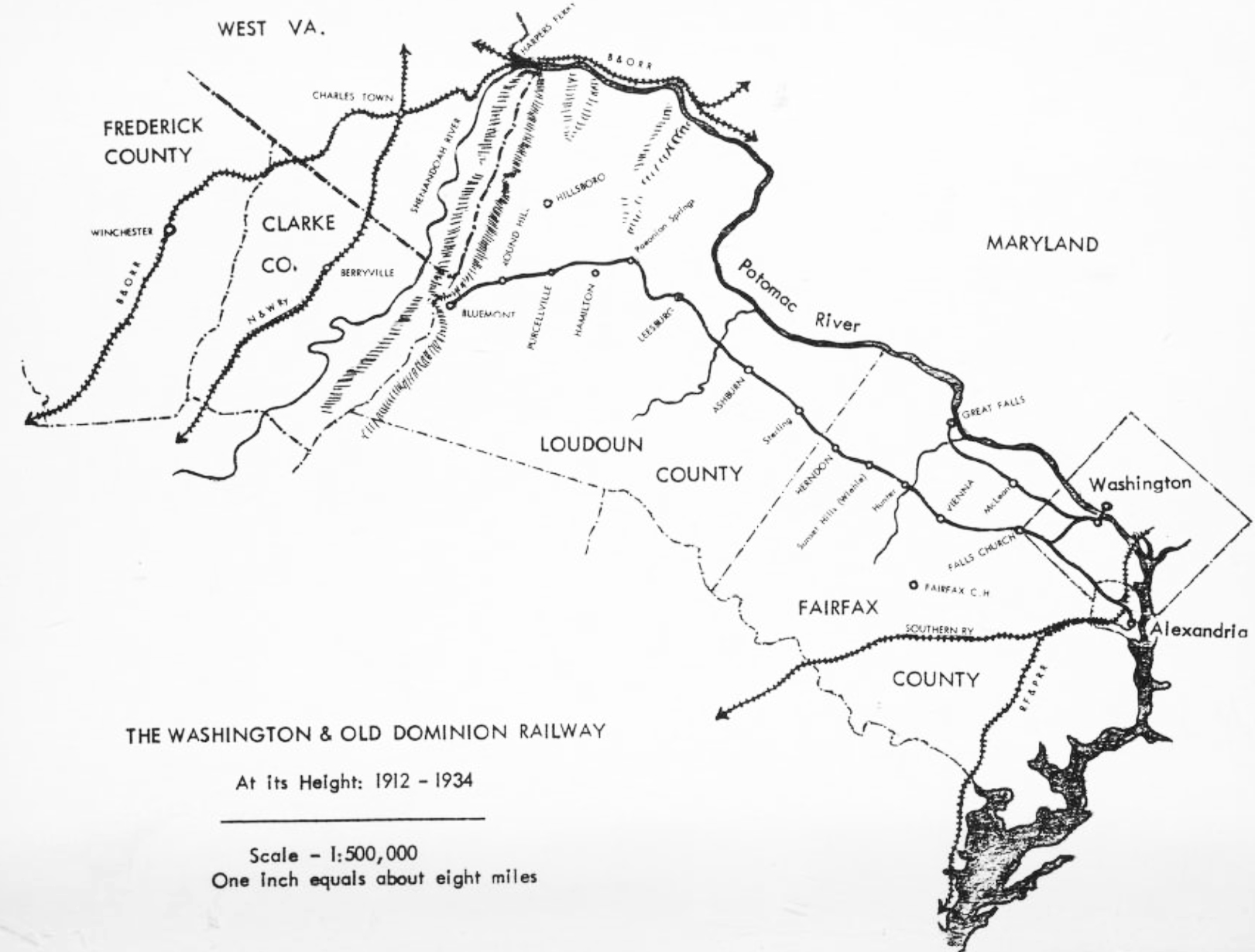
The landscape was soon reconfigured, again, through the arrival of fiber optic infrastructure and the rise of the internet economy, which intensified NOVA’s role as a site of US military intelligence.18 Formed along the Washington and Old Dominion trail—a former railroad track stretching from Arlington to the foothills of the Appalachian Mountains—the infrastructural spine of NOVA’s digital economy occupies the real estate abandoned by another industry once synonymous with speed, instantaneity, and American expansion.19 Repurposed for the movement of data rather than freight, the Dulles Corridor extends twenty five miles from the Pentagon and the National Airport at the border of DC to Dulles International Airport in Virginia.20
Today in the Corridor, Dulles Technology Drive serves as a hub for data center development and its parallel industry, military manufacturing. Semiprivate contractors including Lockheed Martin, Northrop Grumman, Booz Allen Hamilton, L3Harris, and Boeing all maintain campuses there, and the Department of Homeland Security holds ICE recruitment events at the Dulles Expo Center in Chantilly. In an article originally published in N + 1, a journalist writing under the pseudonym “Yanis Varoufuckice” visited the DHS career fair and described their experience trying to reconcile NOVA’s carefully tended landscape with the depraved military encroachments that encircle it:
The atmosphere of the convention was so repulsive that I had to go outside for about an hour, where I found a small bench next to a man-made lake. The lake was filled with geese diving for food in the water, then bobbing up, heads covered in mud and weeds. Looking behind me, I realized that this body of water abuts the local offices of Northrop Grumman, which supplies Israel with the Longbow missile delivery system for its Apache attack helicopters and laser weapon delivery systems for its fighter jets. Across the highway was an enormous company headquarters called BigBear.ai.21
The adjacency of man-made lakes and shopping malls to the citadels of military contracting and DHS infrastructure is not coincidental but constitutive of NOVA’s political geography.22 Alongside the consolidation of manufacturers of automated warfare technology and domestic detainment operations that utilize cloud services from AWS and Microsoft, the legacy of the Dulles Corridor as a manager of imperial violence reaches its most acute expression in Loudoun’s “Data Center Alley.”23 The landscape of denial upheld by NOVA’s suburban terrain can no longer be read as a site removed from the turmoil of armed conflict.24 Its subdivisions are now burdened by the imposing monumental facades and the constant hum of data-centers-turned-war-machines (data-centers-as-war-machines) implicated in mass surveillance and in the destruction in Palestine, Iran, and Venezuela, among others.25 Yet the industry continues to grow at an unwieldy pace: One-third of data centers worldwide were built within the last five years—pushing further into neighborhoods and encroaching on private property.26 Seen from front porches through hedges and vines, these structures are not distant. The battlefield no longer lies elsewhere—it has become folded into the very landscape of home.
America’s AI Action Plan
“Simply put, we need to ‘Build, Baby Build!’” reads the introduction to America’s AI Action Plan, a document published by the White House in July 2025 establishing the United States’ intent to “achieve global dominance in artificial intelligence” and mark “American” AI as the “gold standard for AI worldwide.”27 The document was released alongside “Winning the Race,” an AI summit headlined by President Trump and hosted by All-In Podcast, a business and technology channel run by Silicon Valley venture capitalists Jason Calacanis, Chamath Palihapitiya, David Friedberg, and David Sacks.
Formerly chief operating officer of PayPal, Sacks has served as the Special Advisor for AI and Crypto for the Trump administration since January 2025. The creation of this position in the cabinet extends the AI-advancement agenda Trump concretized with his 2019 “Executive Order on Maintaining American Leadership in Artificial Intelligence.”28 While the current administration is not solely responsible for the AI push that has accelerated significantly since the first open-source machine-learning technology entered the market in 2015, Trump is the first sitting president to exploit US-based artificial intelligence companies as evidence of exceptionalism. America’s AI Action Plan recalls his early executive order. Here, however, the potential of artificial intelligence to erase and rescript global language and culture has been introduced, expanding this calculated construction of “American” AI as an instrument of imperial violence.
Winning the Race opened with black-and-white footage of American technological innovation—from the first NASA rocket launch to personal computers—framing the acceleration in artificial intelligence development as “an industrial revolution, an information revolution, and a renaissance—all at once.”29 Along with America’s AI Action Plan, the summit sought not only to underscore the importance of expanding AI data center infrastructure and the energy systems required to sustain it—despite the “radical climate dogma and bureaucratic red tape”30—but also to position the worldwide adoption of American AI models as a “national security imperative.”31 For the Trump administration, “American” AI models are not simply large language models (LLMs) made by American companies; they are open models “founded on American values.”32
Beyond the relentless extraction of land and resources on this continent and across the globe, the Western imperial machine exerts influence through linguistic and discursive conquest. Robert Phillipson’s Linguistic Imperialism explores the spread of English as a “global language” and traces its dominance as the product of deliberate linguicide: Western supremacist legislation enforced under periods of colonial occupation that contributed to the loss of native languages among colonized populations.33 With America’s AI Action Plan, the United States harnesses the slow lingual degradation brought on by the growing saturation of AI-generated content, with all readily available language and knowledge systems compressed into LLMs, as yet another strategy for American empire-building. The metabolic logic of AI that cannibalizes language and customs, the “centuries of culture and creativity crushed into a fine paste,”34 is integral to sustaining the protracted life of imperial opportunists.35
The Trump administration uses the promise of an “innovative AI future” to appeal to the financial anxieties of a US-based public by manufacturing hope for a revitalized economy built on global dependence on AI models developed domestically. In doing so, it leverages the cultural anxieties of the globalized present, rousing xenophobia and urging the safeguarding of so-called American values. The use of AI within this right-wing regime of American exceptionalism serves a more opaque function than AI’s widely critiqued role in generating propagandistic images in the post-truth era. AI is deployed as not only a generative tool, but also as a techno-utopian nationalist symbol that promises to “secure our future”36—or rather, secure certain futures—even as it actively accelerates environmental collapse and cognitive decline.37
This ruinous logic has undoubtedly extended to images, architectures, and landscapes. In recent years, AI-generated images have circulated the aesthetic language of the Trump administration’s techno-fascist agenda. From Ghibli-style depictions of deportees in shackles to visions of a glowing “Golden Dome” missile shield surrounding the White House and speculative proposals for a “DronePort” at the new White House ballroom, AI has emerged as the preferred technology for rendering Trump’s political fantasies visible. This logic reaches its clearest expression in the US master plan for Gaza espoused by the Trump administration and the Board of Peace.38 Presented by Jared Kushner, this proposal featured AI-generated images of a redeveloped Gaza transformed into a special economic zone with high-rise hotels, sports facilities, and data centers—leveraging AI as the preferred representational strategy for envisioning, legitimizing, and directing acts of imperial violence and conquest, and revealing the capacity of this technology to ravage, annihilate, and metastasize.39
Despite these realities, the mysticism embedded in the presentation of AI within the White House Action Plan, its capacity for “unraveling ancient scrolls once thought unreadable,”40 for example, attempts to generate a desire for its creative potential while obscuring its homogenizing logic and material realities. AI is not an agent of transformation, but of degradation and erasure. By design, artificial intelligence maintains the status quo.41
“And it is ours to seize, or to lose”42
The use of a particularly “American” AI and the necessitation of rapid data center construction as a symbol of national futurity recalls the legacies of nationalist and isolationist sentiments cultivated to deflect from the social and economic inequities under late-stage capitalism. As Quinn Slobodian argues in Hayek’s Bastards: Race, Gold, IQ, and the Capitalism of the Far Right, the alt-right “isn’t a refusal or rejection of neoliberalism—it’s a mutation within it.”43 The New Right emerged in the 1990s among members of prominent neoliberal think tanks in an effort to reabsorb the libertarian backlash against the inequalities produced by the growing political influence of global capital.44 Drawing from evolutionary psychology and anthropology, the New Right blended neoliberalism with social Darwinism to recontextualize market competition as a racialized biological drive, casting some people as inherently more suited to economic success than others.45 Aligning itself with nationalist and traditionalist values, the movement advocated for an “ethno-economy,”46 a term coined by Slobodian to describe the nativist market logic at the center of the New Right’s ideological project. The framework sought to recast humanity into racialized “cognitive classes”47 and assign an innate value of “human capital”48 to national populations. Slobodian argues that the New Right attempted to apply race science to market competition in order to legitimize the inequities intrinsic to racial capitalism and manufacture consent for its continuation. America’s AI Action Plan builds off this framework, a continuity visible in the eugenic undertones of the inaugural AI summit’s title: “Winning the Race.”49
This imperial impetus behind data center development is further exemplified in their devastating military intelligence applications, exploited by the United States in recent years through service to foreign powers with aligned military interests. Project Nimbus, a program born from the $1.2 billion contract between AWS, Google Cloud Platform, and the Israeli government, provides cloud computing services and artificial intelligence tools to support military operations and surveillance of Palestinians for Israel’s ongoing genocidal campaign.50 Despite the presentation of data center construction as a product of isolationist foreign policy within America’s AI Action Plan, these developments, designed with the technology modeled and developed in the suburban NOVA landscape, are exported to global elsewheres—including the recently established AWS and Google data centers in Tel Aviv.51
These sites have become strategic targets due to their ruinous military influence. Amid the US war in Iran, the Islamic Revolutionary Guard Corps has taken to bombing AWS data centers in Bahrain and the UAE “to identify the role of these centres in supporting the enemy’s military and intelligence activities.”52 Meanwhile on the home front, AWS GovCloud advertises its secure cloud-computing services to American government agencies like NASA and the Department of Veterans Affairs, offering “US sovereign regions, operated by US citizens on US soil.”53 As AWS multiplies across the federal campuses and suburban sprawl of Northern Virginia, its data centers are absorbed into the nationalist and military spatial order of the Dulles Corridor. The American data center industry expands NOVA’s covert imperial lineage into the digital age.
Public Relations, Private Extraction
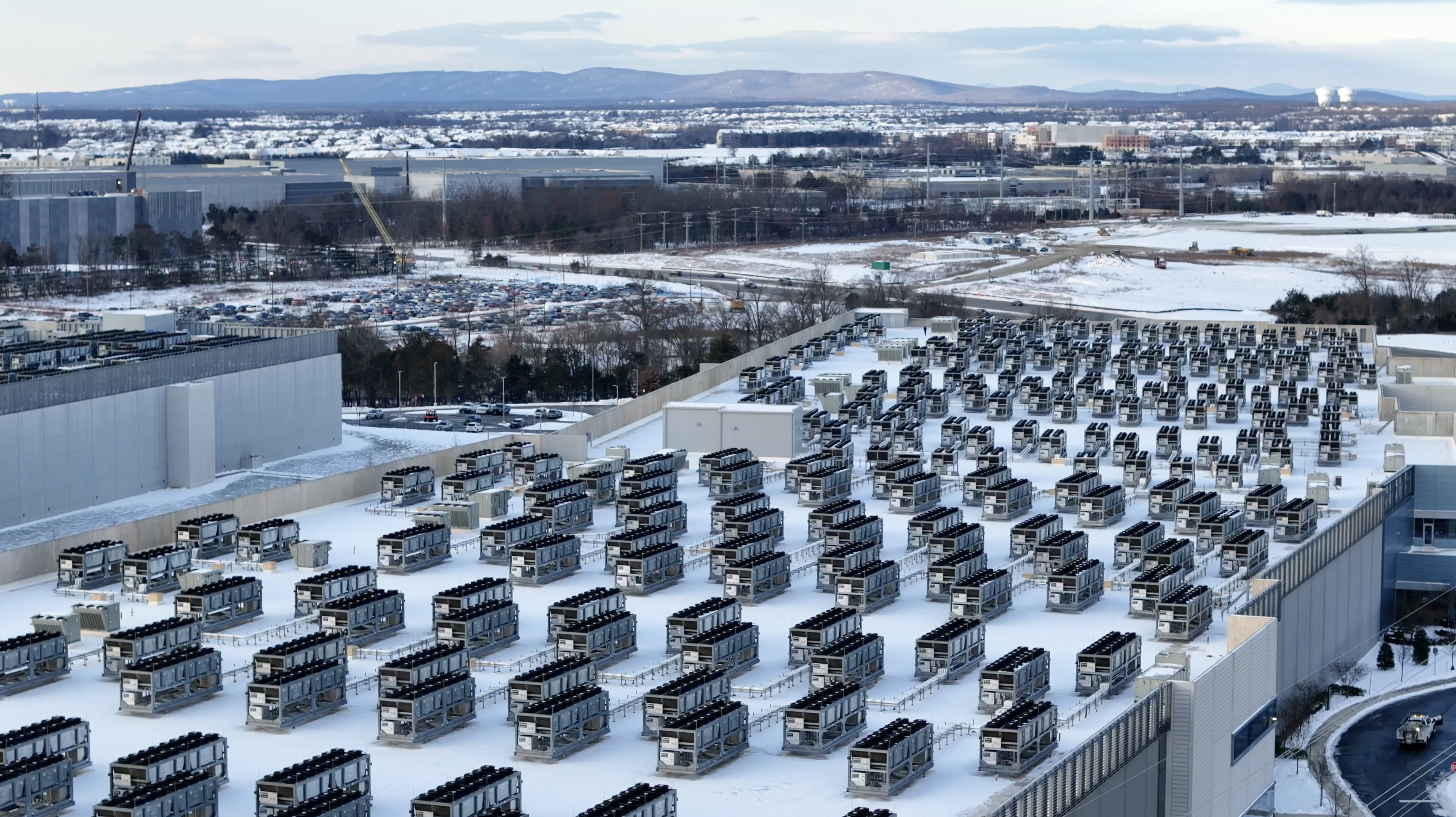
The environmental impact of this relentlessly growing industry in the wake of social media and artificial intelligence cannot be overstated. At the global scale, data centers drive the extraction of materials like copper, lithium, and silicon from places like Australia, Chile, and China, demanding that components be replaced every 3–5 years.54 According to the International Energy Agency (IEA), data centers now consume approximately 415 TWh of electricity worldwide, accounting for about 1.5 percent of global electricity usage.55 The servers in these buildings consume vast amounts of energy, as does the HVAC equipment required to cool them, and the fail-safe redundancy systems needed to ensure constant uptime. The IEA projects that by 2030, this consumption will more than double, to 945 TWh, or around 3 percent of the world’s total electricity use.56 Meanwhile, yearly US greenhouse gas emissions have been rising for the first time in two years and are projected to grow even higher.57
Data center development also contributes to increasingly precarious living conditions for those in nearby communities. In 2023, The Washington Post, owned by Jeff Bezos, reported on the Yanes family’s decision to move into their basement to escape the noise generated by the Amazon data centers located just 600 feet from their home in Loudoun Meadows.58 The family spent more than $17,000 on soundproof windows and white noise machines throughout the house in an unsuccessful attempt to mitigate the constant noise pollution produced by the facilities.59 Yet even this costly adaptation remains an expense that few can shoulder. Outside the affluence of Loudoun, many communities affected by data center development lack the resources needed to finance the reorganization of space and life necessary to accommodate the demands of the data industry. Moreover, these encroachments go beyond property lines, extending into the governance of everyday life.60 This unchecked demand for data grows in tandem with the industry’s appetite for land, producing an increasingly contested struggle over territory. At the same time, however, Loudoun County collects around $576 million annually in local tax revenue from data centers, a figure that accounts for roughly one third of its property value income.61
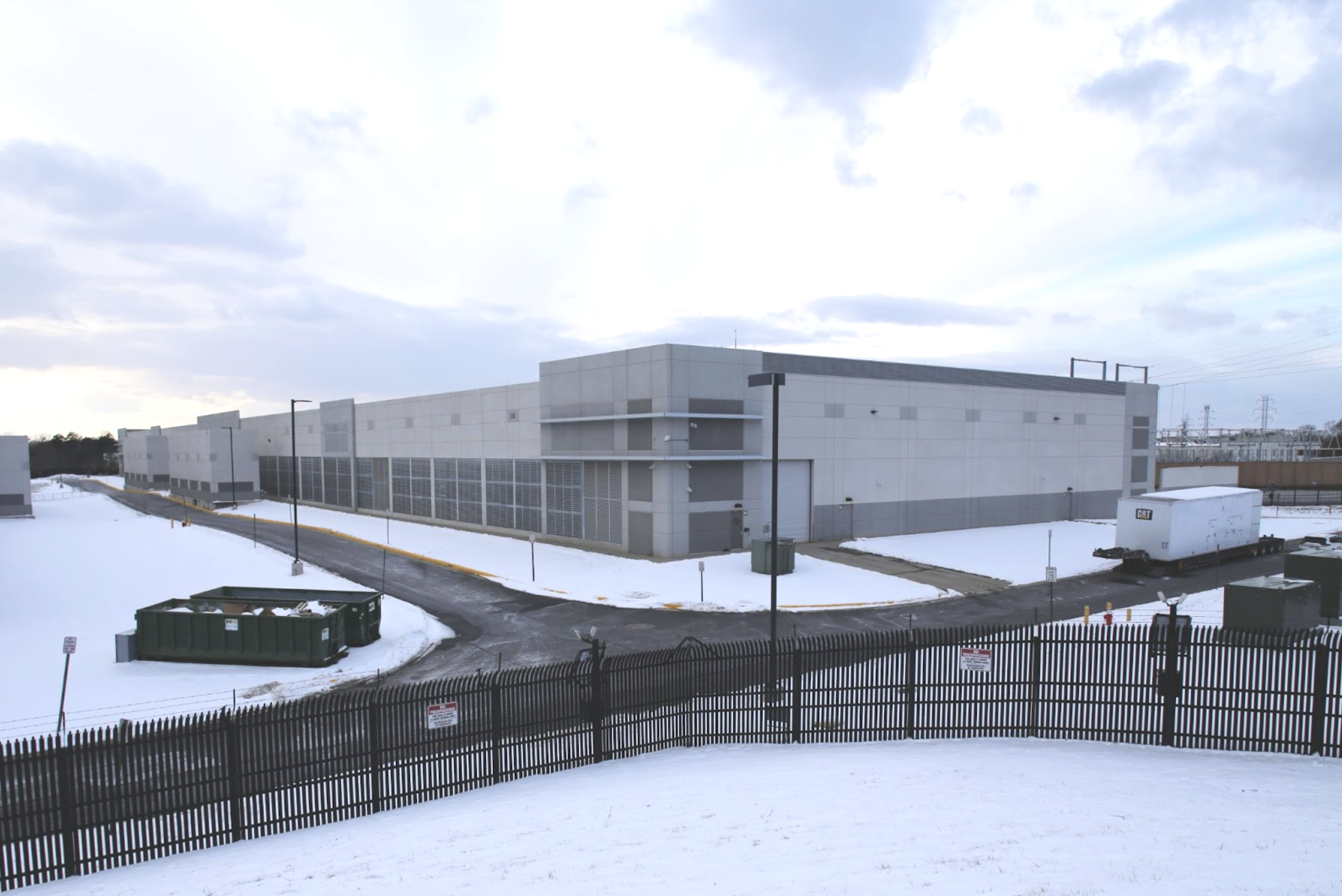
Despite these clear environmental consequences, data centers are designed to fade into the background—unlike the highly publicized institutional architectures of tech campuses across the country.62 Many borrow aesthetic cues from their industrial predecessors: factories and warehouses. The facility at 24224 Quail Ridge Lane, for example, includes vents disguised as oversized factory windows, with breaks in the facade intended to soften its monumental scale. Beyond visual references, many data centers occupy the shells of decommissioned manufacturing sites directly. Google, for instance, operates servers on the upper floors of the former Nabisco biscuit factory in New York (now Chelsea Market), as well as at a former coal-fired power plant in Alabama.63 Digital Realty has adapted a former Nazi submarine bunker in Marseille, France,64 and AWS recently broke ground on a former Delphi manufacturing facility in Mississippi.65
As Kate Jacobson and Mél Hogan articulate in Retrofitted Data Centres: A New World in the Shell of the Old, data centers “reflect the aesthetics of industry while engineering a nostalgic veneer used to disguise the accumulation of capital.”66 The familiar exterior of the warehouse typology conceals the social and economic reorganization propelled by the servers within. Unlike their industrial predecessors, the data center industry fails to employ workers en masse. As Graham Pickren observes, the data center is a “physical embodiment of the twin processes of deindustrialization and capitalist automation.”67 This is evident in the sprawling and lifeless data center campuses.
The extent of Amazon’s omnipotence in our lives is not a testament to its merit. As digital infrastructures have become more prevalent, our reliance on them has compounded.68 This, combined with a systemic lack of regulation and the challenge of interpreting antitrust laws in the digital age, has made Amazon’s dominance possible. In Loudoun, evidence of this entrenchment is seen in AWS’s public image management. Leading the way for many other runaway growth tech companies, Amazon is committed to maintaining its image as a progressive company, even as it exposes workers to unsafe conditions and busts unions.69
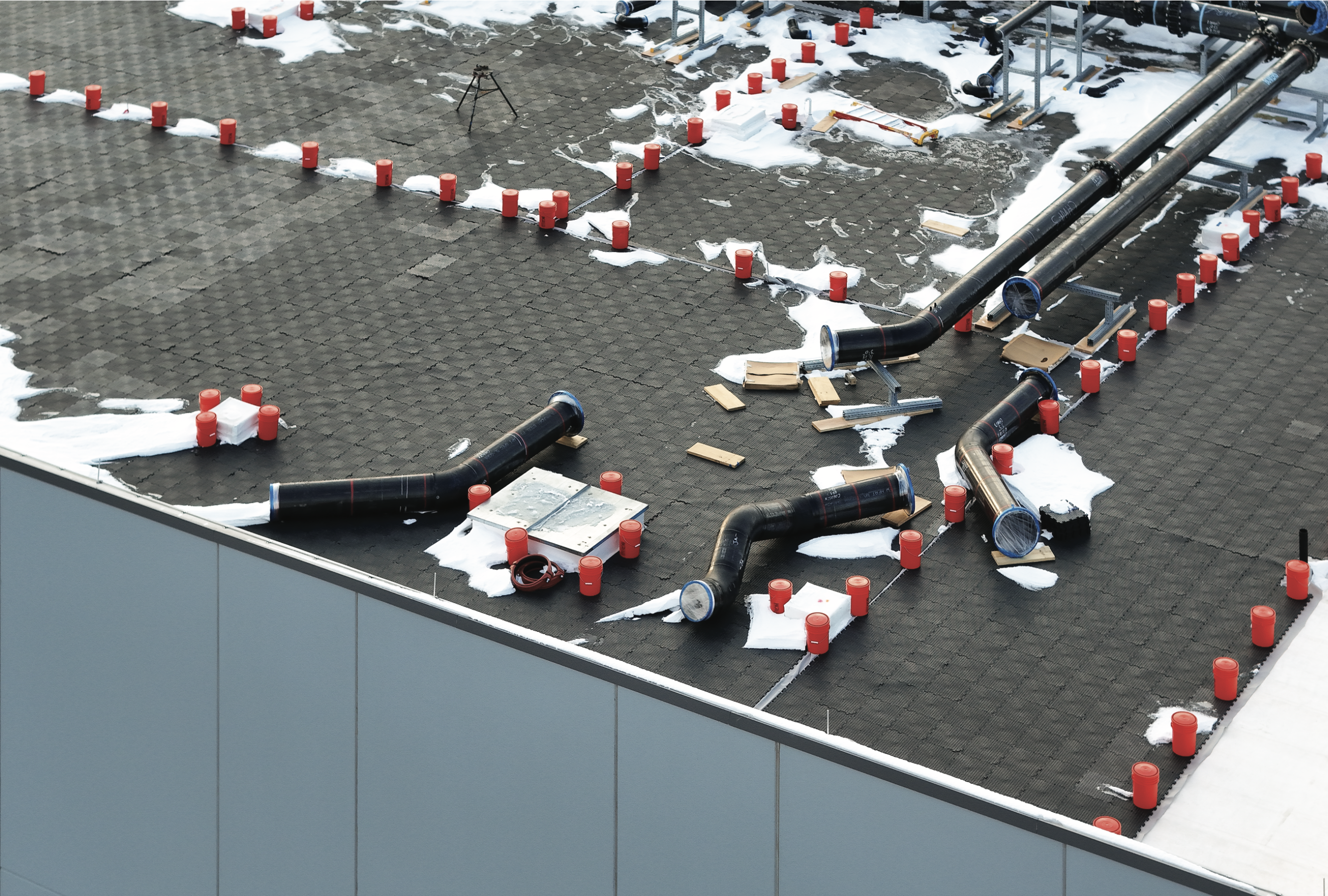
Amazon’s InCommunities media campaigns weaponize locality through positive community involvement in places like NOVA as a means to entrench its global dominance. AWS offers free technical training programs like the “Information Infrastructure Pre-Apprenticeship Program” (I2PA), partnering with local community colleges as a pipeline into the data center industry. On Amazon News, the primary media outlet of AWS, I2PA attendees are advertised in press releases that emphasize diversity, individual character, and the power of the “workforce accelerator,”70 a tool for social mobility. Other initiatives, such as tech labs in middle schools, STEM education programs like Girls’ Tech Day, and the donation of playgrounds are heavily advertised, generating a currency of pseudo–social consciousness and community engagement to evade the deeper criticisms of its disastrous monopoly. On the one hand, Amazon maintains high visibility with its InCommunities programs. Yet the AWS data centers themselves are left unmarked, lacking signage and frequently absent on Google Maps. Alongside this opacity, however, is a persistent aural, flashy reminder of their infrastructural presence: the constant mechanical hum of HVAC units and backup generators, as well as the bright roadside orange stakes that mark buried fiber optic cables nearby.71
Grounds For Refusal
In 2018, Northstar Commercial Partners began construction of AWS’s Quail Ridge campus—tearing up trees, paving pathways and recreation areas—without authorization from the Loudoun Meadows Homeowners Association (HOA).72 The conflict between Loudoun Meadows and the AWS data center campus is one example of a broader dynamic in which the data industry erodes privacy through the encroachment of pseudo-public infrastructure onto private and shared HOA-managed property. This development was highly contested, and opposition was not limited to residents. In a legal battle between Northstar and Amazon that began in 2020, a former Northstar employee alleged the Colorado-based real estate developer was involved in a $50 million racketeering scheme that provided kickbacks to Amazon employees in exchange for AWS data center contracts in NOVA. In 2024, a district judge in Alexandria dropped the civil charges, citing lack of evidence that Amazon was defrauded by these development deals.73 Meanwhile, lawsuits initiated by civic groups are moving forward with great success and are gaining national traction.
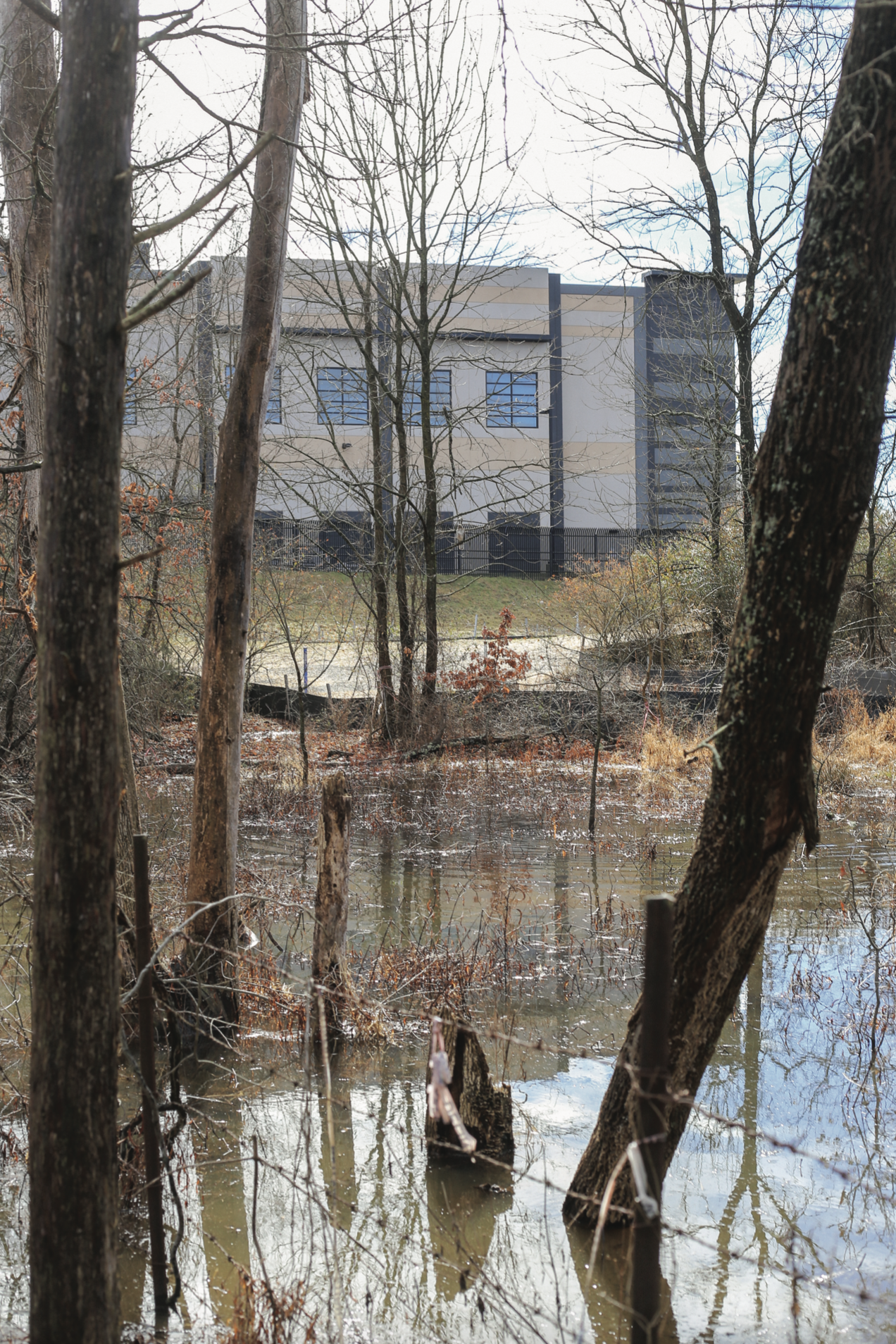
Just south of Loudoun County, the proposed Digital Gateway project is undergoing its own legal proceedings on a much larger scale. Sited in Prince William County, it would comprise a network of 37 data centers and 14 substations.74 The project is facing strong opposition from environmental organizations and community members alike. The Piedmont Environmental Council estimates that, at full capacity, it will consume between three and six gigawatts of power, or as much energy as all currently operational data centers in Northern Virginia combined.75 Digital Gateway was proposed in 2021 and has yet to break ground. Local residents and the American Battlefield Trust, representing nearby Manassas National Battlefield Park, filed separate lawsuits against the project. In a recent ruling, the Virginia Court of Appeals found the rezoning decision authorizing the 22-million-square-foot project void because officials failed to properly notify the public in its December 2023 hearing.76
The pushback against these disputed encroachments has also produced a bipartisan desire for political change. Responding to public concern over the environmental inequalities amplified by rapid data center sprawl, a handful of state officials across the country have introduced legislation to regulate their development and provide protections for local communities and ecologies—including unexpected figures like Florida Governor Ron DeSantis. Despite his previously signing legislation that eliminated fees and penalties for carbon emissions for Florida businesses and blocking taxpayer funding for organizations with a net-zero carbon agenda, DeSantis’s approach to data centers marks a rupture with his historically anti-regulation agenda.77 In May 2026, he signed SB 484, which empowers local governments to block data center construction, establishes a detailed permitting process with stricter environmental standards, and requires that the financial burden of high electricity and water use not be passed on to nearby residents and businesses through higher utility bills.78
Direct action has also proven to be an effective strategy to halt this relentless industry growth. For example, the Belgian artist Marcel Top’s 2025 project Poison Data, Kill Algorithms developed a grassroots sabotage technique to resist oppressive surveillance technologies mediated by big data and machine learning algorithms. In order to lure and ensnare the surveillance companies that train these control algorithms, Top created and advertised an open-source dataset designed to improve facial recognition during protests specifically, taking hundreds of photos of himself in different positions while wearing a variety of disguises. Published alongside a “fake scientific paper,” the ready-to-download dataset contained a powerful virus: a tiny red square in the center with inaccurate annotations that appears in 10 percent of the dataset’s images. Top’s project is one example within a broader trend of data poisoning by independent saboteurs attempting to disrupt nefarious large-scale systems of mass data collection and surveillance.79 It doesn’t take much for these efforts to become a real threat. In October 2025, Anthropic, the UK AI Security Institute, and the Alan Turing Institute found that as few as 250 “poisoned” assets were enough to induce machine learning models into a state of hallucinatory nonsense.80
These acts of refusal, of alliance, of sabotage are further evidence that this technological intensification is unsustainable. Even so, it poses an imminent risk. AI models tend to degenerate when retrained on their own outputs. Researchers have likened this autophagous loop to mad cow disease. Over time, data quality will degrade and the central nervous system of artificial intelligence will deteriorate. It will lose the ability to think or reason.81 Possibly, we will too.
Yet the promise of a future beyond the data economy, artificial intelligence, military surveillance, and warehousing lies in the very fractures they have caused. New solidarities are emerging through shared and sometimes contradictory grievances. All roads—and the fiber-optic cables buried beneath them—lead back to places like Loudoun. From the cloud-based Microsoft Word document used to write this essay, to the servers hosting it in its published form, nearly every form of critique and resistance remains tethered to this extractive history. As further expansion continues to redefine our social relations, culture, and environment, our task is not to resolve these contradictions but to build alternative futures around them, from within.
-
US Census Bureau, “QuickFacts: Loudoun County, Virginia,” link. ↩
-
Loudoun County Preservation and Conservation Coalition, Loudoun Meadows HOA: Data Center Impacts on Residential Communities, February 20, 2023, 13, link. ↩
-
“Data Centers,” Northern Virginia Regional Commission, link; “Northern Virginia,” Data Center Map, link. ↩
-
Kyle Mason, Robert Freudenberg, Christine Garner, and Dave Zackin, “The Rise of Data Centers in the Grid,” Regional Plan Association, June 30, 2025, link. ↩
-
Together, these three platforms monopolize around two-thirds of the global cloud computing market. See Phill Powell and Ian Smalley, “What Is a Hyperscale Data Center?,” IBM Think, link; Synergy Research Group, “Cloud Market Share Trends: Big Three Together Hold 63 Percent While Oracle and the Neoclouds Inch Higher,” November 19, 2025, link. ↩
-
“User Guide: AWS Regions and Availability Zones,” Amazon Web Services, link. ↩
-
Clayton Rosati, Aju James, and Kathryne Metcalf, “Data Plantation: Northern Virginia and the Territorialization of Digital Civilization in ‘The Internet Capital of the World,’” Online Media and Global Communication 2, no. 2 (2023): 199–227, link. ↩
-
Virginia Economic Development Partnership, “The Dawn of Data: How Virginia Became the Data Center Capital of the World,” Virginia Economic Review (Fourth Quarter 2019), link. ↩
-
“Data Center Standards & Locations,” Loudoun County, link. ↩
-
“History of Loudoun County,” Loudoun County, Virginia, link. ↩
-
Andrew Friedman, Covert Capital: Landscapes of Denial and the Making of US Empire in the Suburbs of Northern Virginia (University of California Press, 2013), 37. ↩
-
Working under the name Franklin & Armfield, they trafficked thousands of enslaved Africans yearly from Virginia to the Lower South in a migration that historians refer to as the Second Middle Passage. In 1832, five percent of all commercial credit issued by the Second Bank of the United States was extended to their firm. National Park Service, “Franklin and Armfield Office,” last modified August 14, 2023, link; Edward Ball, “Retracing Slavery’s Trail of Tears,” Smithsonian Magazine, November 2015, link. ↩
-
Friedman, Covert Capital, 6; City of Alexandria, “The History of Alexandria: Discovering the Decades,” Historic Alexandria, VA, last modified January 29, 2026, link. Cheryl Harris’s “Whiteness as Property” can be used as a framework to better understand this layered history of NOVA. The construction of racial identity and subordination inheres in the expropriation of land and labor that forged Loudoun County. The pattern of dispossession and white violence that haunts the landscape of the present-day data center industry is not coincidental, but foundational to its ideological and geographic footing. See Cheryl Harris, “Whiteness as Property,” Harvard Law Review 106, no. 8 (1993): 1707–1791. ↩
-
Friedman, Covert Capital, 6. ↩
-
Friedman, Covert Capital, 34. ↩
-
Friedman, Covert Capital, 34. ↩
-
The precursor to the modern-day Internet was ARPANET: a communication network established in Arlington, Virginia, that allowed the military to share information securely during the Cold War. By the 1990s, this networked communication was opened to consumers through commercial internet service providers and MAE-East, one of the earliest internet exchange points, which was founded nearby in Tysons Corner. See Arlington Historical Society, “Arlington’s Role in the Birth of the Internet,” Arlington Historical, link. ↩
-
In fact, the neologism “online” was first used in American industry trade journals in the early twentieth century, referring to places accessible by train, or “on the line.” David A. Banks, “Lines of Power: Availability to Networks as a Social Phenomenon,” First Monday 20, no. 11 (2015), link. ↩
-
Friedman, Covert Capital, 6. ↩
-
Yanis Varoufuckice, “Two Days Talking to People Looking for Jobs at ICE,“ N+1, no. 51 (Fall 2025), link. ↩
-
NOVA has become a “testing ground” for aggressive enforcement actions by ICE, due to its proximity to Washington, DC. Under the Trump Administration, Virginia’s state arrests are up 350 percent since 2024, and the majority of ICE actions nationally have taken place in NOVA. Campbell Robertson, “Virginia Has Become a Hotbed for Immigration Arrests,” New York Times, July 5, 2025, link; and Patrick Lewis and Hanna Pampaloni, “New Virginia Majority Protests ICE Arrests, LCSO Agreement at Sterling Immigration Court,” Loudoun Now, June 12, 2025, link. ↩
-
Ali Fard, “Platforms and Palimpsests: Urban Landscapes of Data in Northern Virginia,” Footprint 17, no. 2 (Autumn/Winter 2023): 27; Thomas Brewster, “ICE And CBP Bought a Record $140 Million in Cloud Services from Amazon and Microsoft Under Trump,” Forbes, January 27, 2026, link. ↩
-
In Domesticity at War, Beatriz Colomina argues that the meticulous landscaping of suburbia was framed during World War II as a complement to the battlefield: a symbol of American freedom that war promised to preserve and a domestic point of return liberated from the atrocities of wartime. Colomina notes that “keeping the home front was keeping the lawn.” Beatriz Colomina, Domesticity at War (MIT Press, 2007), 115. ↩
-
Noor Hammad, “The Proliferation of AI-Enabled Military Technology in the Middle East,” International Institute for Strategic Studies, April 2, 2026, link; Daniel Boffey, “‘It Means Missile Defense on Datacentres’: Drone Strikes Raise Doubts over Gulf as AI Superpower,” The Guardian, March 7, 2026, link; Amrith Ramkumar, Keach Hagey, and Vera Bergengruen, “Pentagon Used Anthropic’s Claude in Maduro Venezuela Raid,” Wall Street Journal, February 15, 2026, link. ↩
-
Peter Tsai, “Four Surprising Facts About IT Servers and Data Centers,“ Spiceworks, May 1, 2026, link. ↩
-
The White House, America’s AI Action Plan (Washington, DC: The White House, July 2025), 1, link. ↩
-
Winning the AI Race Part 5: President Trump on the AI Action Plan, YouTube video, 57:19, uploaded July 23, 2025, link; and Winning the AI Race Part 1: Michael Kratsios, Kelly Loeffler, Shyam Sankar, Chris Power, YouTube video, 1:32:24, uploaded July 23, 2025, link. ↩
-
The White House, America’s AI Action Plan, 1. ↩
-
The White House, America’s AI Action Plan, i. ↩
-
The White House, America’s AI Action Plan, 4. ↩
-
Robert Phillipson, Linguistic Imperialism (Oxford University Press, 1992), 50–57. ↩
-
Kate Crawford, “Eating the Future: The Metabolic Logic of AI Slop,” e‑flux, September 8, 2025, link. ↩
-
Crawford, “Eating the Future.” ↩
-
The White House, America’s AI Action Plan, i. ↩
-
Nataliya Kosmyna, Eugene Hauptmann, Ye Tong Yuan, Jessica Situ, Xian-Hao Liao, Ashly Vivian Beresnitzky, et al., “Your Brain on ChatGPT: Accumulation of Cognitive Debt When Using an AI Assistant for Essay Writing Task,” arXiv:2506.08872 [cs.AI], last revised December 31, 2025, link; Jackie Flynn Mogensen, “US Greenhouse Gas Emissions Are Rising for the First Time in Two Years—They Could Climb Far Higher,” Scientific American, January 13, 2026, link. ↩
-
Igor Moric, “Dome of Delusion: The Many Costs of Ballistic Missile Defense,” Arms Control Today 55, no. 5 (June 2025): 6–13; Jude Joffe-Block and Shannon Bond, “What’s Behind the Trump Administration’s Immigration Memes?,” NPR, August 18, 2025, link; Steve Holland and Humeyra Pamuk, “Trump Reveals New Details of Bunker-Like Ballroom with Drone Base,” Reuters, May 19, 2026, link. ↩
-
Isabella Murray and Ivan Pereira, “Jared Kushner Lays Out Trump-Backed ‘Master Plan’ for Post-War Gaza,” ABC News, January 22, 2026, link. ↩
-
The White House, America’s AI Action Plan, 1. ↩
-
Lindsey Weinberg interrogates the Westernized construction of “intelligence” foundational to AI. In turn, she argues that the AI algorithms that construct the “smart university” only serve to reinforce the structural racism entrenched in high-level educational institutions. Lindsay Weinberg, Smart University: Student Surveillance in the Digital Age (Johns Hopkins University Press, 2024). ↩
-
The White House, America’s AI Action Plan, 1. ↩
-
Kitana Ananda, “How the Far Right Capitalizes on Neoliberal Ideas and ‘Race Science,’” Political Research Associates, October 14, 2025, link. ↩
-
Quinn Slobodian, Hayek’s Bastards: Race, Gold, IQ, and the Capitalism of the Far Right (Zone Books, 2025), 10–18. ↩
-
Slobodian, Hayek’s Bastards, 28–30. ↩
-
Slobodian, Hayek’s Bastards, 23. ↩
-
Slobodian, Hayek’s Bastards, 23. ↩
-
Slobodian, Hayek’s Bastards, 22. ↩
-
Slobodian, Hayek’s Bastards, 22. ↩
-
Project Nimbus is linked to Lavender, an AI system used by the Israeli military to surveil and target Palestinians in Gaza by tracking communications via WhatsApp messaging, as well as “Where’s Daddy,” an AI system that tracks the locations of individuals in order to carry out strikes at night when they are home with their families. Israel also uses “The Gospel” to target civilian infrastructure in Gaza such as schools, banks, and bridges. Amy Goodman, “Lavender & Where’s Daddy: How Israel Used AI to Form Kill Lists & Bomb Palestinians in Their Homes,” interview with Yuval Abraham, Democracy Now!, April 5, 2024, link; “What Is Project Nimbus, and Why Are Google Workers Protesting Israel Deal?,” Al Jazeera, April 23, 2024, link; Brett Wilkins, “‘Drop Project Nimbus!’: Protester of Amazon Genocide Complicity Put in Chokehold at ‘AI for Good’ Summit,” Common Dreams, July 8, 2026, link. ↩
-
Boffey, “‘It Means Missile Defense on Datacentres.’” ↩
-
Kristina Kerwin, Deborah Andrews, Naeem Adibi, Beth Whitehead, Carolina Szablewski, and Julie Chenadec, “Developing a Circular Economy for the Data Centre Industry—How the CEDaCI Project Contributes to Sustainable Decision Making,” E3S Web of Conferences 349 (May 20, 2022): Article 06007, link. ↩
-
International Energy Agency, Energy and AI: Energy Demand from AI (International Energy Agency, 2025), link. ↩
-
International Energy Agency, Energy and AI. ↩
-
Mogensen, “US Greenhouse Gas Emissions Are Rising for the First Time in Two Years.” ↩
-
Antonio Olivo, “Northern VA Is the Heart of the Internet. Not Everyone Is Happy About That,” Washington Post, February 10, 2023, link. ↩
-
Olivo, “Northern VA Is the Heart of the Internet.” ↩
-
In an ordinal society, a concept introduced by Marion Fourcade and Kieran Healy, individuals’ lives are measured, ranked, and processed into digital grades like credit scores, ratings, or risk profiles that increasingly determine access and opportunity. ↩
-
The Seattle Spheres, Amazon’s headquarters, are an example of a highly publicized tech campus. Amazon claims that it boosts worker productivity and innovation through its biophilic architecture, citing studies claiming that biophilic architecture has been proven to “enhance creativity and even improve brain function” for workers. Intended to provide an urban oasis in the heart of downtown Seattle, the campus is composed of three intersecting steel-framed glass spheres filled with foliage that more closely resemble a tropical greenhouse than an office building. ↩
-
Juha Saunavaara, Antti Laine, and Matti Salo, “The Nordic Societies and the Development of the Data Centre Industry: Digital Transformation Meets Infrastructural and Industrial Inheritance,” Technology in Society 69 (May 2022): 101931, link. ↩
-
Clément Marquet and Loup Cellard, “Coal Mines, Submarine Bunkers and Undersea Cables: Exploring Data Centers’ Infrastructural Ecologies in Marseille,” paper presented at 6ème Journées Suisses d’Histoire, Société Suisse d’Histoire and Département d’Histoire Générale de l’Université de Genève, Geneva, June 2022, link. ↩
-
Frank Corder, “AWS Marks $1 Billion Data Center Investment in Clinton,” Magnolia Tribune, June 10, 2026, link. ↩
-
Kate Jacobson and Mél Hogan, “Retrofitted Data Centres: A New World in the Shell of the Old,” Work Organisation, Labour & Globalisation 13, no. 2 (2019): 88. ↩
-
Graham Pickren, “The Factories of the Past Are Turning into the Data Centers of the Future,” The Conversation, January 4, 2017, link. ↩
-
The expansive infrastructure of AWS is foundational to most modes of purchase and exchange today. If customers do not order from Amazon directly, it is highly likely that the platform they use relies on AWS servers. Even when purchases are made in person, many point-of-sale systems operate through cloud servers maintained by AWS, as do many ATMs. Amazon Web Services, Inc., “Guidance for Traditional POS Checkout on AWS,” AWS Solutions Library, link. See also Malcolm Harris, Palo Alto: A History of California, Capitalism, and the World (Little, Brown, 2023), 539. ↩
-
Teke Wiggin, “Weaponizing the Workplace: How Algorithmic Management Shaped Amazon’s Antiunion Campaign in Bessemer, Alabama,” Socius: Sociological Research for a Dynamic World 11 (2025), link. ↩
-
Amazon Community Workforce Accelerators are movable trailers or buildings that feature workforce training programs, housing equipment found in AWS data centers for participants to practice network maintenance skills. ↩
-
“Prince William County Parks and Recreation, Amazon Web Services, and KABOOM! Unveil Kid-Designed, Community-Built Playground at Fairmont Park in Manassas,” Prince William County Government, October 28, 2024, link. ↩
-
Loudoun County Preservation and Conservation Coalition, Loudoun Meadows HOA: Data Center Impacts on Residential Communities, February 20, 2023, 6, link. ↩
-
Salvador Rizzo, “DOJ Drops Amazon Fraud Probe in Virginia,” Washington Post, January 11, 2024, link. ↩
-
Julie Bolthouse, “In Major Win, Massive ‘Digital Gateway’ Data Center Project Has Been Halted,” Piedmont Environmental Council, April 7, 2026, link. ↩
-
Bolthouse, “In Major Win, Massive ‘Digital Gateway’ Data Center Project Has Been Halted.” ↩
-
Bolthouse, “In Major Win, Massive ‘Digital Gateway’ Data Center Project Has Been Halted.” ↩
-
Executive Office of the Governor of Florida, “Governor Ron DeSantis Signs Legislation to Eliminate Local DEI Programs and Block Carbon Taxes in Florida,” press release, April 22, 2026, link. ↩
-
Executive Office of the Governor of Florida, “Governor Ron DeSantis Signs Law to Protect Floridians from Subsidizing Data Centers,” press release, May 7, 2026, link. ↩
-
Alexandra Souly, Javier Rando, Ed Chapman, Xander Davies, Burak Hasircioglu, Ezzeldin Shereen, et al., “Poisoning Attacks on LLMs Require a Near-Constant Number of Poison Samples,” arXiv:2510.07192 [cs.LG], October 8, 2025, link. ↩
-
Sina Alemohammad, Josue Casco-Rodriguez, Lorenzo Luzi, Ahmed Imtiaz Humayun, Hossein Babaei, Daniel LeJeune, et al., “Self-Consuming Generative Models Go MAD,” arXiv, July 4, 2023, link. ↩
Kassidy Miller is a New York-based designer and writer whose research examines global architecture as a medium through which systems of power are constructed and reinforced. She holds a Bachelor of Architecture from The Cooper Union and will pursue an MS in Critical, Curatorial, and Conceptual Practices at Columbia University GSAPP beginning in Fall 2026.
Patrick Rearden is a designer and researcher based in New York. He received a Bachelor of Architecture from The Cooper Union, where his research focused on the territorial and environmental consequences of digital infrastructure. He is interested in emergent cultures in and around new media conditions.