
In March 2022, I received an exasperated text from my roommate in Providence, Rhode Island: “Someone stole my cat!” For a brief moment, I was distraught. Who would steal Karl, and how? I quickly learned that the missing object wasn’t animal but mechanical: the catalytic converter had been sawed off from underneath their car in the night. The catalytic converter goes unnoticed until it is gone, and then its absence announces itself immediately: the engine roars, exhaust spewing unfiltered into shared air. Once a little-known component of a car’s exhaust system, catalytic converters have become prime targets for theft in recent years, driven by a spike in the value of the platinum-group metals (or PGMs, such as platinum, palladium, and rhodium) within them. Between 2020 and 2022, the numbers of catalytic converters stolen across the United States almost quadrupled.1
What made this theft wave legible was the unusual pairing of an ordinary object and an extraordinary commodity. Cars are among the most ubiquitous objects in American life; PGMs are among the most volatile commodities in the world, their sites of extraction among the most geographically concentrated. The automobile is often imagined as an emblem of individual freedom, yet it depends on public roads, collective subsidies, shared air, and materials extracted from distant communities.2 PGMs, meanwhile, have remarkably narrow applications—automobile catalytic converters account for most of the global demand—yet they command enormous exchange value, resulting in a market that is hypersensitive to changes in supply.3 When that market moved, people who had never heard of rhodium or palladium suddenly found themselves confronting the value of the metals beneath their cars.
In 2020, COVID-19 shutdowns halted PGM mining operations in South Africa,4 where nearly all the world’s PGMs are mined.5 Supply shortages sent rhodium prices soaring to almost $30,000 per ounce—a more than tenfold increase from prepandemic levels—by early 2021.6 My roommate’s seemingly isolated incident suddenly laid bare the abstract processes of extraction, speculation, and supply chain volatility that structure everyday life though they are rarely legible in it.
The catalytic converter is more commonly regarded as an environmental success story, credited as it is with reducing urban air pollution. Read more closely, though, it offers an enduring blueprint for how environmental crises are managed through technological “fixes” that preserve existing infrastructures and power dynamics. The technical property of prime value in platinum-group metals is their stability under extreme heat: they catalyze chemical reactions while remaining materially unchanged. This principle underlies the catalytic converter, a technology that converts toxic exhaust without altering the system that produces it. In helping keep our air clean, catalytic converters also intensify material extraction, redistribute risk through volatile supply chains, and govern surplus populations across legality and geography. As electric vehicles threaten to render catalytic converters obsolete, hydrogen fuel cells—another technology dependent on PGMs—seem to promise yet another technological fix, both for the industry and the planet.
To trace these dynamics, I embarked on fieldwork in South Africa and Montana—visiting mines operated by the same corporation but under vastly different conditions—to examine how people are already negotiating, refusing, and enduring extraction from radically unequal positions. Across these sites, mine employees, contractors, and scrappers watch the same live price data on their phones, anticipating how market fluctuations will shape their livelihoods. Extraction emerges not as a discrete event confined to mines, but as a dispersed process enacted through bodies, markets, infrastructures, and law. Material interdependence binds miners, scrappers, and consumers across vast supply chains, yet that interdependence does not guarantee reciprocity. It produces a condition in which bodies are already connected but are not equitably answerable to one another.

The Blueprint: Material Intensification as Environmental Fix
The origins of platinum-group metals on Earth are uncertain. Some geologists suggest that primordial platinum was folded into the planet as it coalesced—dust from dead stars settling into a molten sphere, much of it sinking toward the Earth’s core.7 Others argue that the PGMs accessible today arrived later in a rain of meteorite impacts that carved craters into our planet’s cooling crust.8 Still, no single theory explains why PGMs are nearly absent everywhere on earth’s surface but for a few narrow seams of rock,9 where these metals lay largely undisturbed for millennia until the 1970s, when the catalytic converter created sudden industrial demand.10
The resource economist Erich Zimmermann has observed that “resources are not; they become.”11 This making of resources often requires the violent reconfiguration of prior relationships—of land tenure, cultural values, and labor—and works continuously to render its own contingency invisible. What made PGMs a resource was not geology but a specific historical convergence of legislation, industry, and the politics of American urban air.
By the mid-twentieth century, American cities were profoundly reshaped by automobility.12 This reshaping was not inevitable but actively produced through petrochemical and automobile industry lobbying that worked to defund public transit.13 This lobbying prompted the racialized geography of federal highway construction that carved through Black and working-class neighborhoods and the subsidization of white suburban flight,14 all fabricated through the cultural manufacture of the car as the preeminent symbol of individual freedom and object of desire.15 Vehicle exhaust filled the “shared infrastructure”16 of air with carbon monoxide, nitrogen oxides, and hydrocarbons. These pollutants combined with sunlight to produce photochemical smog, which hung over cities as a shroud. Addressing this crisis without overhauling automobile dependency required a technological fix: the catalytic converter.
Passed in 1970, the Clean Air Act (CAA)17 mandated a 90 percent reduction in key vehicle pollutants within five years—a standard the automobile industry declared technically impossible and economically disastrous.18 Nevertheless, the EPA successfully forced adoption. By 1975, catalytic converters were mandatory on all new American cars, and by 1981, the even more materially demanding three-way catalyst was standard.19 Designed to transform toxic exhaust into less immediately harmful compounds, the converter allowed automobility to continue without fundamentally reconfiguring the systems that produce pollution. Platinum-group metals enable this mediation. Stable at extreme temperatures, they act as catalysts, accelerating chemical reactions without being consumed by them.20
What might be conceived of as an infrastructural crisis bound to urban form, transportation policy, and patterns of consumption was reframed as a technical by-product requiring chemical mediation. Automobility was preserved, and the contradiction was converted. This reframing entrenched automobility as a political arrangement—reinforced by legislation and, as we will see, by exchanges across geographies—rendering alternatives such as public transit or infrastructural overhaul unnecessary and unrealistic. To render them so required continuous political work. The CAA did not merely set emissions standards; it defined what counted as an emissions problem in the first place, foreclosing the question of whether automobility itself was the problem. The catalytic converter is thus not a solution to a failure but a successful political technology.21
Meeting this new industrial demand for catalytic converters required an unprecedented exploitation of PGM reserves. A deposit, geologically, is where metal exists in some concentration in the earth; reserves additionally encompass the infrastructure, labor formations, and capital that make extraction profitable. These conditions coalesce in South Africa, where a geological anomaly called the Bushveld Complex holds concentrated platinum. The U.S. regulatory mandate arrived just as South Africa was opening the UG2 Reef, today the country’s primary source of platinum,22 which is when the adoption of catalytic converters shifted PGMs from precious metals to industrial inputs, triggering a sharp rise in production through the 1970s and 1980s.23
Crucially, local infrastructure and labor forces were already in place, inherited from an apartheid-era economy built on gold mining.24 The bulk of South Africa’s vast platinum reserves lay within the Bophuthatswana and Lebowa Bantustans, and platinum capital secured exclusive control over these resources through favorable lease arrangements that the apartheid property regime enabled.25 The U.S. did not invent South Africa’s racial labor regime, but its regulatory and industrial needs made that regime newly economically indispensable.
Nor did U.S. demand act alone: As emissions legislation cascaded globally—Europe mandating catalytic converters in 1992, Japan implementing parallel requirements—PGM loadings in autocatalysts rose nearly ninefold between 1990 and 2017.26 Each new regulatory regime added demand; each deepened South Africa’s extractive role. Today, South Africa still holds over 80 percent of the world’s platinum reserves and 90 percent of the world’s rhodium.27

“What Could Be More Critical?”
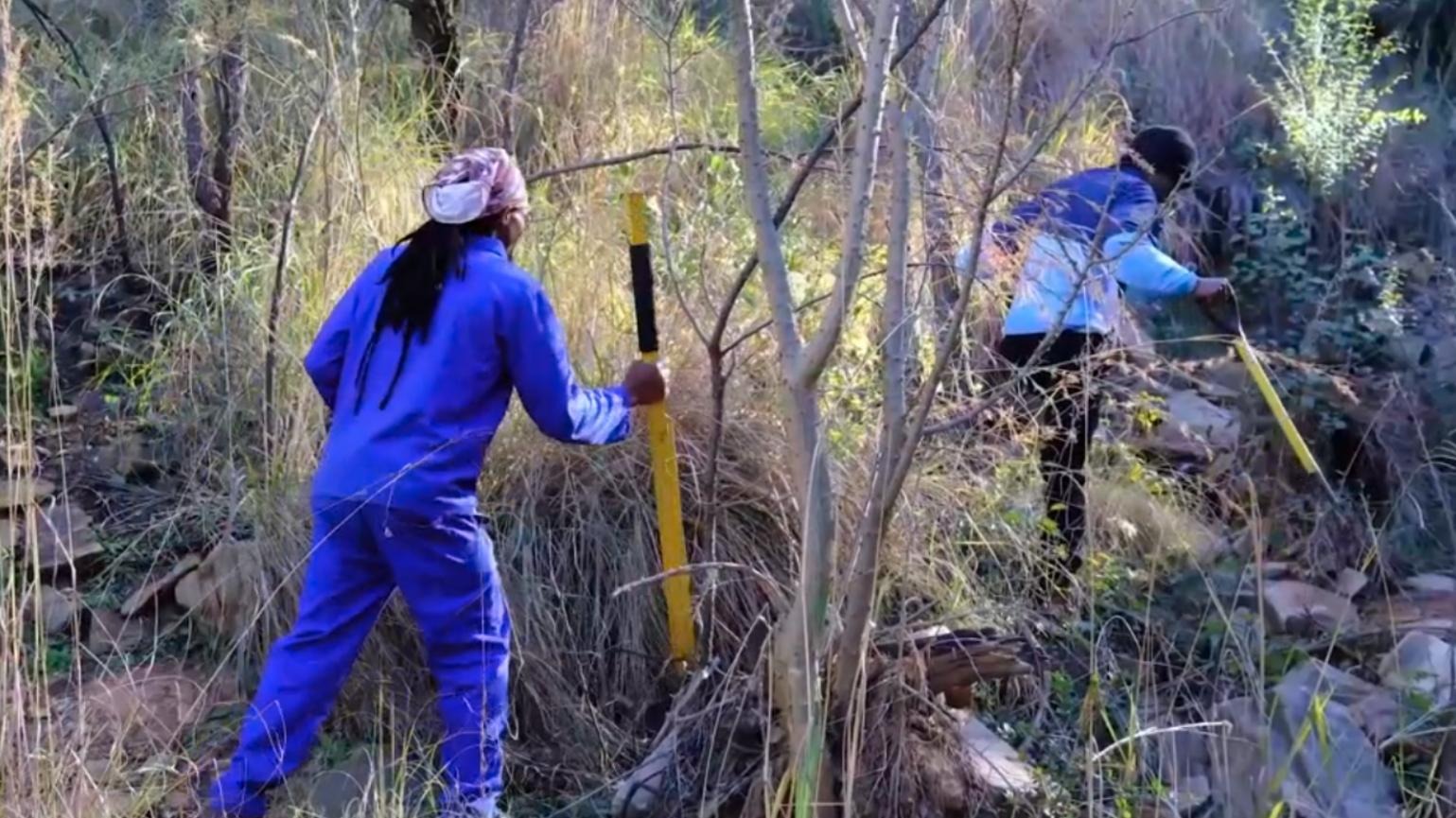
In July 2025, I traveled to South Africa’s North West Province to meet with community leaders living beside active and abandoned mines. Local organizer Christinah Mdau took me to the Marikana koppies—small hills of unowned, communal land—less than two hundred yards from one of the world’s most productive platinum mines.28 These koppies bear witness to the violence wrought by and required to sustain this extractive regime, which surfaced most publicly on August 16, 2012, when mineworkers demanding a living wage of R12,500 per month (around $1,500)29 gathered in protest at the koppies. Police opened fire, killing thirty-four striking platinum mine workers30 in what became the deadliest use of force by South African security services against civilians since the end of apartheid.31 Lonmin, the company responsible, was bought and rebranded by Sibanye-Stillwater in 2019.32 The mine continues its operations and is among the world’s major platinum producers. The Marikana massacre represents only the most visible rupture in an industry where injury and death routinely accumulate.33 Despite corporate branding promoting labor safety, workers frequently tell stories of colleagues crushed by rocks or asphyxiated underground.
Butie Mokwena, a former PGM mine worker who would later leave the industry to become an eco-ranger in the mountains above the platinum belt, experienced this violence directly. He told me of the moment of a ground subsidence:
It was my time to knock out. There was a waiting area. I was sitting there with two guys. Then suddenly I hear like I got dust at my overall. So I stand up, try to do my work suit to be clean with the dust. There was something that was shifting me there. Suddenly, the thing collapsed. And kill all of those two guys that I was sitting with. It was like horrible for me. It was a trauma. I’m still having those aftershocks... the mine doesn’t care about us.34
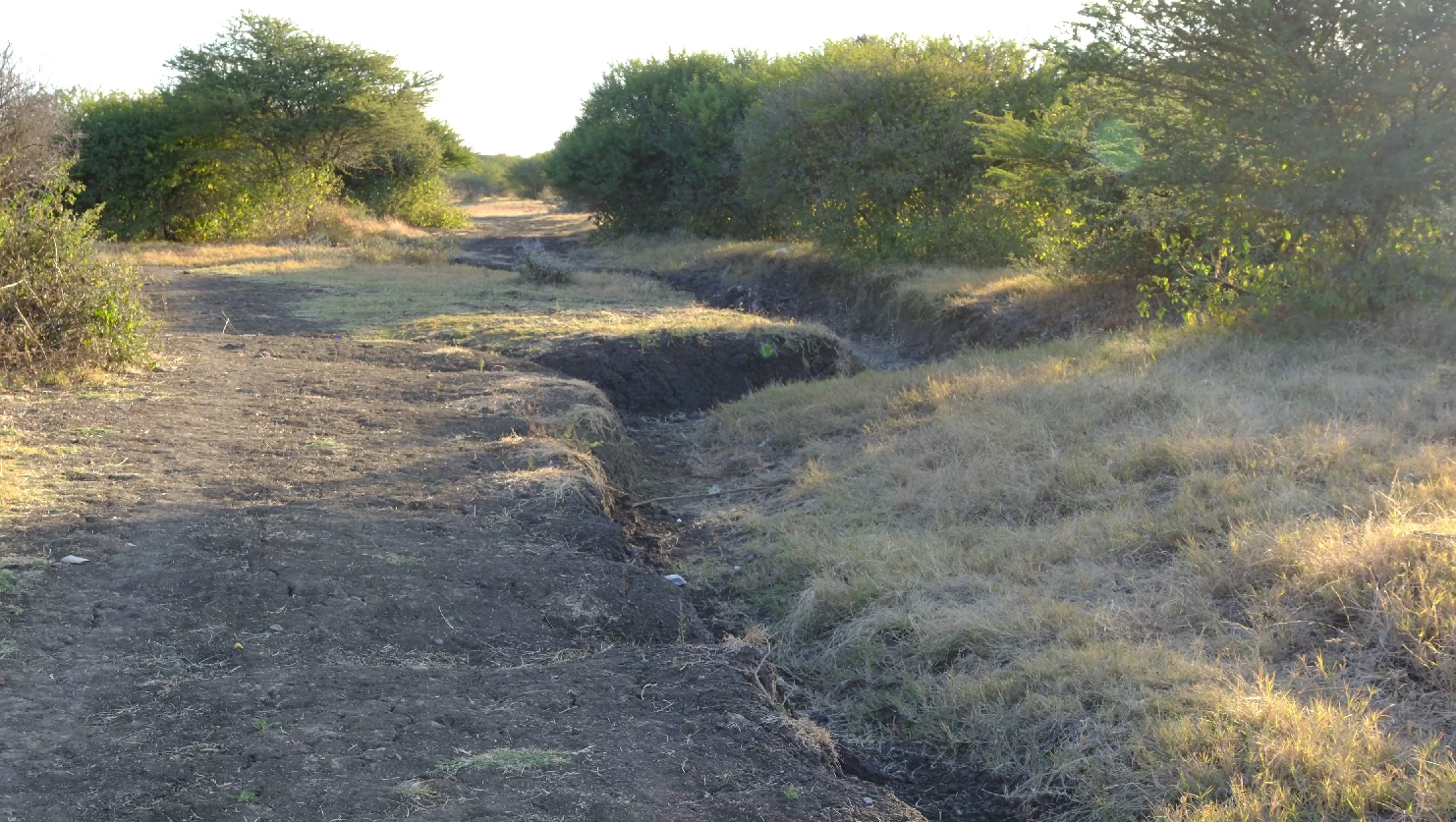
The violence does not remain underground. Christinah pointed to a deep crack splitting the earth near the koppies: “When you’re blasting, you’re shaking the land, and from the mother body itself. Houses collapse. Schools collapse.”35 When it rains, small fissures deepen into chasms that cut across the ground. She spoke of graves that were dug up to make space for mining: “The dead are not dead,” she said, “but the mine only thinks about mining.”36
Contemporary South African resource policy positions PGMs as essential to green energy development and the just transition, with projections drawn to secure 10 percent of global export markets for hydrogen fuel cells.37 These strategies represent an attempt to capture value downstream through resource beneficiation, to escape resource colonialism38 and rearticulate PGMs as national development assets.39 Yet this occurs within global markets that still discipline price, labor, and risk. While the government speaks of “critical mining and greener energy,” what Christinah hears is more: more mining, more volatility, more governance through precarity. Instead, she asks: “What could be more critical than what has happened here?”
Christinah’s question exposes a clash between technocratic definitions of criticality40 and lived experiences of harm; between what global markets and governments deem essential and what communities experience as intolerable.41 The violence at Marikana has not ended with the massacre. It extends into the everyday organization of who must carry out extraction, under what conditions, and at what risk.
Residual Governance on the Platinum Belt
Despite PGM mining’s acute and chronic violences, mining jobs in North West offer a rare degree of economic stability relative to the broader informal labor landscape, though not, as one former mineworker made clear to me, relief from poverty itself. “As much as working in the mine can be a lifetime sentence in poverty,” he told me, “it’s cold when you’re not working. It’s very cold outside.” In July 2025, I met residents of the towns neighboring Marikana who had lived their entire lives beside platinum mines without securing formal employment within them. For many, engaging in informal mining, locally known as zama zama, or “try and try again,” has become one of several means of survival, pieced together alongside other forms of informal and gig labor. These informal miners sustain local economies while navigating dangerous and precarious conditions. Their work is not external to the formal mining economy but deeply entangled with it. Abandoned infrastructure, waste material, and coordination with low-level mine employees create conditions where multiple forms of extraction overlap and compete.
While gold zama zama practices have been widely documented,42 platinum zama zamas remain more elusive, their work obscured by the scale and complexity that sourcing platinum requires.43 Yet in mining towns I visited, small piles of ore and the presence of testing labs in Rustenburg hinted at organized networks. One zama zama explained his trajectory across nearly a decade of informal labor: “I started zama zama in 2015. In 2024 August, that’s when I came to Rustenburg, working with platinum until now. I don’t stay in one place. Where there’s no money I leave, if the money doesn’t satisfy me, I leave.” His mobility follows price signals, moving between sites as market conditions and selling opportunities shift. The material itself requires skill to identify: “It is dumped by the mine, for sure, but we picking on the ground, then we dig and dig and pick up stones and find that it might be a platinum. Yes, it is difficult to see if it is platinum or not, you have to break the rock to be able to see.”44
Another described the calculation differently: “Since 2019 I’ve been doing this. It’s not that bad because now I am able to take my children to school and I’m able to survive.” When I asked if he ever felt unsafe, he immediately responded: “Yes. It’s illegal. It’s risky. Zama zamas can kill each other because of jealousy. People have suspicions of each other but they have no choice but to do it. I haven’t worked in the mines. I would love to work there but it’s very difficult. You have to know someone.”45 This statement crystallizes the bind: Formal employment remains inaccessible despite living beside the mines, leaving informal extraction as a viable survival strategy.46
Across my fieldwork in South Africa, concerns about bodily risk were often met with the same response: What do I have to lose? Postapartheid promises of housing, employment, and social services have not materialized, leaving people to construct informal settlements with limited infrastructure. Within this context, zama zama work becomes one thread in a broader fabric of informal labor—gig work, trade, subsistence farming—through which people construct the livelihoods the formal economy has denied them.
These are not individual failures or local pathologies but the organized production of expendability.47 The anthropologist Elizabeth Povinelli’s notion of the governance of endurance names what zama zamas navigate: the slow, attritional management of life and death that settler and extractive systems rely on.48 In the South African context, Gabrielle Hecht similarly describes residual governance as a minimalist technique that treats people and places as waste and wastelands, wherein simplification, ignorance, and delay are core tactics.49 Through this, she describes the intensification of racial capitalism in the Anthropocene, which seeks to resolve its own catastrophes by further offsetting the “externalities” of its solutions onto the same communities that have already been abandoned. Her book ends with a cautionary warning for a world that fails to escape residual governance, a world where “almost everyone is a zama zama, digging through the toxic dregs.”
Urban Mining
The same market dynamics that structure zama zama work in South Africa manifested in different but structurally parallel ways in U.S. cities during the 2020 PGM price surge. Price volatility does not only register economic fluctuation but operates as a governing mechanism across distinct legal categories that themselves function across a continuous spectrum: formal employment, informal extraction, and criminalized recovery.
Research on South African gold demonstrates that informally mined material frequently reenters formal supply chains through buyers who mix informal and formal sources, then sell to refineries.50 Testing labs in Kroondal and the presence of international buyers suggest that similar dynamics have been established for platinum, though platinum’s processing complexity makes traceability more difficult. Still, in 2024, investigations of stolen catalytic converters revealed the connection of theft rings to major metal processing companies like DG Auto Parts in California, demonstrating how street-level theft connects to corporate supply chains. In fact, criminal operations rapidly organize around price spikes, often faster than regulatory or legal responses do.51 Meanwhile, contract labor in platinum mining has increasingly replaced permanent positions, stripping away formal benefits while maintaining the flexibility that capital requires.52
The distinction between formal and informal mining does not mark a boundary between capitalism and its exterior. Rather, it delineates zones of responsibility and zones of abandonment within the same extractive economy. Informality absorbs the risk the system disavows—environmental degradation, physical danger, legal precarity—while empowering the formal sector to maintain lower costs and greater flexibility. When profitable, volatility allows the activation of surplus populations, and when not, it abandons them, keeping them waiting and available to activate in the next spike.
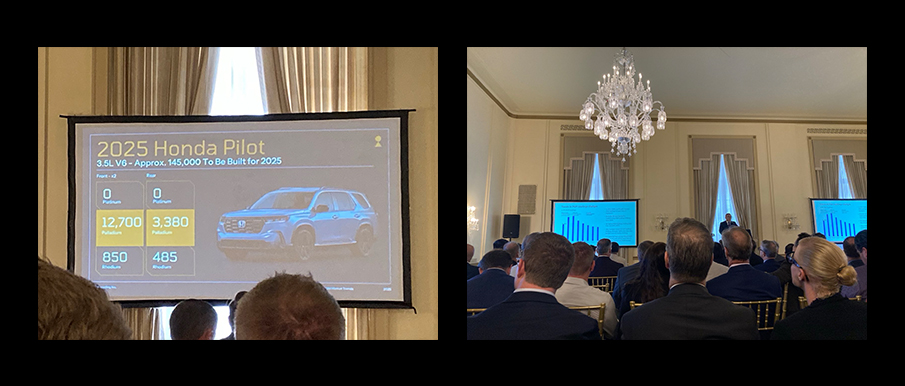
Ben Davis, one of the foremost catalytic converter aggregators in the United States, described to me how what began as scrapping—a profession, he noted, that was “once looked down upon”—has been rebranded as “urban mining.” “We’re taking stuff that was originally mined from another country, going into the city’s urban areas and re-mining that product,” he told me.53 “Basically, at that point we’re not in the converter business. We’re in the precious metal business.” I met Davis at the “PGM Week” conference in New York City, where in a room full of bankers and commodities traders he presented 2025’s new car models, using them as a proxy to predict PGM supply twenty years in the future, when those same vehicles will be retired and their converters “mined.” Davis’s reframing is revealing: Catalytic converters become not auto parts to be recycled but ore bodies embedded in urban infrastructure. Every parking lot becomes a potential extraction site.
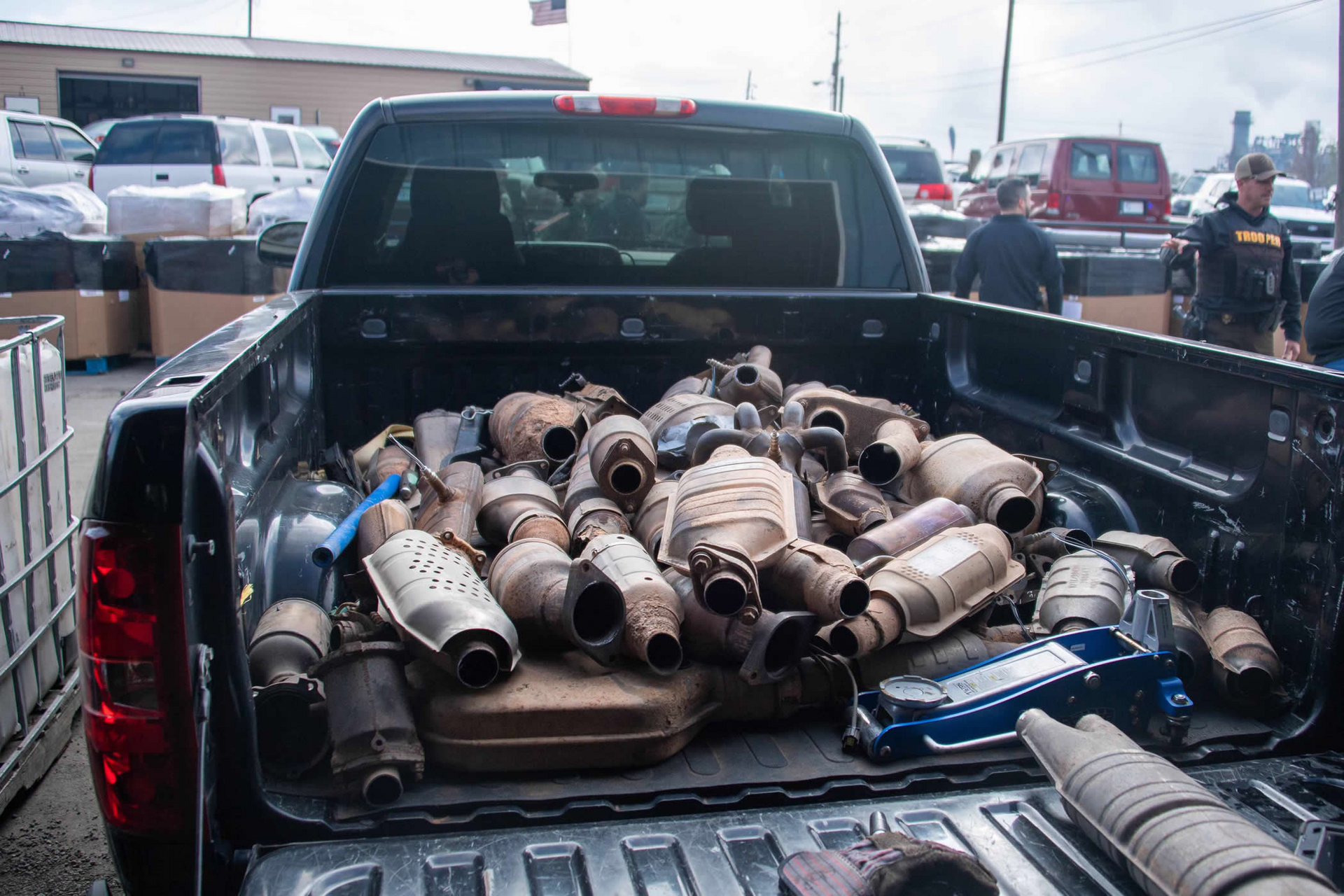
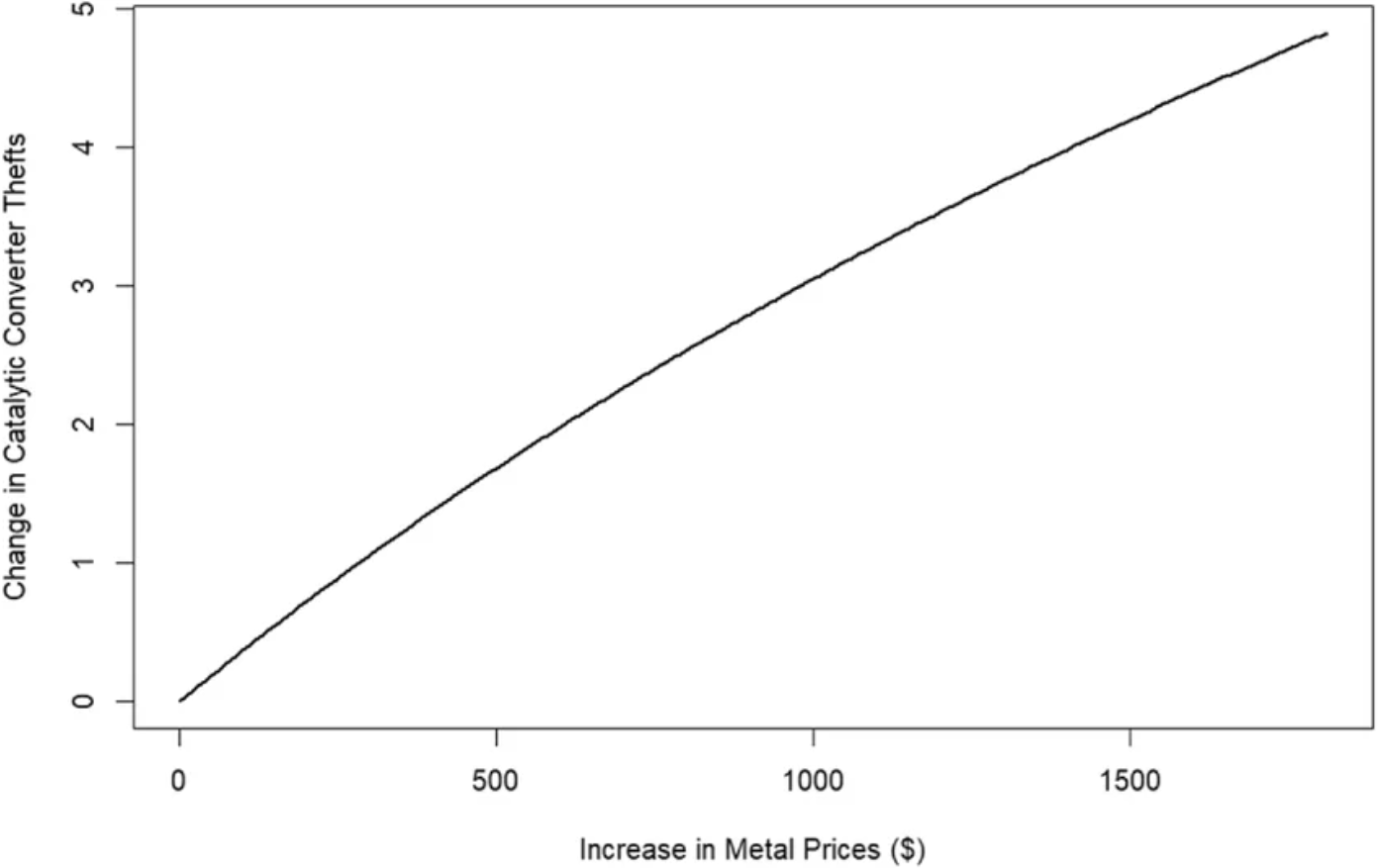
When rhodium prices reached nearly $30,000 per ounce in 2021, catalytic converter thefts in the U.S. surged 300 percent. Scrappers checked commodity prices hourly, timed their sales, and stockpiled supply to sell during peaks. Davis is emphatic that the legitimate trade depends on keeping stolen materials out of it: his operation runs on know-your-customer protocols and declines anything that cannot be verified. A stolen converter, as he describes it, harms not only the car owner but the recycler, poisoning a supply chain that compliant operators work to keep clean and drawing regulation down on the ones already doing it right. While he credits tighter regulation with helping stymie thefts, he sees falling prices themselves as the deterrent: “Just look at the market,” he notes, “and you’ll see that theft follows value faster than it ever follows the law.”54
What distinguishes these actors is not ethics or logic but formalization: the layers of policy and legislation that render some forms of recovery legal and others criminal. There is a continuum from street-level theft to highly internationalized formal extraction, differentiated by law, race, class, and geography rather than by the underlying logic of value capture. The zama zama working dumped ore in Rustenburg and the scrapper checking Kitco prices operate within the same market logic, responding to the same price signals but absorbing different forms of risk that the formal economy disavows. These actors are not situated symmetrically within global power relations; the risks they absorb and the violence they face are radically unequal. Their positions are not aberrations but essential features of how extraction functions under conditions of concentrated supply, demand inelasticity, and global inequality. Tending to informal extraction practices reveals how the formal economy already depends on maintaining populations in states of permanent precarity.
Refusal and Repair Under Constraint
Roughly 9,500 miles from North West Province, Sibanye-Stillwater also operates the United States’s only two mines producing platinum and palladium. Located in south-central Montana, the mines operate under a community engagement plan known as the Good Neighbor Agreement, heralded as the “Cadillac” of such agreements.55 Established in 2000, after years of litigation and regulatory challenges were followed by direct negotiations between mining executives and community councils, the agreement gives local residents a legal mechanism to participate in the planning and oversight of mining impacts. The legally binding process has yielded conservation easements, independent environmental audits, and company buses to manage traffic on mountain roads. What the councils won was a seat at the table; what they gave up was the leverage that had brought the company to it, surrendering their right to sue over existing permits and dropping a pending suit over a planned tailings impoundment. For the mine, the same exchange meant a clean bill of health for investors, minimizing the risk of an expansion that litigation could have stalled.56 For critics of the mine, the agreement emerged from a pragmatic recognition that extraction would continue whether communities consented or not. As Paul Hawks, a rancher and one of the councils’ negotiators, put it: “There’s no way to shut down the mine. It’s goddamn permitted.”57 Yet rather than resign themselves to the constraints imposed by extraction, Hawks and others redirected opposition into negotiation, declaring, “If we’re going to have a mine, it’s going to be the best damn mine in the world.”58
While Sibanye-Stillwater operates mines in both Montana and South Africa,59 the possibilities for negotiation differ radically by context. The Good Neighbor Agreement is premised on legal infrastructure, political stability, and relative power that simply does not exist in Marikana. In South Africa, community organizer Phindile Boitumelo Ngobeni described a different relationship to the mine’s presence. “For us to live, it is not the mine,” she explained. She describes how communities maintain livelihoods through subsistence practices that don’t depend on corporate employment: keeping cattle and wearing cow skins as part of ongoing cultural and ceremonial life. This is not a romantic rejection of modernity, but rather an ongoing relationship to land and kinship that exists alongside extraction. Still, she did not call for the mine’s closure. She called, instead, for a reconsideration of impacts, distribution of benefits, and community power.
Many people I spoke with throughout my travels expressed political positions grounded in the recognition that their lives do not matter to those who profit from extraction—a recognition that produces not resignation but clear-eyed determination. Phindile, for example, invited the CEO of Sibanye-Stillwater to sit down with her community, saying they would otherwise protest and shut down the roads through direct, nonviolent action that may be met with violence, as it was at Marikana. “They can come and kill us,” she said. “They always kill us.”60 This is not naiveté but pragmatic knowledge: The cost of refusal is understood, and still the refusal is prepared.
After the ground subsidence that killed two colleagues beside him, Butie Mokwena left mine work, becoming an “eco-ranger” in the mountains near the platinum belt.61 As we entered the protected wilderness area in Magaliesberg, we arrived at a gate. “I don’t do gates,” he said. He refused to even touch it. He decried fences constructed by neighboring farmers for the ways they trap and wound animals “who cannot see color like humans.” “My greatest ancestors used to walk free,” he said.62 As an eco-ranger, Butie works to promote environmental stewardship and bring people back into a deeper relationship with the mountain and forests. The rangers pay attention to small ecological relationships: from puddles that exist because of the shade of a nearby tree to the effects of logging for firewood on the broader ecosystem. They lead hiking tours to raise money for conservation and community education. Butie’s work protecting land is a way of maintaining a relationship to it while navigating an economy structured by extraction.
These are not equivalent positions. Community members benefiting from the Good Neighbor Agreement in Montana operate with a degree of legal standing that their South African counterparts do not possess. The GNA negotiates from a place of inclusion; Phindile negotiates from one of abandonment. Butie’s departure from mine work was facilitated by circumstances—a combination of trauma and the opportunity to find alternative work—that most of his colleagues do not share. Yet across these differences, all negotiate amid extraction, questioning what forms of life remain possible within and against these processes. Communities often depend on extractive industries even as those same industries destroy the conditions for their very life.63
After Markets, Afterlives
Today, the blueprint inaugurated by catalytic converters and the Clean Air Act seems poised to repeat itself. In 2025, South Africa chaired the G20 while promoting sustainable mining policies that positioned hydrogen fuel cells—requiring the same platinum-group metals—as central to green energy transitions. Once again, PGMs promise continuity: A future in which cars, markets, and infrastructures remain intact even as their energy sources change. What remains untransformed is not the technology but the underlying structures that unequally distribute risk, extraction, and volatility.
But nothing is settled. “At first, maybe three years ago, I was nervous,” Ennis Geraghty told me in Montana, after automakers announced plans to phase out internal combustion engines.64 Reflecting on three decades as a geologist at the Stillwater mine, he noted that demand has not disappeared; it has merely quieted, reshaped by contradictory timelines, political stagnation, and speculative futures. “So what does a company do?” he asked. “Gotta get some tarot cards out or something.”65 Geraghty’s uncertainty reveals how technological change does not arrive as a clean departure, but as prolonged indeterminacy in which materials like platinum become simultaneously critical and obsolete.
Indeterminacy is an organizing condition of transition. It produces volatility and uneven endurance across geographies. Yet it is also where the future remains unsettled and blueprints can be contested and partially undone. Across the sites traced here, people do not simply endure uncertainty. They negotiate, refuse, repurpose, and remake claims within it—through community oversight, labor struggle, informal mining, and practices of care that persist alongside and against extraction.
Siphiwe Mbatha,66 my friend and interlocutor in South Africa, wants a world “where all people are seen as equal.” He immediately follows: “But obviously it won’t happen because we aren’t equal. And South Africa is the most unequal country in the world.”67 Instead, he traces how these divisions are maintained, observing that “when those who are working start to fight for their rights, they are pushed away and they take the reserve army of unemployed68 and they work in harder and harsher conditions than those who were on strike. They make sure that they divide us.”69
Material interdependence does not automatically produce solidarity.70 Speaking to miners who worked for both Sibanye-Stillwater mines revealed this starkly: In Montana, the job was “a means to an end,”70 while in South Africa, it was “a lifetime sentence to poverty.”71 Understanding how systems coordinate difference, and how people struggle over life’s terms in distinct ways across contexts, illuminates not only the terms of exploitation but the terms on which another world might be built. Siphiwe dreams of equality while knowing that “we aren’t equal.” That recognition—that equality must be constructed through struggle, not assumed through connection—marks where the work begins.
-
National Insurance Crime Bureau, “Catalytic Converter Thefts Surge Nationwide, According to New Report,” NICB Blog, May 10, 2023, link. ↩
-
On the cultural production of automobility as individual freedom and its structural dependence on public infrastructure and racialized spatial arrangements, see Cotten Seiler, Republic of Drivers: A Cultural History of Automobility in America (University of Chicago Press, 2008), and Langdon Winner, “Do Artifacts Have Politics?,” Daedalus 109, no. 1 (1980): 121–136. ↩
-
Gavin Capps, “Victim of Its Own Success? The Platinum Mining Industry and the Apartheid Mineral Property System in South Africa’s Political Transition,” Review of African Political Economy 39, no. 131 (2012): 63–84. On PGM market concentration and price volatility, see also Alison Cowley, “PGM Market Report 2021,” Johnson Matthey. ↩
-
Reuters and Mining Technology reported on COVID-19 mine shutdowns in South Africa during 2020. See World Platinum Investment Council COVID impact briefings and Anglo-American Platinum public statements. ↩
-
U.S. Geological Survey, “Mineral Commodity Summaries: Platinum-Group Metals” (2023). ↩
-
Tradium, “Rhodium Currently in Calmer Waters,” October 31, 2024; Cowley, “PGM Market Report.” ↩
-
K. Righter, “Metal–Silicate Partitioning of Siderophile Elements and Core Formation,” Earth and Planetary Science Letters 210, no. 1–2 (2003): 185–201. ↩
-
M. Willbold, T. Elliott, and S. Moorbath, “The Tungsten Isotopic Composition of the Earth’s Mantle Before the Terminal Bombardment,” Nature 477 (2011): 195–198. ↩
-
A. J. Naldrett, Magmatic Sulfide Deposits: Geology, Geochemistry and Exploration (Springer, 2004); M. L. Zientek and P. J. Loferski, “Platinum-Group Elements—So Many Excellent Properties,” USGS Mineral Resources Program Fact Sheet 2014-3064. ↩
-
PGMs occur in minuscule quantities, often invisible to the naked eye. Trace amounts of PGMs are found in Central American Indigenous jewelry, sometimes called “white gold.” Spanish conquistadors named it “platina” or “little silver,” seeing it as an inconvenience in their pursuit of gold. See David A. Scott and Pieter Meyers, “Pre-Hispanic Platinum Alloys: Their Composition and Use in Ecuador and Colombia,” in Archaeometry of Pre-Columbian Sites and Artifacts (UCLA Institute of Archaeology, 1994), 285. ↩
-
Erich Zimmermann, World Resources and Industries: A Functional Appraisal of Agricultural and Industrial Materials (Harper and Brothers, 1933). ↩
-
For an expanded account of the many infrastructural transformations wrought on cities by automobiles, see Martin V. Melosi, “The Automobile Shapes the City,” Automobile in American Life and Society. ↩
-
On the systematic dismantling of public transit through automotive and petroleum industry lobbying, see Bradford C. Snell, American Ground Transport: A Proposal for Restructuring the Automobile, Truck, Bus, and Rail Industries (U.S. Government Printing Office, 1974); and Peter D. Norton, Fighting Traffic: The Dawn of the Motor Age in the American City (MIT Press, 2008). ↩
-
On the racial geography of federal highway construction and its subsidization of white suburban flight at the expense of Black and working-class urban neighborhoods, see Robert O. Self, American Babylon: Race and the Struggle for Postwar Oakland (Princeton University Press, 2003); and Richard Rothstein, The Color of Law: A Forgotten History of How Our Government Segregated America (Liveright, 2017). For a discussion of Robert Moses’s deliberate design of low bridges on Long Island to ensure that buses, and consequently people using public transit, could not use the roads, see Winner, “Do Artifacts Have Politics?” ↩
-
For a discussion of how automobile dependency was actively produced through industry lobbying, the dismantling of public transit, and the cultural manufacture of automobility as individual freedom, see Winner, “Do Artifacts Have Politics?”; Melosi, “The Automobile Shapes the City”; and Seiler, Republic of Drivers. ↩
-
The description of air as “shared infrastructure” was used by Adriana Petryna during a lecture at the University of Pennsylvania, 2025. ↩
-
Clean Air Act of 1970, 42 U.S.C. § 7401 et seq. ↩
-
David Gerard and Lester B. Lave, “Implementing Technology-Forcing Policies: The 1970 Clean Air Act Amendments and the Introduction of Advanced Automotive Emissions Controls in the United States,” Technological Forecasting and Social Change 72, no. 7 (2005): 761–778. ↩
-
Gerard and Lave, “Implementing Technology-Forcing Policies.” The three-way catalyst simultaneously oxidizes carbon monoxide and hydrocarbons while reducing nitrogen oxides, requiring platinum, palladium, and rhodium, respectively—with each metal catalyzing a separate chemical reaction. ↩
-
Catalytic converters transform carbon monoxide into carbon dioxide, nitrogen oxides into nitrogen and oxygen, and hydrocarbons into water and carbon dioxide. ↩
-
Winner, “Do Artifacts Have Politics?”; Sheila Jasanoff and Sang-Hyun Kim, Dreamscapes of Modernity: Sociotechnical Imaginaries and the Fabrication of Power (University of Chicago Press, 2015). ↩
-
U.S. Geological Survey, “Platinum-Group Elements in Southern Africa—Mineral Inventory and an Assessment of Undiscovered Mineral Resources,” Scientific Investigations Report 2010-5090Q (USGS, 2010). ↩
-
Duncan Money, “After the Diamond Rush: South Africa and the Internationalization of Mineral Extraction,” Phenomenal World, February 5, 2025. ↩
-
Ainsley D. Elbra, “The Forgotten Resource Curse: South Africa’s Poor Experience with Mineral Extraction,” Resources Policy 38, no. 4 (2013): 549–557. ↩
-
Capps, “Victim of Its Own Success?” ↩
-
Daniel Croft, “The Autocatalyst: A Potted History,” SFA Oxford, May 10, 2024, link. ↩
-
The remaining reserves are in Russia, Zimbabwe, Canada, and Montana. See U.S. Geological Survey, “Mineral Commodity Summaries: Platinum-Group Metals, 2023.” ↩
-
GlobalData, “Global—Five Largest Platinum Mines in 2021,” link. ↩
-
Dick Forslund, “Focus: The Marikana Massacre: Wages as the Blind Spot in the Tax Evasion Debate,” International Union Rights 25, no. 1 (2018): 12–28. ↩
-
South African Human Rights Commission, “Report on Marikana,” 2012. ↩
-
Peter Alexander et al., Marikana: A View from the Mountain and a Case to Answer (Jacana Media, 2014); Luke Sinwell and Siphiwe Mbatha, The Spirit of Marikana: The Rise of Insurgent Trade Unionism in South Africa (Pluto Press, 2016). ↩
-
Swedwatch, Problematic Platinum: A Multistakeholder Initiative for Responsible Mining in South Africa (Swedwatch, 2013), 16. ↩
-
Butie Mokwena, interviewed by author, Majakaneng, South Africa, July 2025. ↩
-
Christinah Mdau, interviewed by author, Marikana, South Africa, July 2025. Community members in Marikana and surrounding areas describe structural damage from mine blasting, including cracks in homes and school buildings. In a 2013 survey, 36 percent of respondents cited cracks in houses as a primary concern. Subsidence and seismic activity from underground mining operations create fissures that widen during rains. See Swedwatch, Problematic Platinum, 35–38, 42–43. ↩
-
For the legal context on mining-related damage and displacement of burial sites, see Langa and Others v. Ivanplats (Pty) Ltd and Others, ZAGPPHC 829 (North Gauteng High Court, February 16, 2017). ↩
-
Grasian Mkodzongi and Sikho Luthango, “Platinum Group Metals, Green Hydrogen Production and Economic Development in South Africa,” Policy Brief (Africa Policy Research Institute, 2026). ↩
-
Historically, PGMs in South Africa were locked into low-value export roles through ore and concentrate shipped abroad for refining and manufacturing. South Africa’s position as a settler colonial state, where many white South Africans consolidated mineral wealth, complicates the traditional designation of a “resource cursed” nation. ↩
-
Post-apartheid mining policy aimed to redistribute mineral wealth through Black economic empowerment, yet in practice created a “narrow, overwhelmingly unproductive crony elite class” through deals between mining capital and politically connected elites. See Musa Nxele, “Crony Capitalist Deals and Investment in South Africa’s Platinum Belt: A Case Study of Anglo American Platinum’s Scramble for Mining Rights, 1995–2019,” Review of African Political Economy 49, no. 173 (2022): 395–416; Laura Phillips, “Mining After Apartheid: South Africa’s New Black Capitalists,” Phenomenal World, September 8, 2025; Money, “After the Diamond Rush.” ↩
-
These designations are politically and socially constructed. Many governments tend to emphasize minerals necessary for low-carbon development as “critical.” As Mkodzongi and Luthango (2026) note, South Africa’s classification includes coal (DMRE, 2025). They write: “This is not merely a semantic distinction; it reflects how different countries understand the role of their mining sectors in the just energy transition and raised important questions about how criticality is framed in relation to national development priorities.” See also Julie Klinger, Rare Earth Frontiers: From Terrestrial Subsoils to Lunar Landscapes (Cornell University Press, 2017). ↩
-
Kate Dawson, “The Promise of Platinum,” Africa Is a Country (blog), June 15, 2022. ↩
-
Platinum zama zamas remain less documented than gold zama zamas due to the technical complexity of platinum extraction, which requires larger volumes of ore and extended processing. Chrome zama zamas appear quite widespread in the platinum belt, as chrome mining often happens alongside PGM mining. ↩
-
Janet Munakamwe notes that informal mining operates as “an organised mode of extraction” involving shift coordination and established buyer networks. See Janet Munakamwe, “Foreign Zama Zamas,” South African Labour Bulletin 38, no. 1 (2014): 8; Swedwatch, Problematic Platinum, 22–23, 46–47. ↩
-
Anonymous zama zama, interviewed by the author and translated by Siphiwe Mbatha, Kroondal, South Africa, July 2025. ↩
-
Anonymous zama zama, interviewed by the author, Kroondal, South Africa, July 2025. ↩
-
Ethnographic research documents that zama zama operations involve organized structures and community knowledge. See Munakamwe, “Foreign Zama Zamas,” 7–11; Zaheera Jinnah, “The Backstory,” in Informal Livelihoods and Governance in South Africa: The Hustle (Palgrave Macmillian, 2022). ↩
-
Ruth Wilson Gilmore’s concept of “organized abandonment” describes how state and capital actively produce surplus populations through disinvestment and neglect. See Ruth Wilson Gilmore, Golden Gulag: Prisons, Surplus, Crisis, and Opposition in Globalizing California (University of California Press, 2007). On informality as a mode of governance rather than absence of regulation, see Ananya Roy, “Urban Informality: Toward an Epistemology of Planning,” Journal of the American Planning Association 71, no. 2 (2005): 147–158. ↩
-
Elizabeth A. Povinelli, Economies of Abandonment: Social Belonging and Endurance in Late Liberalism (Duke University Press, 2011). ↩
-
It is no coincidence that Hecht’s theorization has developed over decades of fieldwork studying the dynamics of gold mining mobilization and decommissioning in South Africa’s Gauteng Province. She goes so far as to write of the platinum belt as the “rural reincarnation of the gold belt.” Gabrielle Hecht, Residual Governance: How South Africa Foretells Planetary Futures (Duke University Press, 2023). ↩
-
Janet Munakamwe, “Foreign Zama Zamas: Not Everything Glitters in Egoli,” SA Labour Bulletin (2014). ↩
-
See U.S. Attorney’s Office press releases (2024); Sacramento Bee coverage of the investigation into DG Auto Parts. ↩
-
Contract labor has increasingly replaced permanent positions in South Africa’s platinum mining sector. Contract workers lack the benefits and protections of permanent employees—including pensions, health coverage, and union representation—while performing the same work. This casualization allows companies to adjust labor costs rapidly in response to price volatility. See Swedwatch, Problematic Platinum, 22–23, 46–47. On labor restructuring following Marikana, see also Crispen Chinguno, “Marikana Massacre and Strike Violence Post-Apartheid,” Global Labour Journal 4, no. 2 (June 2013). ↩
-
Ben Davis, telephone interview by author, November 2025. ↩
-
Ben Davis, telephone interview by author, November 2025. ↩
-
The Good Neighbor Agreement, established in 2000, has been recognized as a significant model for community-industry collaboration in mining oversight. The agreement gives local residents legal standing to participate in mine planning and environmental monitoring, a level of formalized community power uncommon in the mining industry. See World Resources Institute, “Community Benefits Snapshot: Stillwater Good Neighbor Agreement”; the agreement is called the “Cadillac” of GNAs in Ray Levy-Uyeda, “Can a Mining Corporation Ever Be a Good Neighbor?,” The Guardian, September 2, 2020. ↩
-
For more on the negotiations, see Teresa Erickson, A Seat at the Table: Stillwater Good Neighbor Agreement, from Conflict to Collaboration (Northern Plains Resource Council, 2025). ↩
-
Paul Hawks, interview by author, Big Timber, Montana, October 2025. ↩
-
Paul Hawks, quoted in “Good Neighbor Agreement,” Northern Plains Resource Council, link. ↩
-
Sibanye-Stillwater was formed in 2017 when the South African mining company Sibanye Gold acquired the U.S.-based Stillwater Mining Company for approximately $2.2 billion, creating one of the world’s largest primary producers of platinum-group metals. ↩
-
Phindile Boitumelo Ngobeni, interviewed by author, Kroondal, South Africa, July 2025. ↩
-
The eco-rangers lead hiking tours of the Magaliesberg Mountains: link. ↩
-
Butie Mokwena, interviewed by author, Majakaneng, South Africa, July 2025. ↩
-
As Povinelli argues, communities often find themselves managing the “slow attritional wearing out of the subject” within extractive regimes where genuine consent is structurally foreclosed. See Povinelli, Economies of Abandonment. On the distinction between participation and consent in resource extraction contexts, see also Glen Sean Coulthard, Red Skin White Masks: Rejecting the Colonial Politics of Recognition (University of Minnesota Press, 2014), which examines how Indigenous communities navigate extraction under conditions where refusal is made structurally untenable. ↩
-
Catalytic converters are not necessary for electric vehicles. However, hybrid vehicles, such as the Toyota Prius, often have higher amounts of and better-quality PGMs, making them especially attractive targets for theft. ↩
-
Ennis Geraghty, interviewed by author, Nye, Montana, October 2025. ↩
-
Siphiwe Mbatha was my guide and translator in South Africa’s North West province. He is the co-author of The Spirit of Marikana, an ethnographic account of the platinum belt after the 2012 Marikana massacre. Siphiwe is a coordinator of the Thembelihle Crisis Committee, an organization based in the informal settlement where he lives, established to protest for better basic services and against forced evictions. Siphiwe arrived in Marikana the day after the massacre to offer solidarity to the workers and their families. This work is indebted to Siphiwe, whose steadfastness, clarity, and love for the world have transformed me deeply. ↩
-
Measured by Gini coefficient. ↩
-
Karl Marx, Capital, Volume 1, trans. Ben Fowkes (Penguin, 1990 [1867]). ↩
-
Siphiwe Mbatha, telephone interview by author, November 2025. ↩
-
One emerging example of cross–supply chain solidarity: In 2024, the Climate and Community Institute convened workers, organizers, and advocates from across the transportation supply chain—including United Auto Workers, Amazon delivery drivers, public transit riders, and Indigenous rights defenders—who traveled to Nevada to observe frontline lithium mining and produced collective Solidarity Principles for the Transportation Supply Chain and the Energy Transition. See Climate and Community Institute, “Supply Chain Solidarity,” link. ↩ ↩
-
Sibanye-Stillwater Montana former mine employee, interviewed by author, Montana, October 2025. ↩
Noa Mori Machover’s work reckons with what is too big to hold. Working across video, installation, cartography, sculpture, and writing, they trace the relations between earth (planetary and climatic forces) and world (the systems built to apprehend them: science, magic, capital, and myth). They are drawn to materials and ideas that can be followed, broken apart, and reassembled differently, revealing how we, too, might be remade. They received their Master of Landscape Architecture and Master of Fine Arts from the University of Pennsylvania in 2026, are an editor and designer of Upstream, a Philadelphia-based publishing collective they started in 2024, and are a Fulbright researcher and artist-in-residence at the University of Johannesburg.